
AGENCY GROWTH CLUB
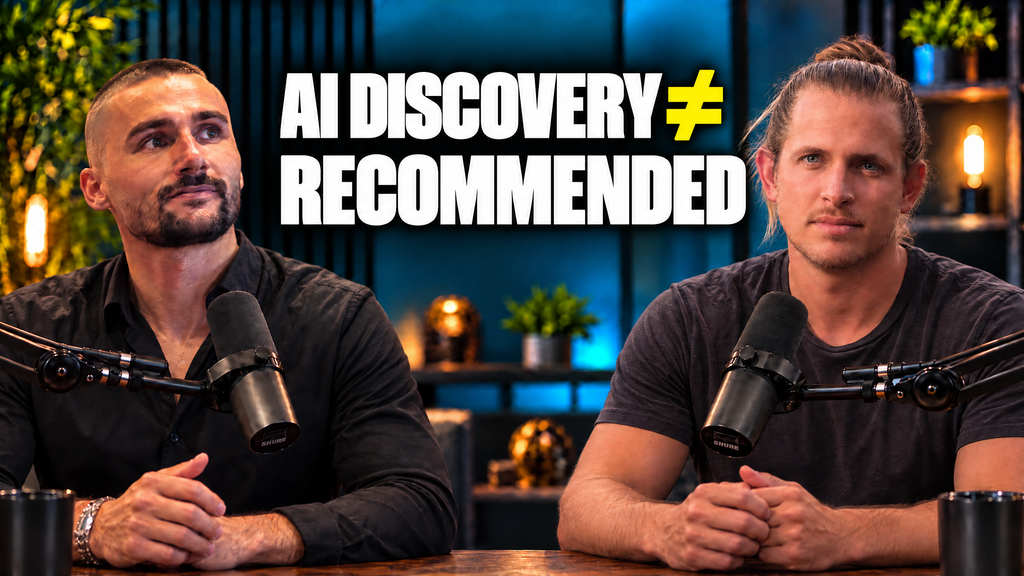
Michael Transon on Why AI Knows Your Brand but Won’t Recommend It
Guest: Michael Transon
Guest: Michael Transon
Michael is the founder and CEO of Victorious. Having grown the company from a small few-person startup in San Francisco to a multi-year winner of SEO Agency of the Year across 4 different publications, Michael’s strategic vision prioritizes sustainable, long-term success for both the agency and its customers, with a focus on transparent communication and data-driven decision-making.
Michael’s leadership has been pivotal in fostering lasting customer relationships and embedding the company’s core values into every aspect of the business.
Pulled from the transcript’s real per-line timestamps, matched to where each topic starts.
Michael’s case starts with adoption speed.
He describes AI platforms as being on “an exponential curve” because they are so good at helping people make decisions and buy things, referencing research suggesting almost all businesses and their buyers now use AI somewhere in the buying process – which he says is unsurprising given how useful it is “at the exact moment someone is deciding what to buy,” in both B2B and B2C.
He is open about what he doesn’t know: which platforms will survive.
Cash burn across AI companies is enormous, and he thinks only a few, Google in particular, have the war chest to meet demand.
He points to Google’s cloud division generating strong revenue growth, which he believes has given Google room to experiment with the search page through AI Overviews and AI Mode. Once platforms monetise, as ChatGPT already has started to, he expects velocity to increase further. His conclusion: AI search becomes the biggest channel, “and I think by a long shot.”
Josh adds that Search for Hire had two leads come in on a single Monday evening, one from Claude and one from ChatGPT, and that business owners who asked “what does SEO mean?” a few years ago now raise AI visibility with him unprompted.
Michael says Victorious “eats its own dog food“: what it does for itself is what it does for clients. The foundation is treating SEO and AEO as one unified program. In his words, they are “the same body of work that just needs to get measured across multiple different surfaces.”
In practice that means an entity-based search strategy, with the brand as the core entity, surrounded by an infrastructure of the other entities the brand wants to be known for and recommended for, whether in traditional search or the newer AI surfaces.
Measurement is layered:
Victorious tracks AI mention rate and citation rate separately, broken out by platform, because each platform has a different user base, from smaller ones like Perplexity to larger ones like ChatGPT. Those sit alongside standard organic numbers: traffic, conversion rates, keywords ranked, and positions. Victorious then turns its findings into published research studies, which Michael describes as the way the company builds its own brand entity in a market full of chatter about what works.
Actionable advice:
The finding that surprised Michael most was how much of the outcome depends on “what happens off of your website.”
A brand’s own site has an important but distinct job: making it clear to AI systems who you are and what you do. AI is good at that. In a Victorious study of about 170 or 175 brands, almost all of them could be described accurately when the AI was asked about the brand directly.
But almost that same number were not named when buying questions were asked about their category. The signals that actually drove brands into responses were referring domains from third-party websites, how often the brand was mentioned in content on other sites, and co-occurring content, meaning content around the brand mention that relates to the service the brand wants to be known for.
Looking at roughly 50,000 citations tied to buying decisions, Michael says something like 99.999% pointed somewhere other than the brand’s own website.
The second surprise was link type.
For years, off-page SEO has drawn a hard line between followed and nofollow links. For AI brand mentions, nofollow links were doing almost as much work as followed ones, and being talked about by name without any link at all also carried weight. Michael’s takeaway is that search has “drifted a long way towards what I would call brand building,” while many companies still measure it like performance marketing.
Actionable advice:
This part is Josh’s own experience, not Victorious’s. Search for Hire rebranded in February, consolidating previous brand names (Josh mentions SEO for Hire and Paid Media Jobs) under Search for Hire. He says the team had to go back through everything because AI systems did not understand who they were as one entity.
Michael names the problem: brand disambiguation, when systems don’t recognise that two names are the same entity. He says Victorious has seen it with many clients, and it goes beyond name changes. A company might stop offering a service and remove it from its site, but an older piece of content elsewhere can still say it offers that service. If AI picks that up, the brand has no control over whether it gets used as a source. His point is that disambiguation has to happen both on the site and off the site.
Actionable advice:
Josh observes that many of the people strongest at AI search right now come from digital PR, because they have spent years earning brand mentions and building authority. Michael agrees without hesitation: any service provider in this space “needs to have a digital PR arm stood up,” and he calls it a non-negotiable core component of performing in AI search.
He frames link building as a narrow, performance-focused version of digital PR, built to help pages show up in traditional search results. AI search widens what agencies need to do. The good news, he says, is that you no longer need a link to drive impact: a brand mention on a third-party site with co-occurring content can make a difference on its own. He sees this as important for brands hiring agencies, for in-house teams, and for agencies selling the service.
No, says Michael, though “the pieces of it are getting solved pretty quickly.” He is wry about the cottage industry of overnight experts: “it’s been around for like two months. How are you supposed to be an expert at this?”
He calls the reporting layer “challenging, to say it lightly,” mainly because these systems are non-deterministic and don’t give the same answer twice. He cites a SparkToro study, shared on LinkedIn, in which fewer than one in 100 prompt runs asking for brand recommendations came back with the same list.
That is why, living in San Francisco and seeing bus ads for AI tracking tools that promise to control what AI says about your brand, he is blunt: you can’t do that, and if someone is selling a guaranteed spot inside ChatGPT, “I’d be just like super skeptical.”
Still, he thinks the direction is clear enough to act on.
Outside the expansion of link building into digital PR, most of the work is what has always worked in search, applied to new places. After 13 to 14 years running an agency, he says he has seen the same outcomes on AI search using tried-and-true traditional SEO practices, and doesn’t buy the framing of a different game with its own secret sauce.
Michael’s philosophy: “humans drive the work. AI makes them better at it.” Victorious has never been in the business of mass-producing content or deliverables, which he believes is a bad way to build a brand in search.
One of the first things the company did was take 13 to 14 years of SOPs, process docs, and deliverable workflows and put that methodology inside its AI tools. Everyone at Victorious has Claude, and the team has written its own skills covering its search methodology for traditional and AI search, writing standards, brand guidelines, and diagnostics. A strategist starts from how Victorious does search, not from generic average best practice. The team also connects MCPs and data sources including Semrush, DataForSEO, and Scrunch for AI visibility tracking, so first drafts happen fast and strategist time goes to discernment and decisions.
Because AI “can be fully confident on something that is completely incorrect,” Victorious runs comprehension tests to make sure people understand the methodology well enough to check the output. If something wrong reaches a client, “the egg is on your face, not the AI’s face.” His summary: you can produce near-infinite output for a couple of bucks a month, so “judgment is the part that clients are paying for right now,” and the bar for the whole industry is rising fast.
Actionable advice:
Michael sees AI as an operational unlock for leaders, not only a delivery tool. Historically, getting information meant spending a lot of time finding it, paying someone to do it, or pulling someone off other work. He points out that nobody wants to be the person whose job is just delivering reports to a CEO, and leaders running fast-growing companies don’t want to wait, because “time impacts decisions.” Getting what he needs, when he needs it, without waiting on anyone, he calls a huge win for everybody.
Josh describes a Search for Hire automation built in about an hour and a half to two hours: Fireflies call notes feed a Claude workflow that builds a custom proposal page, and when the prospect clicks the CTA, the activation fee is sent through Xero and terms through DocuSign. Michael’s response is that the point is not replacing people but freeing them for work they find meaningful.
Michael has always had an entrepreneurial bug.
In high school he started Puppy Pickup, picking up dog waste in neighbours’ backyards every Friday, which earned him an entrepreneurship scholarship. At business school he handwrote lecture notes, scanned them, and sold them online to classmates who skipped class.
After graduating with a marketing degree around 2012 to 2013, he became marketing director at a small security company with a website he estimates was 10 or 15 years old. He built the whole digital side from scratch: SEO, social, a rebrand, and a website redesign he did himself. That repetition gave him the skills. In his early 20s, with no family, about a thousand dollars to his name, and rent of roughly 300 dollars a month, he decided that if there was ever a good time to try, it was when he had the fewest commitments and the drive to do something.
Josh notes Victorious has made the Inc. 5000 three times in a row. Asked when it started to feel like a scalable business, Michael says about three or four years in. The zero-to-one years are hard physically, mentally, and emotionally: “you live and die by a couple clients. Every lead is like totally precious.” He adds that while the name has stayed the same, the company “is constantly being reborn,” reinventing itself every time something breaks.
Michael calls it trying to be all things to all people, and says he learned the lesson twice.
The first time was around 2016, when Victorious was trying to make it as a full-service marketing agency. People, money, and resources were split across too many service models, and it took longer than it should have to see that focusing on one thing would mean faster growth. He drew on Jim Collins’s hedgehog concept from Good to Great: something you are deeply passionate about, can be the best in the world at, and that can drive profit.
The second time was 2021 to 2022, when post-COVID demand for search services surged. Victorious signed almost every contract it could, many of them long-term deals with smaller companies that lacked the resources to support a dedicated specialist SEO agency. Results were weaker than they would have been with fewer, fully resourced clients, and Michael says “that was nobody’s fault but our own.” Accounts that never became profitable led to a year and a half or two of churn.
The lesson: “just cause somebody wants to work with you doesn’t mean that you’re the right fit for each other.” Victorious’s formalised hedgehog concept is now systemising search for well-resourced and agile companies, and the discipline is saying no to anything that pulls away from it.
He adds a caveat: in the first few years you sometimes have to take clients that aren’t a perfect fit to survive, but once a business is past treading water, saying no becomes one of the most important things it can do.
Actionable advice:
Josh credits his mentor Nick Eubanks with reframing his sales process: a discovery call exists to discover whether the prospect is the right fit for you and your team. Nick also advised him to build a client vetting process listing specific red flags, which Josh says changed the quality of Search for Hire’s client list.
Michael says hiring has changed a lot in the last four years. Victorious used to focus on hard skills and output. Work samples used to stand on their own, but now anyone can use AI to produce something impressive. Victorious still asks for work samples, but treats them as “a prompt for a further conversation”: how did you reason through it, why did you make those calls, what did you change? He also thinks AI usage itself should be part of assessing a candidate.
The aim is to understand how someone thinks, because discernment and judgment are the soft skills that matter most, and mostly come out through time spent in conversation. Victorious also screens against its values. The first, he says on tape, is “give a f***.” Asking what people do in their free time helps show whether they are motivated and goal-oriented, which he finds tends to carry into how they treat process and whether they care about client results.
He sums up the most important skill set as client-facing people who can take a complex problem, synthesise it, use judgment to reach the right outcome, and communicate it to another human. He believes agencies will always need a human at the helm, that client trust will get more valuable every year, and that these skills can be learned even if some people are more naturally gifted at them.
Actionable advice:
Josh shares how Search for Hire vets candidates: a 60/40 split where the 60% is the behavioural fit engine (value articulation, ownership, reliability, curiosity, communication) and 40% is technical and domain skill. He gives two client examples: an AI search client in Europe who could find SEO strategy skills but not ownership and reliability, and a US LSA client who had to let go of an account manager because he talked clients into believing campaigns were failing when they were performing well, a value articulation problem.
He would figure out who he was and who he would serve from day one: pick the niche and ideal client, define the hedgehog concept immediately, and stay disciplined around it.
He believes there is still a lot of room to become a true expert, pointing back to AI search: nobody has fully figured it out yet, someone will, and the addressable market is “enormous.” When it is time to hire, he would hire for judgment and relationship-building, because tools will keep taking on more production every month and year, and judgment about what they produce is what clients will pay for.
Michael and the Victorious team run a weekly podcast called The Search Signal, available on YouTube, Spotify, and Apple Podcasts, which he says is where most of his thinking on AI search lives.
Victorious also publishes a quarterly search report on victorious.com (the Q3 edition was coming soon at the time of recording), and Michael is active on LinkedIn.
In Victorious’s research, Michael says nofollow links were doing almost as much work as followed links in driving AI brand mentions. Unlinked brand mentions on third-party sites also carried significant weight. That is a break from traditional off-page SEO, where the follow versus nofollow distinction has mattered for years.
From Jim Collins’s Good to Great, it means finding what you are deeply passionate about, can be the best in the world at, and that drives profit. Victorious’s version is systemising search for well-resourced and agile companies, and Michael says the hard part is the discipline to say no to anything outside it.
Michael treats them as one program. He describes SEO and AEO as the same body of work measured across different surfaces. Victorious builds an entity-based strategy around the brand and tracks AI mention rate and citation rate by platform alongside standard organic metrics like traffic, conversions, rankings, and positions.
Michael says no, and he would be very skeptical of anyone selling a guaranteed spot. AI systems are non-deterministic. He cites a SparkToro study in which fewer than one in 100 prompt runs asking for brand recommendations returned the same list, which also makes reporting on AI visibility difficult.
Brand disambiguation is the problem of AI not recognising that two names, or old and new information, refer to the same entity. It happens after rebrands, and when outdated third-party content still describes services a company no longer offers. Michael says fixing it requires work both on your own site and off it.
Michael calls a digital PR function non-negotiable for any provider in this space. He sees link building as a narrow version of digital PR and says AI search widens the job: third-party brand mentions with relevant surrounding content make an impact even without a link.
Michael uses work samples as prompts for conversation rather than standalone proof, asking how candidates reasoned and what they changed. He prioritises judgment, discernment, and client relationship skills, screens against company values, and asks what people do outside work to gauge motivation.
According to Michael, your website mostly tells AI who you are and what you do, which it handles well. Recommendations in buying queries are driven by off-site signals: referring domains, brand mentions on third-party sites, and co-occurring content. In Victorious research, almost all brands studied were described accurately, but most were not named in category buying questions.


With 95% of roles filled within 25 days, our approach is built for pace and backed by a 1 year guarantee. Get access to the systems and frameworks that power elite SFH teams.