How Agencies are Evolving with the AI Search Era
Blog
SEO hiring trends in 2026 – data on 1,175 jobs & pay range

Josh Peacock
May 6, 2026
What 1,175 job listings and the market’s own pay range reveal about the new SEO talent economy
By Search for Hire, in partnership with our sister company, Salary Guide.
Research methodology
This report is based on 1,175 unique, full-time, US-based SEO job listings posted between April 2025 and March 2026:
✓ All pay range data was collected and processed by SalaryGuide.com, a career intelligence platform powering data-led insights for Search for Hire clients.
✓ Compensation data represents advertised compensation ranges where disclosed by the employer.
✓ The AI skills analysis was conducted by identifying the presence of AI-related terms, including AI, LLM, AEO, GEO, automation, and workflow-related keywords, in job titles and job descriptions, respectively.
✓ Qualitative insight was provided by the specialist recruitment team at Search for Hire, who collectively manage hundreds of active SEO hiring briefs annually.
Introduction
Hiring an SEO used to be relatively straightforward. You looked for a generalist with a broad understanding of on-page optimization, link building, and technical fundamentals.
Today, that same search has become considerably more complex.
The role has fractured into specialties, AI capability has entered the requirements list, and the salary spread has widened to the point where two people with the same job title can be earning $60,000 apart.
To understand exactly how the market has shifted, we analyzed 1,175 unique, full-time, US-based SEO job listings posted between April 2025 and March 2026.
What follows is a data-driven look at where the SEO job market stands in 2026, what it means for hiring managers and founders, and what it means for SEO professionals building their careers.
KEY FINDINGS
| RESULTS | IMPACT |
| SEO job descriptions mentioning AI | 54.9% |
| SEO job titles mentioning AI | 11% |
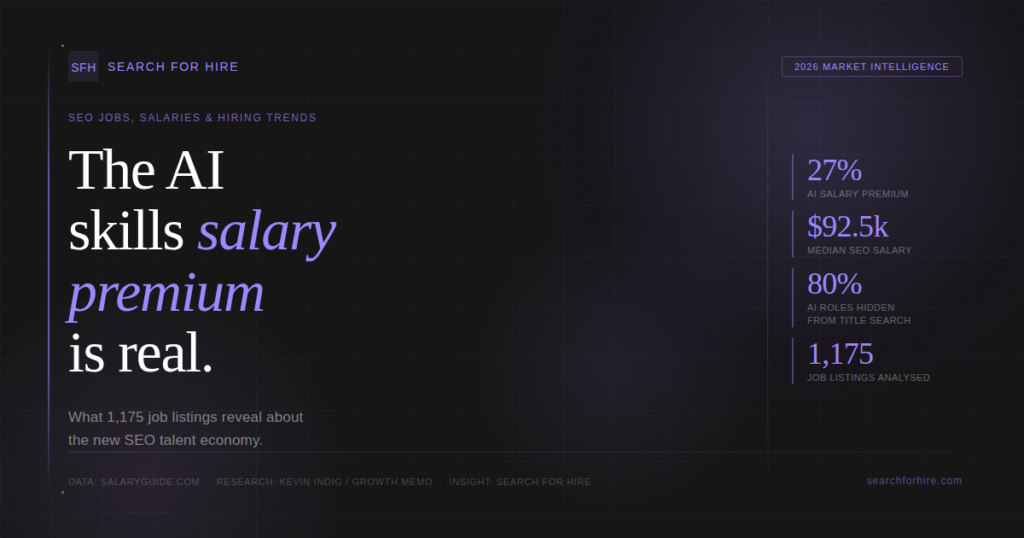
| Median SEO compensation across all roles | $92,500 |
| Middle 50% SEO pay range | $72,500 – $125,000 |
| Pay range premium for AI-native SEO talent | 55.9% |
| SEO job postings in January 2026 (peak month) | 395 |
Finding 1: the AI skills gap in SEO hiring
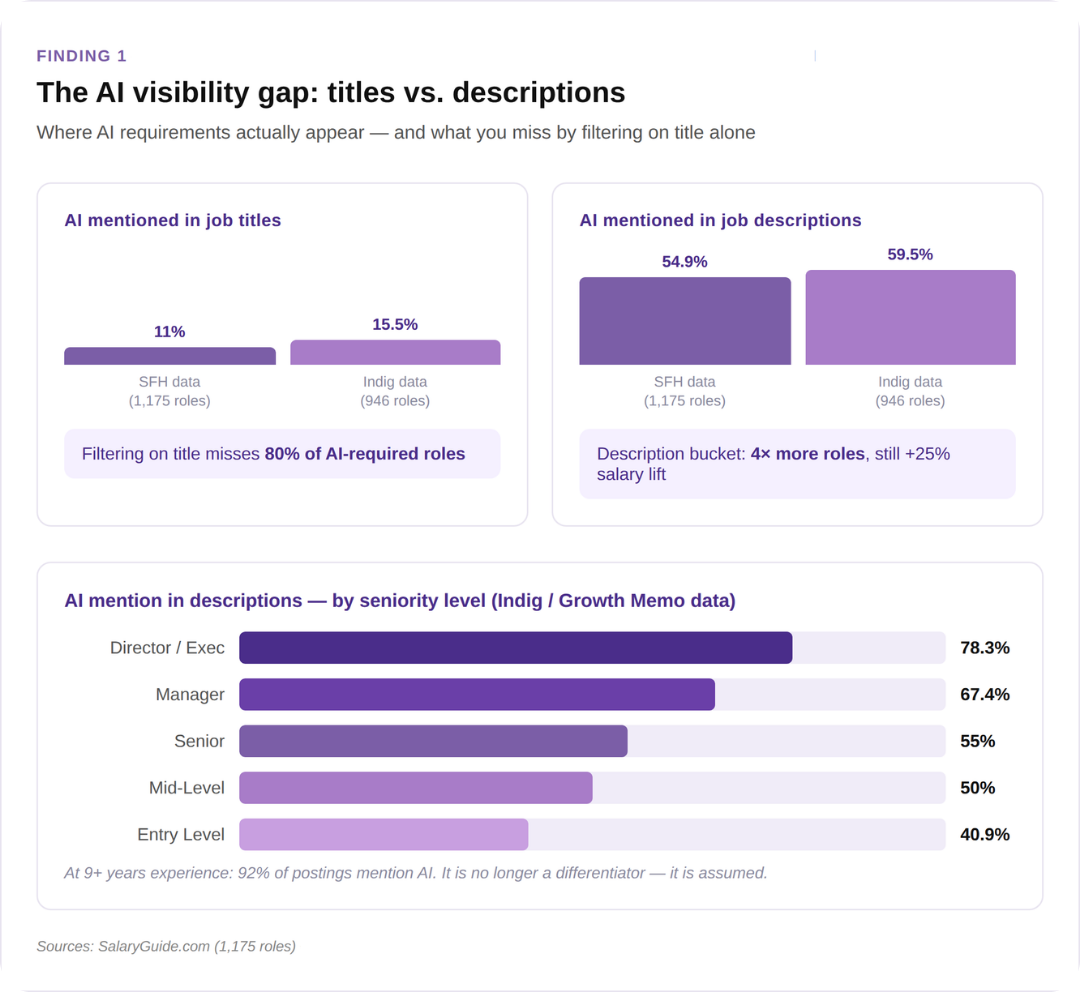
54.9% of job descriptions mention AI, but only 11% of titles do
The single most striking finding in the entire dataset is the gap between AI appearing in job descriptions versus job titles.
Of the 1,175 roles analysed, 54.9% included AI-related keywords in the job description, references to tools like ChatGPT, concepts like LLMs, GEO, or AEO, and requirements around automation and workflow building.
Yet only 11% of job titles referenced AI.
Job seekers see “AI skills required” in a job description and self-select in, often overstating their capability. Hiring managers then struggle to vet for a skill they cannot clearly define. The result is a high volume of mismatched hires and a growing frustration on both sides of the process.
Kevin Indig’s Growth Memo analysis of this data found the same pattern:
Only 15.5% of SEO postings include AI in the title, while 59.5% require it somewhere in the description. Employers are building AI into the role without putting it in the headline.
The practical consequence is severe for job seekers:
Filtering by AI in the title misses 80% of AI-required roles and, crucially, the 25–27% salary premium that comes with them. As Indig writes in the Growth Memo:
Kevin Indig – Growth Advisor
“The description bucket captures 4x more roles and still delivers a 25% median compensation lift over non-AI descriptions ($100,000 vs. $80,000).
The dollar deltas are $24,187 for the title bucket and $20,000 for the description bucket.
Compounded across pay range negotiations over a career, neither is marginal.”
At senior levels, the pattern becomes near-universal, with 78.3% of director/executive descriptions mention AI, and 67.4% of manager descriptions do.
Even at mid-level, one in two (50%) of SEO job postings include it.
This creates a compounding problem at the hiring end, where candidates see ‘AI skills required’ and self-select in, often overstating their capability. Hiring managers struggle to vet for a skill they cannot clearly define.
Our Senior Recruiter, Daris Benallal, sees this in almost every brief we receive:
“Candidates see ‘AI’ on a job description and say, ‘Yeah, I use AI all the time.’ But when you dig in, it’s all just related to having a custom GPT or using ChatGPT for ideation.
There are no Zapiers, no workflows, no systems.
Clients don’t want someone who can use a tool; they want someone who can build a scalable architecture that won’t break when more clients come on board.”
– Daris Benallal, Senior Recruiter, Search for Hire
The distinction between using AI and building with AI is the most important one in the current market. It is also the one that most job descriptions fail to make.
Sophie Brannon, Managing Director US at StudioHawk, frames the structural implication clearly:
Sophie Brannon – Co-founder, Studiohawk
“AI is quickly becoming foundational to how search works, so treating it as just an add-on skill misses the bigger shift.
The technical depth required to operationalize AI, automation workflows, APIs, tools like n8n and MCPs, means it will likely become its own specialization in our industry.
The next generation of SEOs should absolutely be versed in AI search and how LLMs retrieve and interpret information, but full ownership of AI systems, processes, and efficiency will likely sit with dedicated roles.
That makes strong SEO fundamentals even more important, knowing what to automate and how to interpret the output will separate great SEOs from those just using tools.”
Finding 2: SEO pay range trends in 2026
A 30% premium for AI-native talent is creating a two-tier market
The median SEO salary across all 1,175 roles is $92,500. That is a reasonable headline, but it obscures the more important story: the spread.
The interquartile pay range across all SEO roles in the dataset spans from $72.5K to $125K, highlighting substantial compensation variation across the market.
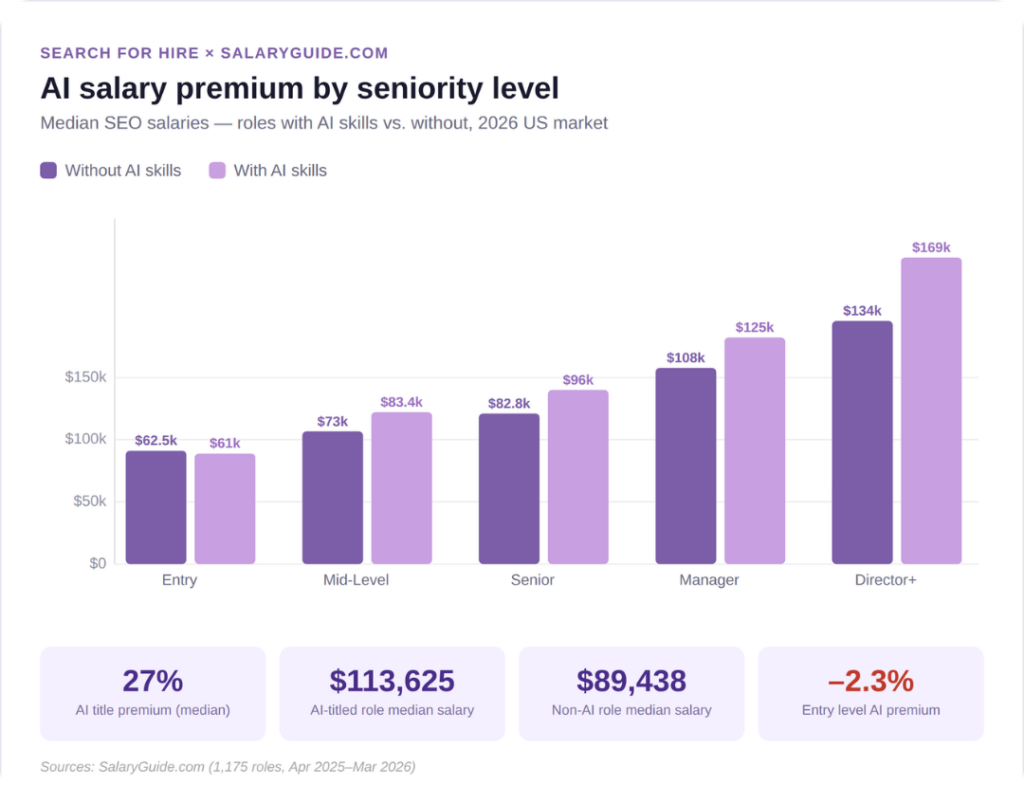
Layered on top of the seniority curve is a second, increasingly powerful axis: AI capability.
| Seniority Level | Median SEO Compensation | AI Title Premium |
|---|---|---|
| Entry Level | $62,500 | ~2.3% (no premium) |
| Mid-Level | $73,000 | +14.3% |
| Senior | $82,750 | Growing |
| Manager | $108,225 | Significant |
| Director+ | $133,750 | +$35,250 for AI roles |
The nuance found in the analysis is critical:
At entry level, AI skills in the description carry a slight negative premium (–2.3%). Employers don’t pay new graduates more for knowing AI.
The signal flips at mid-level (+14.3%), then compounds sharply at the management layer.
A Director-level SEO with AI in the description earns $35,250 more at the median than one without.
Jobs that mention AI in the title pay $113,625 at the median compared to $89,438 for jobs that don’t.
That 27% gap is live in the market right now.
As Indig notes, it is not a projection.
What is accelerating beyond this expected seniority curve is a second axis of salary differentiation: AI capability.
Josh Peacock, Founder of Search for Hire, contributed his perspective to the analysis:
Josh Peacock – Founder & CEO, Search for Hire
“Having been on hundreds of discovery calls with companies hiring SEOs and having built out hundreds of search teams at Search for Hire, the pattern is undeniable:
SEO talent is being priced on two axes now, SEO fundamentals and AI capability.
The candidates commanding a premium aren’t the ones who can use ChatGPT, they’re the ones who can build scalable systems with it.
But AI without precision judgement can take you a long way in the wrong direction, fast.
The real unicorns combine that build capability with deep technical skill, strategic thinking and the ability to sit in front of a client.
That combination barely exists and when it does, it doesn’t stay on the market long.”
Based on compensation data analyzed by Salary Guide, candidates with proven architectural AI skills (those who can build automated workflows, integrate APIs, and design systems rather than simply use tools) command up to a 30% salary premium over peers at the same seniority level.
Key insights for hiring managers
Your pay bands are already two-tier, whether you’ve formalized it or not.
Roles requiring AI pay more at the median, and most of yours probably don’t say so upfront.
If your offer is benchmarked to 2023 compensation data, you will lose the best candidates to competitors who have updated their thinking.
Ross Simmonds – Founder, Foundation Marketing
“There’s a premium being paid to anyone who embraces AI right now, for good reason.
The people who are leveraging these tools can move faster, execute more efficiently, and deliver better results than those who don’t. It’s that simple. Every business wants people who can do more with less. AI-savvy professionals are going to run circles around those who resist the tech.
The market is already rewarding this, and I think we’re only at the beginning of that shift.”
Finding 3: remote work in SEO
55.9% of roles still require in-office presence
The SEO industry still assumes the profession has gone fully remote.
The data does not support this.
Hiring a remote SEO is the single largest individual category (41.8%), but the majority of roles still require some form of on-site presence through hybrid or in-office expectations
| Work Model | Share of SEO Roles |
|---|---|
| Remote | 41.8% |
| On-Site | 34.7% |
| Hybrid | 21.2% |
| Unspecified | 2.3% |
For hiring managers, offering fully remote work remains a genuine competitive differentiator in a market where more than half of employers still ask people to come in.
Agencies and brands that open roles to fully remote candidates access a substantially larger, and often higher-quality, talent pool.
Those insisting on on-site five days a week are limiting themselves to whoever happens to live nearby.
Finding 4: SEO hiring trends by month
January is the peak; Q4 is when you should move
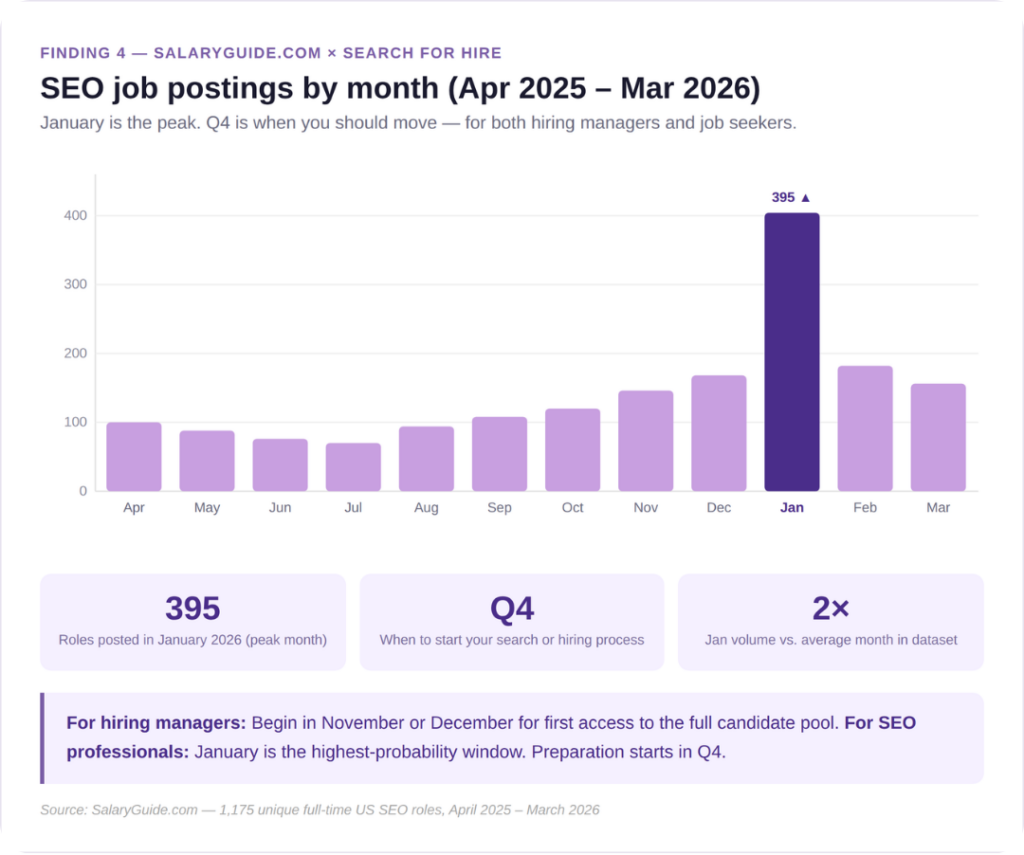
SEO hiring is not a flat, year-round activity. The data shows a pronounced seasonal pattern, with a sharp peak in January 2026, when 395 unique SEO roles were posted.
This is more than double the volume of most other months in the dataset.
This pattern has practical implications for both sides of the market.
For hiring managers:
Beginning the process in November or December, before the January surge, gives access to the full candidate pool before competitors enter the market.
For SEO professionals:
January is the highest-probability window to find a new role, and you should start preparing in Q4.
The seasonal concentration also explains something we see repeatedly in our own pipeline:
The quality of candidates available in January is meaningfully higher than in mid-year, when the pool has been picked over.
If you are serious about making a great hire, start your process in Q4 and aim to close it in January.
Finding 5: The SEO unicorn problem
Why the hardest roles in Search cannot be filled
Beyond the quantitative data, the most consistent theme from our recruiters is the challenge of roles that combine multiple demanding competencies. Faith Jackson-Garbett, Senior Recruiter at Search for Hire, describes the pattern she sees most often:
“The hardest roles to fill are for candidates who are simultaneously deeply technical, highly strategic, and client-facing.
You might get one or two of those things, but to get all three, especially when we’re talking about them being really deeply technical, is like finding a needle in a haystack.”
– Faith Jackson-Garbett, Senior Recruiter, Search for Hire
This is not a salary problem. It is a supply problem.
The candidate who can architect a technical SEO strategy, present it to a C-suite client, and then build the automation system to execute it at scale is rare.
As the industry continues to specialize, hiring managers who write job descriptions for this profile need to either:
- Expand their search significantly
- Adjust their expectations
- Or consider building the capability through two complementary hires rather than one
Josh Peacock captures precisely why:
The real unicorns combine build capability with deep technical skill, strategic thinking, and client presence. That combination barely exists, and when it does, it doesn’t stay on the market long.
The 2026 SEO hiring playbook: how to act on this data
For Hiring Managers and Agency Founders
Define the outcome, not the tool.
“Must have AI skills” is not a job requirement; it is a placeholder. Replace it with a specific, measurable business problem: “Proven ability to build an automated reporting workflow that saves five hours per week” is a requirement you can vet for. “Experience with AI tools” is not.
Budget for the AI salary premium.
The 30% salary uplift for AI-native SEO talent is not a negotiating position; it is a market rate. If your offer is benchmarked to 2023 compensation data, you will lose the best candidates to competitors who have updated their thinking.
Vet for proof, not claims.
The most effective interview process for AI capability is not a technical quiz – it is a live demonstration. Ask candidates to walk you through a workflow they have built, screen-share as they solve a real problem, and show you the measurable output. Fifteen minutes of watching someone think is worth more than an hour of them describing what they think.
For SEO Professionals and Job Seekers
Build, don’t just use.
Prompt engineering is table stakes. The skill that commands a premium is designing and building automated systems: workflows in Zapier or Make, Python scripts, and API integrations. Build side projects that demonstrate this capability, document the results, and make them central to your portfolio.
Specialize deliberately.
The data shows a market that rewards depth over breadth. Identify the niche where your skills are strongest- Technical SEO, AI-driven content systems, local search, international SEO- and invest in becoming one of the top practitioners in that area.
Time your job search strategically.
If you are planning a career move, starting your search in Q4, before the January peak, gives you the best mix of available roles and less competition.
Do not undersell your AI capability, or oversell it.
The market is getting better at testing for this. If you have built real automation workflows, quantify the impact. If you haven’t, build something you can demonstrate before you apply for roles where it is a requirement.
Conclusion
The SEO job market in 2026 is not in crisis; it is in transition.
The fundamentals of the discipline remain valuable, but what constitutes a strong SEO practitioner is shifting faster than most hiring processes have adapted to. The AI skills gap, the salary premium for technical capability, and the persistent demand for in-office presence are all symptoms of an industry recalibrating around a new set of expectations.
For companies, the opportunity is to get ahead of that recalibration by updating compensation benchmarks, improving vetting processes, and being precise about what they actually need. For practitioners, the opportunity is to build the skills that the market is already paying a premium for, before that premium becomes the baseline.
At Search for Hire, we work with agencies and brands across the US and UK to place the top 1% of SEO talent, including people who aren’t actively looking and will never appear on a job board.
If this data has surfaced a hiring challenge you are facing, we would be glad to help you navigate it.
Book a Discovery CallUse this data
Journalists, bloggers, and publishers may use these charts and graphics with attribution to Search for Hire.
For media inquiries, collaboration, or custom data requests, contact: hello@searchforhire.com