
Building and Hiring AI Search Teams for 2027
Blog
5 Mistakes Search Agencies Make When Hiring

Josh Peacock
July 16, 2026
How to Hire for a Marketing Agency (5 Mistakes to Avoid)
TL;DR
Most bad hires aren’t the candidate’s fault; they are caused by flawed company processes. To build a world-class team, stop hiring in a panic and start building a constant talent pipeline. Define clear, measurable 12-month outcomes before writing a job description, and stop letting big brand names on a CV blind your vetting process. Test for current competence using short, paid work trials rather than interviewing for past history. Finally, abandon the “laptop and login” introduction approach in favor of a structured 90-day integration framework.
Key takeaways:
- Shift from Panic to Pipeline: Hiring only when a seat is empty means you are optimizing for availability, not ability.
- Outcomes Over Tasks: Define what success looks like in 12 months with 3 numeric achievements before you write the job ad.
- Kill the Halo Effect: Standardize your vetting process so big brand names (ex-Google, ex-LinkedIn) don’t mask skill gaps.
- Interview for the Present: Use brief, paid work trials to evaluate how a candidate thinks and solves problems today.
- Integrate, Don’t Just Introduce: True onboarding takes 90 days, moving systematically from tools and context to full ownership.
Building a high-performing team is the ultimate goal for any business, yet many organizations consistently stumble during the recruitment process. When a hire goes south, it is rarely just down to bad luck or a poor candidate. More often, it is the result of systematic flaws in how we source, vet, and onboard talent.
Having run a headhunting agency specializing in search marketing for nearly five years, I’ve watched hundreds of hires play out. The disastrous ones almost always come down to five core mistakes.
Here is how to stop making them and build a bulletproof hiring engine.
Want to hear from our CEO’s full breakdown?
Find it here:
Speaker: Josh Peacock, Founder, Search for Hire. Lightly edited for clarity and accuracy.
Chapter 1: Introduction — The Cost of Bad Hires
[00:00 – 00:34]
[00:00] I’ve run a headhunting agency that specialises in search marketing for nearly five years now, and I’ve watched hundreds of hires — the good ones and the disasters.
[00:08] And the disasters aren’t always down to bad luck or bad candidates. They’re normally down to about five mistakes that agencies or companies are making when they hire.
[00:17] I want you to stick around, because I think this might sting a bit — there’s going to be at least one of them that I guarantee you’re making.
[00:26] So, let’s get straight into it.
Chapter 2: Mistake #1 — Only Hiring When the Seat Is Open (Panic vs. Pipeline)
[00:34 – 02:04]
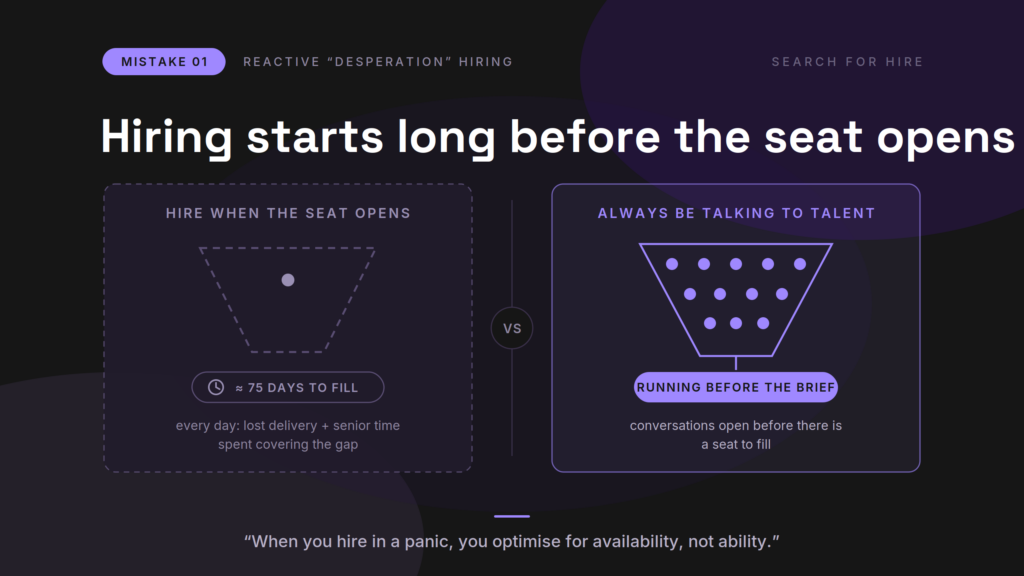
[00:34] Mistake number one: you only start hiring when the seat is already open. That might sound crazy to a lot of people, but I promise you, this is what most agencies do.
[00:42] They sign a new client, they get a new account, somebody resigns — and they go straight to LinkedIn Jobs. They throw up a job description they had three or four years ago, get it live, and you’ve only got a few candidates put through the funnel with a deadline breathing down your neck.
[00:59] It’s just not the way to hire. What we find on average is that it takes 75 days to fill a role by yourself when you have a seat open.
[01:07] The really important thing about that 75 days is that every single day that goes past is a day lost on delivery — a day your senior team are trying to cover that gap.
[01:22] We actually signed a client recently — a massive client, I think they’re in the top 200 most visited websites in the world. Very, very big.
[01:30] They had a very senior hire open for five months, and they had three full-time recruiters trying to fill it. So they knew they were in pain.
[01:38] On that client call, they didn’t even want to go into the cost of vacancy and how much having that role open was actually costing them.
[01:47] If they’d been a bit more proactive, they would have been able to reduce the amount of time that role was open.
[01:56] The thing is, when you hire in a panic, you’re optimising for availability, not ability.
Chapter 3: The Fix — How to Build a “Virtual Bench”
[02:04 – 02:58]
[02:04] The way you make sure this doesn’t happen is what we call having a virtual bench.
[02:11] You can always be talking to talent. It’s about building your brand — always having open roles, having a section on your careers page where you’re always looking at top talent.
[02:19] The same way as when you’re trying to win big clients, you’re always prospecting — that tap never turns off. The same should apply to talent acquisition. You should be talking to the best people out there.
[02:34] You might not have a role open for them now, but you might in six months, eighteen months.
[02:34] We do it at my company. Any time we get on a call with somebody that’s really talented, or somebody messages me and they’ve got the exact experience that I want, I’ll jump on a call with them.
[02:49] And I’ll be completely honest with them that we don’t have the role open right now — but I want to build out that virtual bench.
Chapter 4: Mistake #2 — The Swiss Army Knife Myth (Undefined Roles)
[02:58 – 03:58]
[02:58] Mistake number two is the whole Swiss Army knife myth.
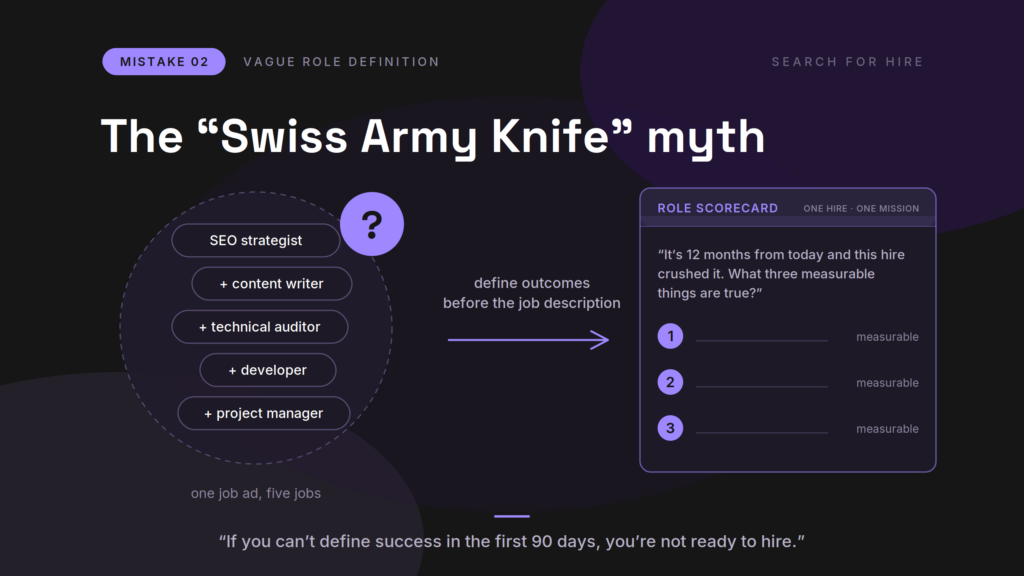
[03:05] The reason these hires fail is because the job is never actually clearly defined. You’ve got somebody that might be an SEO strategist — but they’ve also got content writing, they’ve also got technical audits, they’re a developer, they’re a project manager.
[03:14] I was going to pull up some of the jobs we see on screen where the role is everything. Let’s just call them a Swiss Army knife.
[03:23] The funniest thing about most of these roles is that the salary does not match everything on that list.
[03:31] You could have a role like that at £45k in the UK — let’s say $55–60k USD in the US — and you’re expecting everything from it. Normally when these go up, they get a lot of heat on LinkedIn.
[03:49] This happens a lot on our client discovery calls. Somebody could think they want an SEO Manager, and after about ten questions of digging deeper, it actually changes into a completely different role.
Chapter 5: The Fix — Defining Outcomes Before Writing the Job Description
[03:58 – 05:46]
[03:58] What we get people to do before they actually hire for the role is define the outcomes before writing the job description.
[04:04] It’s twelve months from today and this hire crushed it — what are three measurable things that are true?
[04:11] This is a brief example of what our scorecard looks like. We do this all on a call, but I’ll put the download link in the comments.
[04:18] First, the mission of the role — a concise, compelling statement of the fundamental reason this person exists and the core problems the role is designed to solve.
[04:26] There are a few questions in there: What is the number one thing the rest of the team is currently over-leveraged on because this person isn’t here? If this person fails in the first six months, what is the most likely reason why?
[04:38] Then the role overview and the key measurables. To be considered an A-player, the candidate must achieve three quantifiable goals within the first 3 to 12 months. What are they?
[04:45] Imagine it’s one year from today and we’re celebrating this hire’s performance — what are three specific numeric achievements we’re celebrating?
[04:53] This might sound really easy, but I promise you — once you get all of this done, you can turn it into an actual scorecard, and it becomes your guardrail.
[05:01] If you’re in an interview and someone says something you really like, but you had it down as a red flag on the scorecard, you’ll be able to check yourself.
[05:08] You might have a gut feeling in the interview, but if you go back to the scorecard and it was a red flag — you can’t move forward with that person.
[05:23] These outcomes need to be super measurable. Things like: organic revenue up 40%, owns three client accounts solo, keeps client retention at 87%. Whatever it is — measurable outcomes.
Chapter 6: Utilising Granular Salary Data to Attract Top Talent
[05:46 – 06:24]
[05:46] And while we’re here, we should talk about cost. This is Salary Guide, one of my companies.
[05:54] You can go in here — say, Marketing Manager — and we’ve got really granular data. Once you set up an account, it’s free, and you can get all the data you want.
[06:02] So when you’re building out the outcome-focused scorecard, you can then build out the job description with an accurate salary to actually attract the people you want.
[06:11] One last closing point on this: if you cannot define success in the first 90 days, I promise you, you are not ready to hire — and a speed hire is not going to be successful.
Chapter 7: Mistake #3 — The Halo Effect (Getting Blinded by Big Brand Names)
[06:24 – 07:50]
[06:24] Mistake number three — and this one isn’t about the candidate, this one’s about you. It’s called the halo effect.
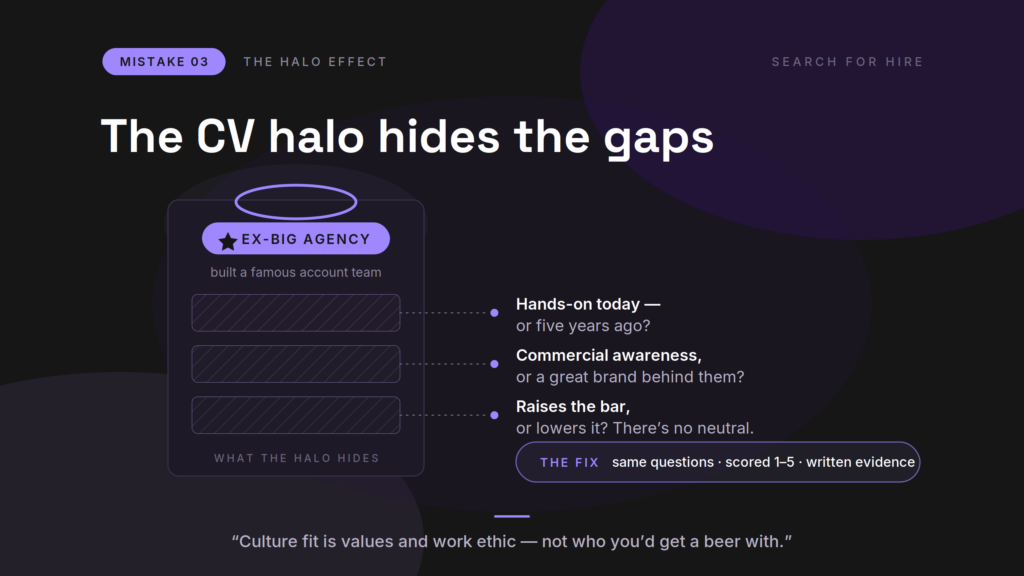
[06:32] A big brand name lands on your desk with a CV. Might be ex-Google, ex-LinkedIn, ex-whatever big agency you look up to. They’ve built a famous account team.
[06:41] The halo is so bright that you stop asking the questions that matter. Everything becomes a mirage, and it hides all the gaps.
[06:49] Are they hands-on today, or were they hands-on five years ago? We call them tick-boxers — were they in a role for three to five years just ticking the box, not doing anything special, not in the trenches?
[07:05] Is their commercial awareness good, or is it just the great brand behind them? And do they actually raise the bar or lower it? It can never be neutral.
[07:16] And this can work both ways. We just signed a client who had an account manager who was unbelievable on everything — went through the vetting process, was great.
[07:25] But when they were actually put into the role, the campaigns were working, but they weren’t able to show the value articulation of the work they were doing.
[07:32] So the clients would ring the owner and get that person in trouble. Ultimately they had to let them go — and the owner really liked them.
[07:41] So this can go both ways. The vetting process needs to be extremely strong.
Chapter 8: The Fix — Fixed Vetting Processes & Culture Indexing
[07:50 – 08:27]
[07:50] The fix is a fixed vetting process for every single role, using the outcome-focused scorecard, and scoring on each one. There’s no mixing — it’s always fixed, with written evidence for each one.
[08:04] The next part is culture fit. Culture fit isn’t whether you can go for a beer with them or have fun with them — especially with a bigger team.
[08:10] Culture fit is about values and work ethic, so you need to vet for those too.
[08:19] There are loads of very good culture index questionnaires you can use, or you can do a 30-minute chemistry call — that’s what a lot of our clients do.
Chapter 9: Mistake #4 — Confusing Experience with Competence
[08:27 – 09:54]
[08:27] Mistake number four is the halo effect’s cousin: confusing experience with competence.
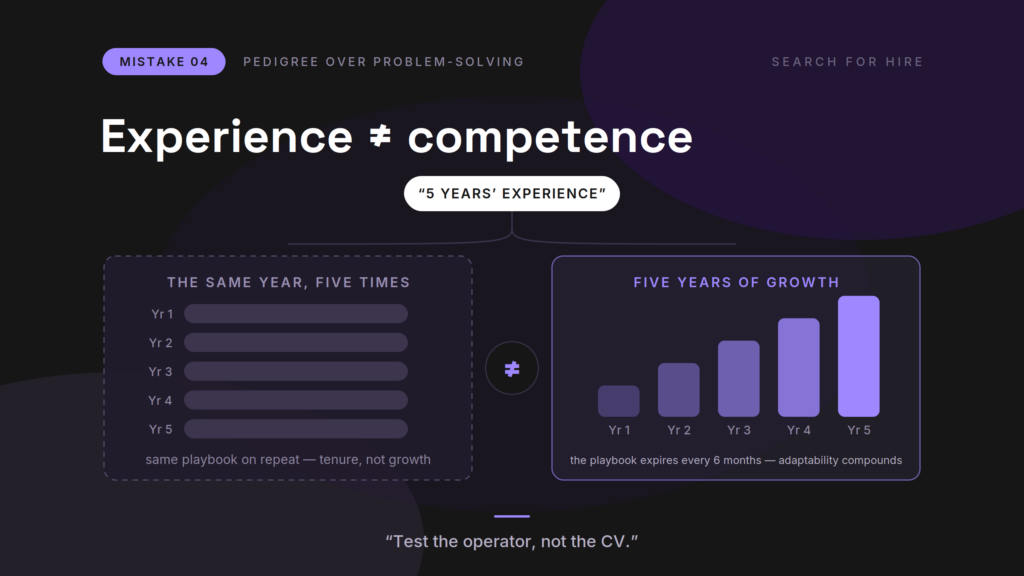
[08:35] Five years on a CV can mean two very different things. It could mean five years of actual growth where they absolutely killed it — or it could mean five years of tick-box activity where they weren’t in the trenches, weren’t hands-on.
[08:48] On the left, you’ve got the same year repeated five times. They are not the people we want.
[08:53] On the right-hand side, you’ve got the stairs going up — they’re growing, they’re getting promotions.
[08:58] When you check references, everybody has positive things to say about how much they’ve grown, how much they’ve really delved into the company. They’re the people we want.
[09:07] We see this a lot. Clients come to us on calls saying, “We want somebody with six years’ experience, or seven years of senior experience.”
[09:22] And we have to politely tell them that a lot of the time it’s not about the years of experience — it’s about their actual growth.
[09:30] And especially in the last year, with all the AI and the tools coming up, this matters even more.
[09:38] That’s why we’ve got such a strong vetting process on how AI-native a candidate is — because we want to see those stairs turn into an absolute ramp, a hockey stick.
Chapter 10: The Fix — Stop Interviewing for the Past (Paid Work Trials)
[09:54 – 11:09]
[09:54] Here’s the fix — and this is the single most stealable bit of this video: stop interviewing for the past and start interviewing for the present.
[10:03] Run a short paid work trial. Take a real problem in your world, anonymise it, and pay the candidate for their time — maybe two to three hours — and just watch how they think.
[10:11] Not what they did in 2021, but what they can actually do this week.
[10:19] A lot of our clients will ask a candidate to share their screen. Actually, it’s funny — we’ve got a great client, really strict with their vetting process.
[10:26] If a final interview is going really well — like, too well — they’ll do what they call throwing them under the bus.
[10:34] They ask the candidate to share their screen and give them a real problem to fix right there. It shows how they think on their feet.
[10:42] These are very senior, very well-paid positions at a great agency. It gives you a real insight into the way that candidate thinks — I think it’s a phenomenal way to hire.
[10:58] And their staff retention rate is something like 93% — and they’re a 12-year-old agency. Phenomenal.
Chapter 11: Mistake #5 — The Onboarding Illusion (Introduction vs. Integration)
[11:09 – 11:36]
[11:09] Mistake number five is the onboarding illusion.
[11:17] So you’ve nailed the scorecard, you’ve beaten the halo effect, you’ve tested them on absolutely everything, and you’ve signed them — and then you introduced them instead of actually integrating them.
[11:25] We joke about this a lot, but onboarding does not equal a laptop login and a meet-the-team call.
Chapter 12: The 90-Day Integration Framework Breakdown
[11:36 – 13:24]
[11:36] Real integration is at least a 90-day onboarding. It’s the honeymoon effect — that first 90 days is what’s going to make sure they stay for, hopefully, years to come.
[11:43] For days 0–30, we’ve got a whole onboarding checklist — message me and I’ll give it to you. The first 30 days is all about tools and context: system accounts and how the agency runs.
[11:52] In those 30 days, nobody is going to be at the summit of that mountain — especially if they shone through the interview. What you really want is for them to get integrated with everything.
[12:00] Days 31–60 is when you start to see the culture and the cadence: how decisions get made, who owns what, how the company operates, and how they fit themselves into that. Integration is the big thing here.
[12:16] Days 61–90 is expectations and ownership — the scorecard outcomes reviewed in the open, with constant meetings.
[12:23] Our onboarding checklist tells you which day you should be having these conversations, and includes a checklist of what to look for in how the candidate is settling in.
[12:38] The biggest thing when it comes to onboarding is two things. One: never let the candidate be left in the dark.
[12:44] Two: don’t have massive expectations that this person — even if they killed it for the last 10 years at their last company — is going to come in and do that in the first 90 days with you. It takes time to really integrate and become part of the company.
[13:00] If you can get these 90 days completely structured and continually improved, it will make sure they have a great experience at your company and love working there.
[13:08] And it will get them up to speed even faster, so they can do what you hired them to do.
Chapter 13: Summary of the 5 Hiring Mistakes & How to Work With Us
[13:24 – 14:05]
[13:24] So those are the five mistakes I see agency owners make all the time:
- Hire from pipeline, never in panic.
- Define success before you write the job ad.
- Kill the halo with structure.
- Test the actual person, not the CV.
- Integrate — don’t just introduce.
[13:41] Every one of these is fixable this quarter. They don’t demand a massive budget — they’re fairly easy and simple to do.
[13:50] And look, if you’re hiring for any search marketing or performance teams and you’d rather somebody run this complete system for you, then please visit us at searchforhire.com — or there should be a booking link in the description below.
Mistake #1: Only Hiring When the Seat is Open (Panic vs. Pipeline)
Most companies only post a job opening when a client signs, someone resigns, or a team member burns out. They throw up an outdated job description on LinkedIn, watch a trickle of candidates come through, and try to force a choice because a deadline is breathing down their neck.
On average, it takes 75 days to fill an open seat by yourself. Every single one of those days is a day lost on project delivery, forcing your senior team to stretch thin to cover the gap. When you hire in a panic, you optimize for availability, not ability.
The Fix: Build a “Virtual Bench”
Treat talent acquisition exactly like client acquisition—the prospecting tap should never turn off.
- Always Be Talking: Regularly meet with top-tier talent, even if you don’t have an active opening.
- Be Transparent: Connect with people who possess the exact experience your company will need in 6, 12, or 18 months. Be honest with them: “We don’t have a role today, but we are building our virtual bench for future growth.”
Mistake #2: The “Swiss Army Knife” Myth (Undefined Roles)
We see it all the time on LinkedIn: a job description demanding a candidate who can handle technical SEO audits, write compelling copy, write code, manage complex projects, and handle clients—all for a entry-to-mid-level salary.
When you look for a “Swiss Army Knife,” you get a role that is impossible to execute, a job post that gets ridiculed online, and an employee destined to fail. If you cannot clearly define success for the first 90 days, you are simply not ready to hire.
The Fix: Define Outcomes Before the Job Description
Before writing a single bullet point for a job post, create an Outcome-Focused Scorecard. Sit down and answer these foundational questions:
- The Mission: What is the fundamental, concise reason this role exists?
- The Relief Valve: What is the number one thing the rest of the team is currently overleveraged on because this person isn’t here?
- The 12-Month Metric: Imagine it is one year from today and we are celebrating this hire’s performance. What are three specific, numeric achievements we are celebrating? (e.g., “Grew organic revenue by 40%” or “Soles-owns 3 client accounts while maintaining an 87% retention rate”).
Pro-Tip: Use granular, real-time salary data to ensure your budget matches the outcomes you are demanding. If the market rate doesn’t align with your expectations, your scorecard acts as a guardrail to keep you realistic.
Mistake #3: The Halo Effect (Blinded by Big Brand Names)
A CV lands on your desk featuring heavy-hitting names: ex-Google, ex-LinkedIn, or an executive from a famous global agency. Suddenly, the “halo” is so bright that you stop asking the hard questions. You assume they are superstars, but big brands can mask significant gaps.
You need to know: Are they hands-on today, or were they hands-on five years ago? Are they just “tick-boxers” who coasted on the infrastructure of a massive corporation, or can they actually get in the trenches and raise the bar for your team?
The Fix: Standardized Vetting & Culture Indexing
- Consistent Scoring: Every single candidate for a role must go through the exact same vetting process and be graded against the written scorecard. Document written evidence for every score to remove gut-feeling bias.
- True Culture Fit: Culture fit doesn’t mean “someone you want to grab a beer with.” It means alignment on values and work ethic. Use structured 30-minute chemistry calls or validated culture index questionnaires to assess this objectively.
Mistake #4: Confusing Experience with Competence
Five years of experience on a CV can mean two entirely different things. It could mean five years of aggressive, upward growth and compounding mastery. Or, it could mean the exact same year of basic, tick-box experience repeated five times over.
In fast-moving spaces like search marketing, where AI tools are completely transforming the landscape, years of tenure matter far less than a candidate’s current trajectory and adaptability.
[Flawed Approach]       -> Interviewing for the PAST (2021 Bullet Points)
[Successful Approach]   -> Testing for the PRESENT (Live Problem Solving)
The Fix: Stop Interviewing for the Past (Paid Work Trials)
The single most valuable adjustment you can make to your hiring pipeline is to start interviewing for the present.
- The Short Work Trial: Take a real, historical problem from your business, anonymize the data, and pay the candidate for 2 to 3 hours of their time to solve it.
- The “Under the Bus” Screen Share: For senior positions, have candidates share their screen during a live interview to tackle an unexpected live issue. Watch how they think, navigate tools, and react on their feet.
Mistake #5: The Onboarding Illusion (Introduction vs. Integration)
You built the scorecard, bypassed the halo effect, ran a flawless work trial, and signed the candidate. Then, you hand them a laptop login, introduce them on a team Slack channel, and consider them onboarded. This is an illusion.
Onboarding is not an event; it is a meticulous, 90-day integration framework. Even an A-player who crushed it for a decade elsewhere will fail if they are dropped into a vacuum.
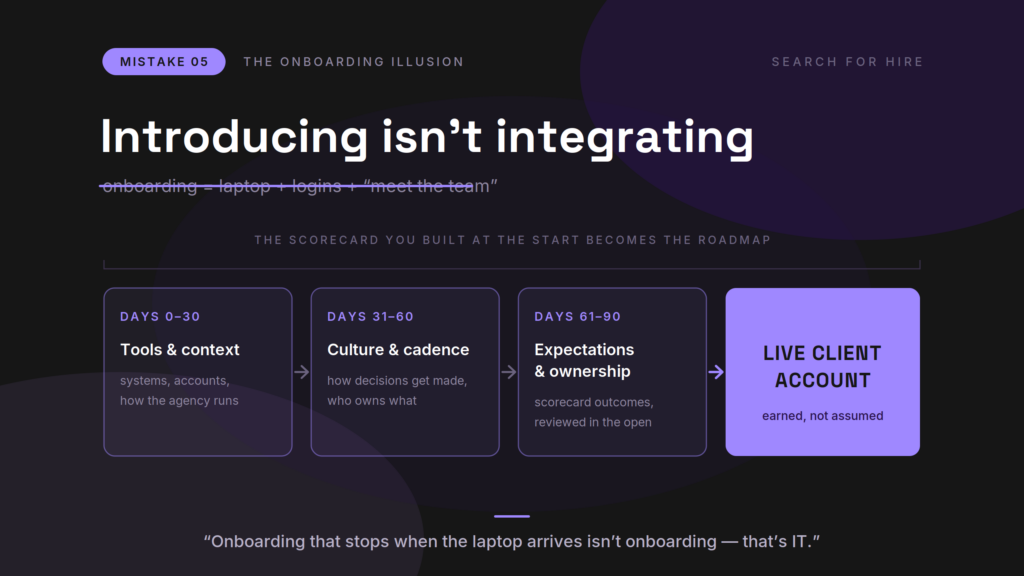
The Fix: The 90-Day Integration Framework
Break your onboarding down into three distinct, structured phases:
Days 61–90: Expectations & Ownership. Review the original scorecard outcomes openly. Transition the hire into complete ownership of their metrics with frequent feedback loops.
Days 0–30: Tools & Context. Focus entirely on systems, account access, and learning how the agency operates. No one should be expected to summit the mountain in their first month.
Days 31–60: Culture & Cadence. Shift focus to how decisions get made, who owns what, and how the team communicates daily.
Summary: The 5 Shifts You Need to Make
Every single one of these common mistakes is entirely fixable this quarter without a massive budget:
- Hire from a pipeline, never from a panic.
- Define success before you write the job description.
- Kill the halo effect with structured, identical vetting.
- Test the person’s current skills, not their past CV.
- Integrate them systematically over 90 days; don’t just introduce them.
If you are looking to scale your search marketing or performance teams and want an expert partner to run this entire, end-to-end recruitment system for you, book a strategy call with our team.
FAQs
Frequently asked questions
My team is at capacity. How can I build a “virtual bench” when I need a body in a chair immediately?
If you need someone by next Monday, building a virtual bench won’t solve your immediate crisis—you are in panic-hire territory. At this stage, you are statistically primed to make a bad hire because you are optimizing for availability over ability.
To bridge the gap without making a long-term mistake:
Bring on a freelance contractor or a white-label partner to handle the initial audits and setup for the first 30 to 60 days.
Use this purchased time to run a proper, non-panicked headhunting process for your permanent hire.
Keep the talent pipeline open permanently going forward so you never find yourself in this reactive position again.
How can I run a live work trial or screening test without violating client NDAs?
Never give candidates access to live client sites, active Google Search Console (GSC), or Google Analytics accounts. Instead, anonymize historical data or use public sites:
The Crawl Test: Export a raw Screaming Frog crawl of a public website (or an old, lost prospect). Give the candidate 2 hours to analyze the sheets, identify the top three high-impact technical issues, and record a brief client-facing video explaining the fixes.
The Diagnostic Test: Take a screenshot of a real, historical traffic drop in GSC (with all brand identifiers blacked out). Ask the candidate to walk you through exactly how they would diagnose the drop and what steps they would take first.
Note: Always pay candidates a fair hourly rate for their time during take-home trials to respect their labor and attract A-players.
We are a boutique agency and need an SEO who can write content, run technical audits, and manage clients. Is a “Swiss Army knife” really a myth?
Yes, it is a myth, and raising the salary won’t change how the human brain is wired.
Technical SEO requires deep, analytical, quiet focus.
Content writing requires creative flow and empathy.
Client management requires high emotional intelligence and relationship building.
When you hire a “generalist” to do all three, they inevitably end up doing all of them mediocrely. Define the single biggest bottleneck your team is currently overleveraged on (e.g., executing audits) and hire to crush that specific outcome. Outsource or delegate the other tasks.
A candidate has a major enterprise brand on their CV. How do I tell if they are a “doer” or just a corporate meeting-sitter?
Enterprise SEO and Agency SEO are completely different sports. Enterprise SEOs often spend 80% of their time navigating internal politics and managing vendors. At a fast-paced agency, they may drown if they are expected to build redirect maps and personally execute optimizations for five clients at once.
To bypass the “Halo Effect”:
Listen for “I” vs. “We”: If they say, “We migrated the site and grew traffic by 50%,” ask: “What was your exact, individual contribution? Did you personally map the URLs, or did you manage the agency that did?”
Focus on execution: Ask them to share their screen during the final stages and solve a live, unexpected technical SEO problem. A corporate meeting-sitter will stumble; a hands-on technical SEO will dive right in.
We don’t have time for a slow, 90-day onboarding process. How do we get an SEO manager billable by week two?
Pushing a new hire in front of clients by week two without deep context is a recipe for churn. However, you can make them internally billable almost immediately:
The Shadow Phase (Days 1–30): The new hire should not own any client accounts. Instead, they work in the background—writing strategy, drafting technical recommendations, and building decks that your senior team reviews and delivers.
The Hand-off Phase (Days 31–60): Introduce them as the co-lead on client calls.
The Ownership Phase (Days 61–90): Hand over full ownership once they understand your agency’s specific communication style and workflow.