Building and Hiring AI Search Teams for 2027
Blog
The Future of Search: 5 Experts and 328,650 Job Postings on What Happens Next

Josh Peacock
July 15, 2026
TL;DR
Search isn’t dying, it’s being absorbed. We asked 5 industry leaders where search ends up by 2028, then tested their predictions against 328,650 marketing job postings. The market’s verdict: 1 in 5 SEO job ads now asks for AI search skills (up from 1 in 8 in December 2025), those roles pay a 20.5% salary premium ($117,500 vs $97,500 median), and 28% of new AI search job titles are leadership hires. Employers are voting for evolution, not extinction.
The job isn’t dying either, but the people doing it are being reordered. And from the hiring frontline, I see two reactions to all this change. Some people are scared and annoyed. Others are excited to learn, experiment and grow. The excited ones are the ones who will thrive in this evolution.
Find my full breakdown of the data below, here:
Key takeaways
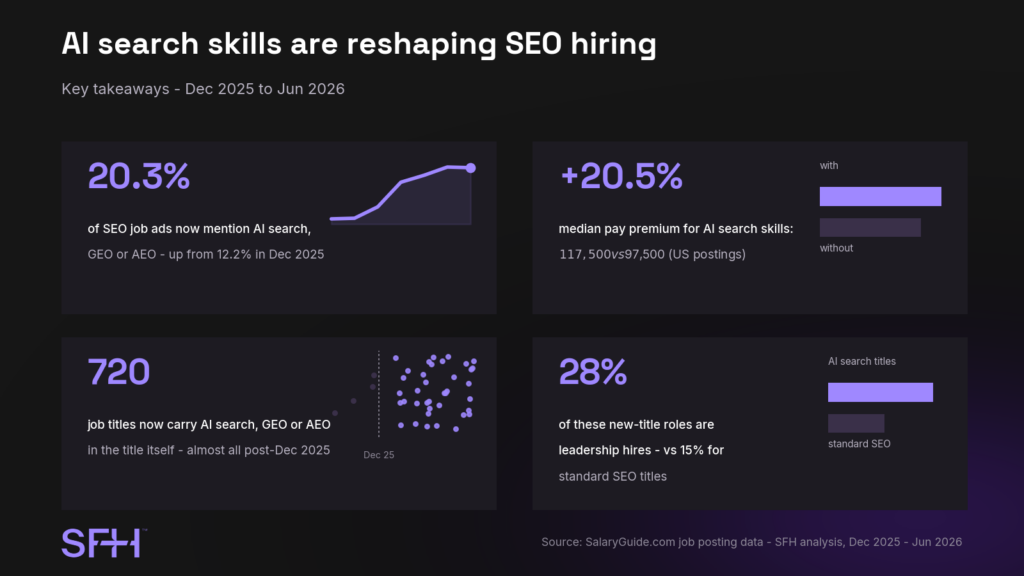
- 20.3% of SEO job ads now mention AI search, GEO or AEO skills (June 2026), up from 12.2% in December 2025. Source: SalaryGuide.com job posting data.
- SEO roles asking for AI search skills pay a median of $117,500 vs $97,500 without, a 20.5% premium (US postings with advertised salaries, n=13,779).
- 720 job postings in the last 12 months carry AI search, GEO or AEO in the job title itself. Almost all first appeared after December 2025.
- 28% of those new-title roles are leadership positions (Director, Head of, VP, Principal, Lead) vs 15% for standard SEO titles. Companies are hiring leaders, not juniors.
- Demand for SEO itself is flat, not falling: SEO appears in 11-12% of all marketing job postings every month, unchanged across the period.
Where does search end up in the next 2 years?
We put that question, plus what to upskill on and how to keep growing, to 5 people running search at the sharp end: JBH, Searchable, Scalerrs, Day Nova and Riverside.
Then we did something nobody else covering this debate can do: we checked their predictions against hiring data from 328,650 marketing job postings.
The short answer?
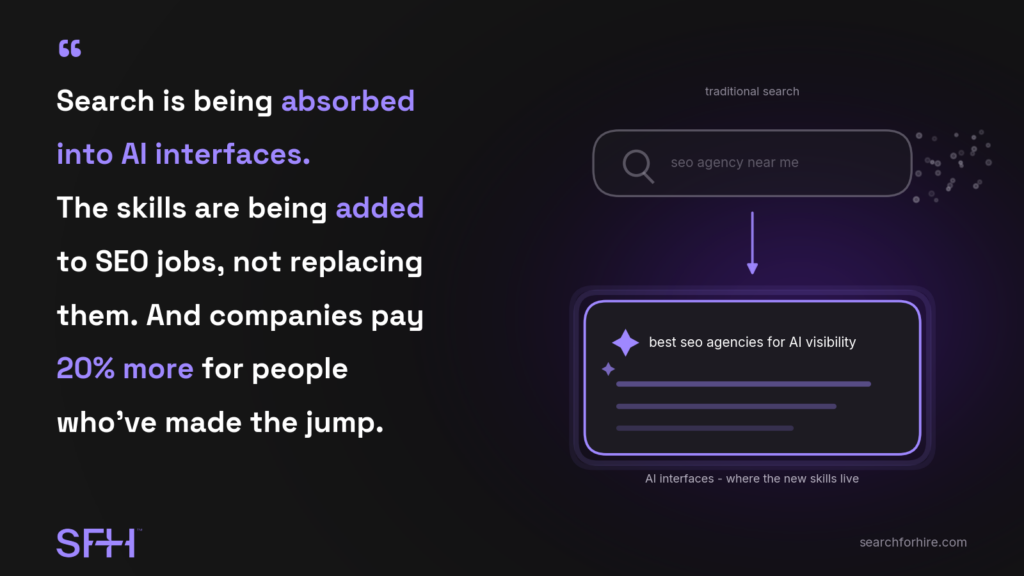
Search is being absorbed into AI interfaces, the skills are being added to SEO jobs rather than replacing them, and companies are paying 20% more for people who’ve made the jump.
I talk to agency owners and search marketing leaders every day, and there’s massive confusion in the air. Some refuse to change. Others chase every new tactic like a golden retriever after a bone.
I have my own opinions, but I wanted to combine expert commentary from industry leaders with real hiring data, and build what I believe is the most informative piece out there on where search is going.
What the hiring market says (the data)
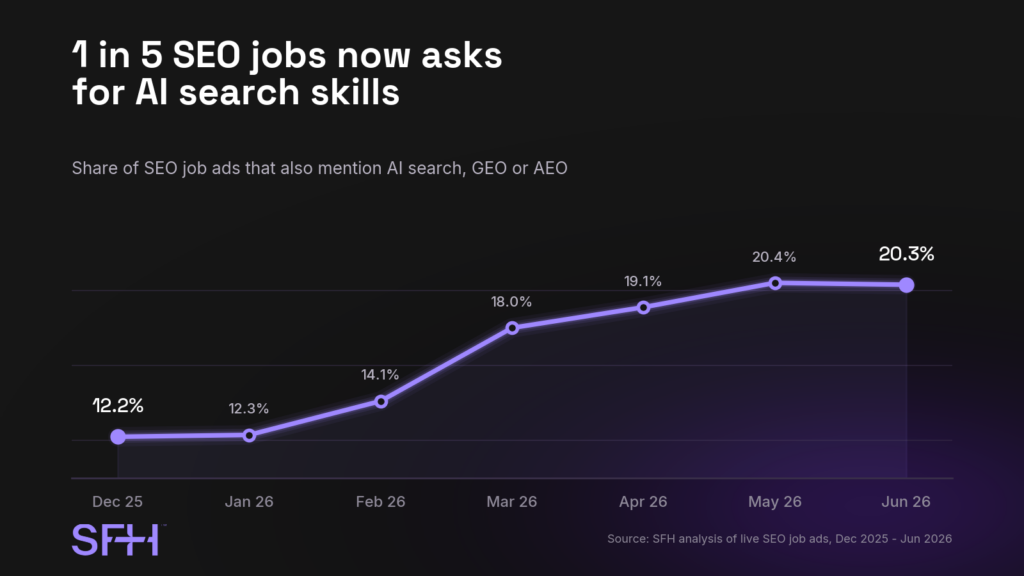
The hiring market shows AI search skills spreading fast through SEO jobs, commanding a salary premium, and arriving at leadership level, while core SEO demand holds steady.
| Month | SEO Job Ads | Also Mentions “AI Search / GEO / AEO” | Share |
|---|---|---|---|
| Dec 2025 | 4,332 | 527 | 12.2% |
| Jan 2026 | 6,274 | 770 | 12.3% |
| Feb 2026 | 4,860 | 684 | 14.1% |
| March 2026 | 4,644 | 837 | 18.0% |
| April 2026 | 4,691 | 895 | 19.1% |
| May 2026 | 4,839 | 988 | 20.4% |
| June 2026 | 4,984 | 1,010 | 20.3% |
As a share of ALL marketing postings:
- Mentions of GEO grew from 0.60% to 1.44% between December and June
- AI search from 0.53% to 1.10%
- AEO from 0.55% to 1.12%
- Plain “SEO” held flat at 11-12% throughout
The 20% AI search salary premium
Among US SEO roles with advertised annual salaries, postings that mention AI search skills carry a median salary of $117,500 against $97,500 for those that don’t. A $20,000 premium that holds at both quartiles ($85k vs $72.5k at the 25th percentile, $151.4k vs $135k at the 75th).
The job titles that didn’t exist a year ago
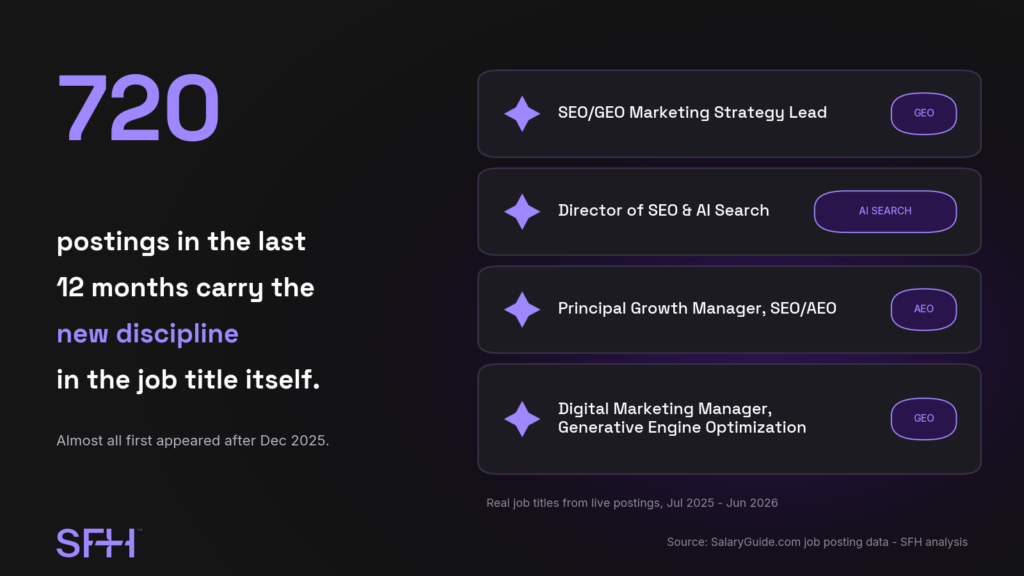
720 postings in the last 12 months carry the new discipline in the title: “SEO/GEO Marketing Strategy Lead”, “Director of SEO & AI Search”, “Principal Growth Manager, SEO/AEO”, “Digital Marketing Manager, Generative Engine Optimization”.
TurboTax and Capital One are among the companies posting them. And 28% are leadership roles, nearly double the 15% rate for standard SEO titles.
My take: In the last 12 months, we’ve been briefed on titles we’ve never hired for before. Head of SEO and AI Visibility. GEO B2B Manager. AEO Director. Head of Experimentation. And that’s everywhere from a 50-person agency to a 1,000-plus-person enterprise. The salaries reflect it too: for the most in-demand roles, we’ve seen offers up to 30% more than what the same seat paid before. Companies aren’t just filling seats anymore, they’re building talent density. It’s a race to the top: who can land the best people who’ve been actively experimenting for the last few years, the ones at the forefront of what’s happening in the industry right now.
Question 1: Where does search end up in the next 2 years?
Our 5 Search Industry leaders split into two camps: search dissolves into AI interfaces entirely (Holland, Garbaccio), or search fragments into an AI answer layer sitting on top of a shrinking but persistent web of sources (Davies, Tallent, Varangouli). Nobody thinks the 10 blue links survive as the main event.
Andrew Holland
Director of SEO at JBH
“Search dies within 2 years and I’ll explain why. Keywords and SERPs will be viewed in a few years like cave paintings. Just go and watch any sci-fi film. Nobody searches, they ask AI. Sure, you’ll always be able to dig into data. But AI will be the default interface. Think how Tony Stark used Jarvis. There will be an information network (the internet) and AI will find us what we want. In that world you optimize for problem-solution fit, not rankings. That’s brand marketing, not SEO.”
I agree with the direction but not the timeline, and I’ve got the receipts.
If search were dying in 2 years, companies wouldn’t still be putting SEO in 11-12% of marketing job ads every month, and 96% of the new AI search titles wouldn’t still have SEO in the role.
What IS dying?
The old version of the job.
SEO used to be a siloed team working quietly in the corner, given little budget, off most people’s radar. The SEOs on top now are the ones who understand brand, digital PR and content marketing, the ones who actually build a brand. So Andrew’s right about where it ends up.
The market just says it’s an evolution, not a funeral.

JP Garbaccio
Head of SEO and AEO at Searchable
“The query stops being text. You’re already seeing it: searching with a photo, your voice, Gemini reading your actual screen and answering off the back of it…
… Assistants start doing the task for you too, though that bit’s more hype than reality right now (Walmart found people buying inside ChatGPT converted way worse than sending them to their own site). So near term it settles on: discover in the AI, buy on your own site…
Longer term, search stops handing you ten links and starts building the answer for you on the fly. Google calls it generative UI: ask something and it assembles a custom interactive thing right there instead of sending you to a page. They tested it and people picked the generated version over the actual top website around 90% of the time. Think what that does to a recipe site, or a comparison site, or half the web. The site stops being the destination, and basically everything getting built right now is a step toward that.”
If the site stops being the destination, then your brand has to be the destination, and it has to live everywhere the answer gets built from. Google is telling you this themselves: Search Console just added the ability to connect your YouTube, X, TikTok or Instagram as a property. Your “site” is no longer the unit Google measures, your presence is.
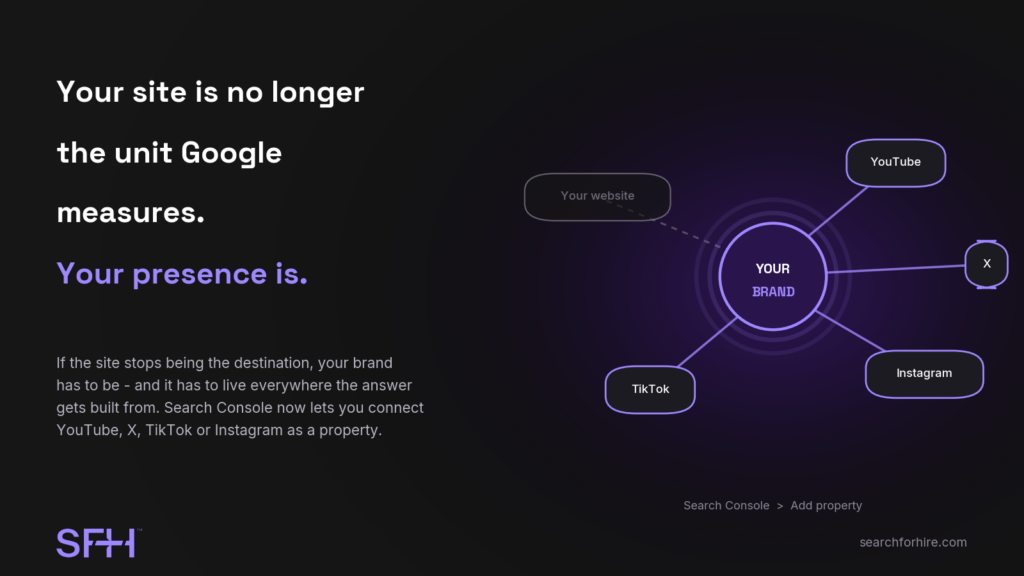
We’re seeing the same signal everywhere, including Reddit. The people and brands showing up on more than one platform are the ones getting recommended. That’s brand marketing.

Jules Davies
Founder at Scalerrs
“I personally think search is simply going to be a mixture of AI chat combined with links pointing you to YouTube videos, Reddit threads, and SEO landing pages which help the user confirm what they found. So we’re going to have more AI chat features present and usage will increase, but still sources pointing users to the source information initially scraped. And people will still be checking out those sources.”
This matches what we see in how people actually buy, and how they hire. The AI answer starts the journey, but nobody makes a decision that matters off a chat response alone. Clients still check out the agency’s YouTube, their Reddit mentions, their case studies, before they ever book a call. Same in hiring: a candidate gets surfaced, then everyone goes digging into their LinkedIn, their talks, their work. The confirmation click isn’t dying, it’s moving up the stakes ladder. The higher the stakes of the decision, the more the sources still matter.

Travis Tallent
Founder and CEO at Day Nova (ex MD of SEO at Brainlabs)
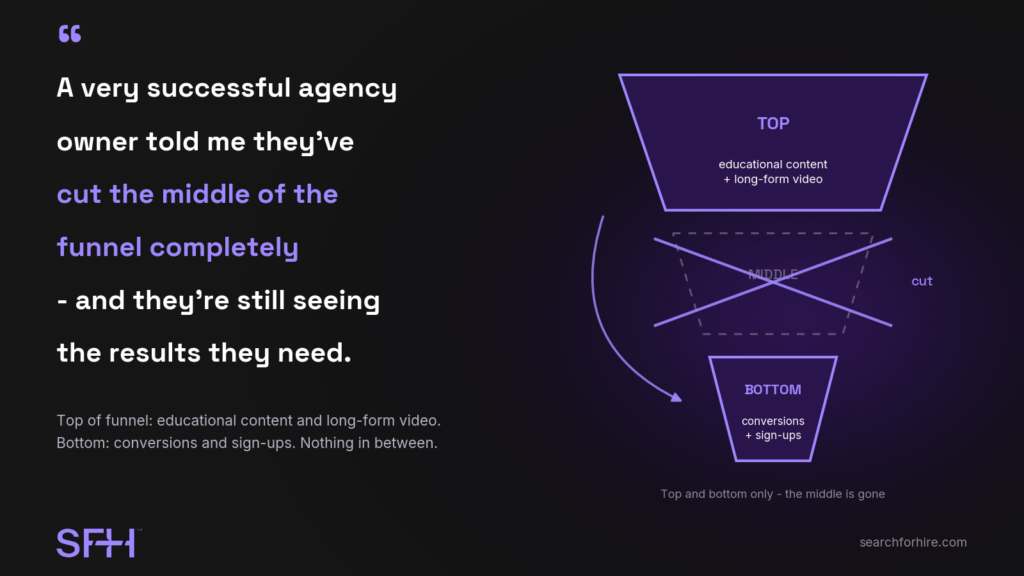
“Informational queries have already been absorbed by the platforms. Next, the transaction layer disappears into the platform. Google Flights and hotel booking were just the preview of this world. What gets swallowed is the middle of the funnel: comparison shopping, aggregator content, and anything that existed to help you decide. Focus on the brand before the search, structuring information for easy retrieval, and the service after the purchase. Those are the territories that remain strong, in my opinion.”
I had a call the other day with a very successful agency owner who told me they now focus only on the top and bottom of the funnel. Top means educational content and long-form video. Bottom means conversions and sign-ups. They said, word for word, the exact same thing Travis is saying: they’ve cut the middle of the funnel completely, and they’re still seeing the results they need.

Erika Varangouli
Head of SEO and AI Search at Riverside
“I see us moving from personalised search to contextualised search. We’re currently talking about search as fragmented into two layers: the shrinking ten-blue-links surface and a growing answer/agent layer (AI Overviews, AI Mode, ChatGPT, Gemini, Claude, agents and in-app assistants). Over time I expect contextual and agentic search to completely overtake the SERP layer, with the latter becoming mostly the backend mechanism feeding the user experience layer.
The 10 links as we know them will transform into a byproduct of the main search interface, only for users who want to collect sources to dive deeper, like someone visiting a library to research using original sources. Webmasters are already experiencing severe traffic loss; I only see this trend growing. Plus a need to start segmenting traffic into visitor types and observe behaviours: human users vs bots vs agents.
One caveat: the tech moves faster than user habits and enterprise buying cycles, so the behavioural shift may well lag the capability shift. I think this is already the case.”
I love what Erika says here, because we see it firsthand. We’ll jump on a call with an agency or company owner, do a deep dive into the business, the growth goals and the role, and they’re posting the same SEO Manager job description they used 18 months ago, expecting the same result. Our data shows the role has changed. After some advice from me and the team, that job description gets updated to match what’s actually going on. So I agree 100%: habits lag capability.
What do search marketers need to upskill on to stay ahead?
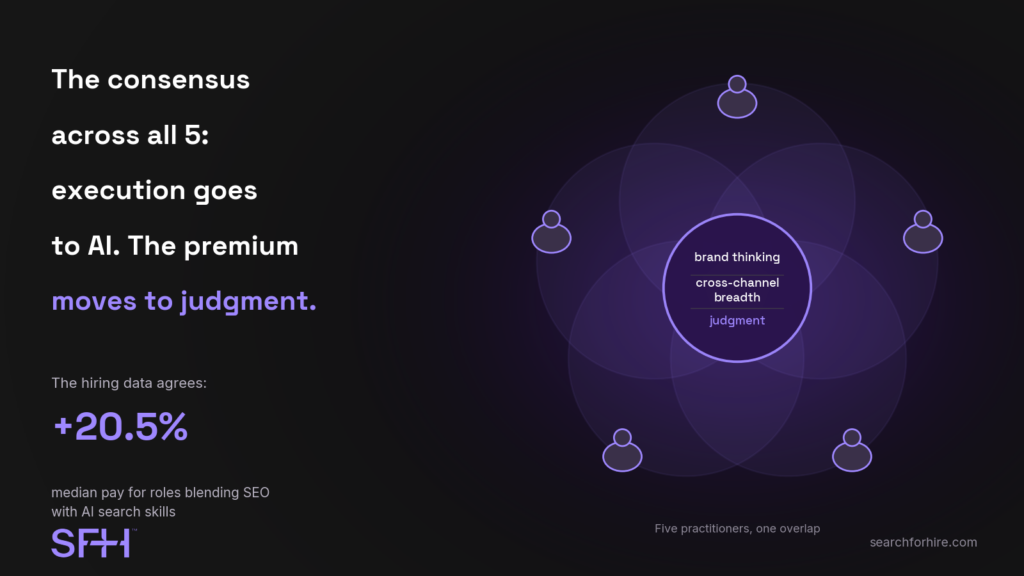
The consensus across all 5: pure execution skills are being absorbed by AI, so the premium moves to brand thinking, cross-channel breadth, and judgment. The hiring data agrees, roles blending SEO with AI search skills pay 20.5% more.
Andrew Holland
“The harsh reality is this is too much for many to handle. I see a lot in SEO being ousted. Sad but true. For those wanting to survive: learn brand marketing, learn content marketing, learn distribution, learn PR, or go so deep into AI you become insanely valuable.”
The ones grabbing this change by the horns are the ones staying ahead. They’re experimenting constantly, learning marketing as a whole, and understanding commercial outcomes and how a business actually works.
The ones who niched down too far and ignored the rest are the ones telling me they’re fed up and not excited. There’s still time, but it takes a radical shift in thinking, and it needs to start today.
JP Garbaccio
“Mindset flip. Stop obsessing over ranking a page, start thinking about whether you’re the thing the model reaches for when it builds the answer. One question fans out into 20 sub-queries, so it’s less ‘am I number one’ and more ‘how much of the answer am I in’. And the query’s going visual and spoken, so if you’re still thinking text-only you’re blind to half of it.”
I love this. It goes straight to “search everywhere”, the phrase Ashley Liddell coined that’s now going around for good reason. Show up on as many platforms as you can to educate the buyer about your product or service. YouTube is massive right now. I put together one video that outranks Semrush blog posts and comes up as the first video for its query on Google and in AI answers. That video isn’t ranking in the old sense, it’s being reached for when the answer gets built. That’s exactly the shift JP is talking about. And there’s so much low-hanging fruit on platforms like YouTube right now.
Jules Davies
“Search marketers need to be more intertwined with other departments. One that comes to mind is product marketing, as how the company is positioned in terms of USPs is largely going to dictate what type of content is put out there, and also what external people say about the company, which is then scraped by AI. This is why search marketers should be thinking about sentiment and understanding how to influence it through content marketing.”
Hiring managers say they want breadth, and now they’re finally paying for it. Two years ago every brief was a specialist brief. Now the roles blending SEO with AI search, content and product thinking are the ones carrying the premium. The data backs it: it’s the blended roles paying 20% more.
Travis Tallent
“Learning AI isn’t a differentiator anymore; it’s the table stakes to get into our industry. For those already in the industry, the real skill is knowing what to do with the time AI frees up: automate the task work, then reinvest that time in ways that show outsized marketing results and business impact.”
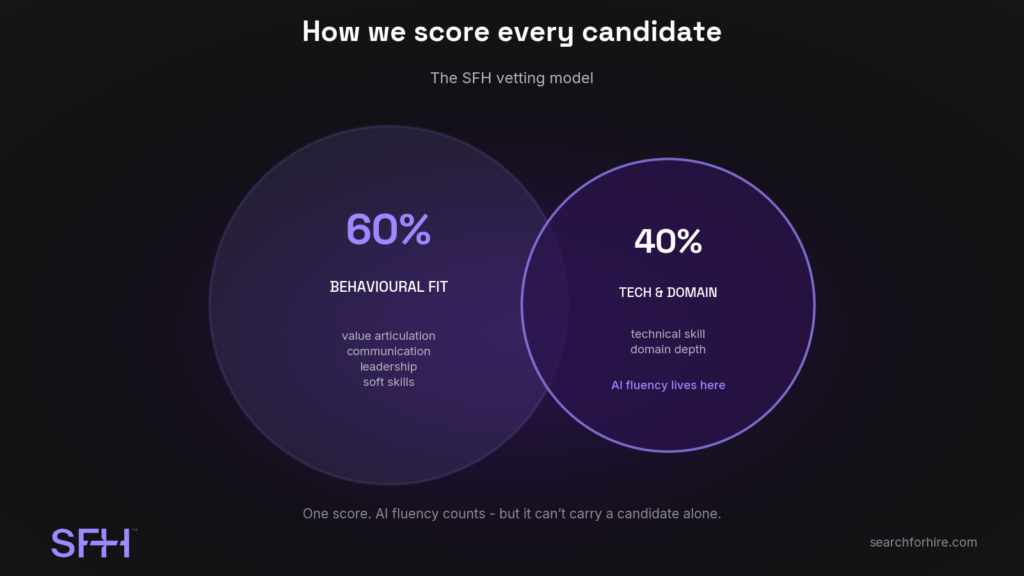
Absolutely. I have these conversations with hiring managers and company owners all the time. In fact, what Travis describes is now literally one of our interview questions: we ask candidates what they do with the time AI frees up. The answer tells you fast who’s reinvesting that time into bigger thinking and who’s just coasting on it. Our own vetting process scores candidates 60% on behavioural fit (value articulation, communication, leadership and other soft skills) and 40% on tech and domain, which is where AI fluency sits.
The funny thing is, this goes back to decades of hiring lessons from some of the greats. On recent discovery calls with some massive companies, the line is always a version of: “The hard skill, whether that’s technical SEO or product marketing, is not hard to find. What’s hard to find is someone who ticks all those boxes 10/10 and also has the behavioural engine that drives everything they do on the tech and domain side.”
Erika Varangouli
“Brand marketing over SEO. Retrievability and semantics over rankings and strict optimisation. If you’re a content or link specialist: learn technical SEO. If you’re a technical specialist: learn content and reputation. With AI and agents absorbing execution, and organisations cutting headcount, what makes you valuable is wider first-hand experience and deep understanding of how marketing systems work.
Last but definitely not least: judgment about what not to chase. Half the AEO advice out there is unverifiable. The skill is running controlled tests and killing tactics that don’t move anything, not adopting every new acronym.”
Everything going on right now is like being handed the keys to a Ferrari. Without judgment, expertise and an eye for detail, you can go very fast down the wrong road. With them, you go very fast down the right one. The way we vet for it is by putting people on the spot with live tests. One of our clients runs a final-stage interview where, if things are going too smoothly, they’ll deliberately throw the candidate under the bus: a live demonstration of a real problem the business is facing right now, to see how they think under pressure. Great judgment shows up fast in that room.
What should companies and agencies do to keep growing through this shift?
Three moves came up again and again: shift budget to brand and PR, start measuring AI visibility now while it’s cheap, and reprice agency services around outcomes instead of deliverables.
Andrew Holland
“You have to double or triple your PR budget. Budget feeds activity. Activity generates coverage. Coverage converts into brand visibility.”
JP Garbaccio
“Measure it, honestly. Most people have no clue if they’re even getting cited in AI answers, and you can’t grow what you can’t see. Cheap to start now, expensive in 18 months once everyone’s caught on. For agencies: AEO isn’t cheap SEO, it’s worth more, price it that way.”
Jules Davies
“Agencies should be aware of other service lines customers want which fit into AI search, and be looking to add them asap. The same way internal teams should be broadening their budgets for AEO, with affiliate marketing for example.”
Travis Tallent
“Invest in your people and provide them the resources to learn and grow with AI. It’s not enough to buy the licences and say ‘use AI’. It requires a clear AI vision of how you expect to double down on your people’s growth and grow your business.”
Erika Varangouli
“Diversify demand and revenue sources so no single channel’s collapse is fatal: brand, community, product-led loops, owned audiences. Invest in genuinely differentiated content (proprietary data, expert POV, original research) because that’s what survives when commodity content gets synthesised for free. For agencies specifically: shift pricing away from number of outputs or ‘we’ll get you traffic and rankings’ toward business outcomes and strategic advisory. The deliverables that justified retainers are eroding.”
All five are right. But the piece everyone nods at and then ignores is Travis’s: the people.
Here’s what acting on it actually looks like:
- Your interview process needs to have changed.
- You can’t use the same questions and assessments you used 24 months ago.
- You need to be constantly building a talent bench, and constantly improving your employer value proposition so the best of the best want to work with you.
As I said earlier, talent density is only getting stronger. The race to the top is on, the people at the top are pulling further and further ahead, and the gap between someone at the top and someone at the bottom is enormous. The companies winning right now are the ones going after them.
Where the experts and the market disagree
The experts lean apocalyptic; the hiring market is voting for evolution. SEO demand is flat, not collapsing, and the new AI search skills are being added to SEO jobs rather than replacing them: 96% of postings with AI search, GEO or AEO in the title still reference SEO in the role.
Companies have realised they can add a new service line for GEO, AEO and AI search, and get paid more for it. Often it starts with the CEO reading a post on X about how your business will die if you don’t show up in AI.
To scratch that itch, you need AI-fluent people who are the best at what they do. They don’t have the exact blueprint yet (nobody does), but they’ve been experimenting for years and comparing notes with others doing the same. Demand for those people is through the roof. That’s the 20% premium, and in my opinion it’s only going up.
So are employers smart money or slow money? Honestly, both. The trigger is often hype, but the hire is right. And that’s Erika’s lag playing out in real time: the capability shifted first, the job descriptions are catching up now, and the flat SEO demand tells you Andrew’s funeral is nowhere on the schedule. The market isn’t paying a 20% premium to bury search. It’s paying it to evolve it.
| Expert | Claim | Check-in in 12 Months |
|---|---|---|
| Andrew Holland | Search (keywords and SERPs) effectively dead within 2 years | SEO share of marketing job ads still 11-12%? |
| JP Garbaccio | AI visibility measurement cheap now, expensive in 18 months | Price of AI visibility tools/services, July 2027 |
| Jules Davies | AI chat grows but source-checking clicks persist | Referral traffic patterns to source sites |
| Travis Tallent | Transaction layer absorbed into platforms next | Share of purchases completed inside AI interfaces |
| Erika Varangouli | Agentic layer overtakes the SERP layer; behaviour lags capability | Agent/bot share of site traffic |
(We update this table every 12 months. Annual refresh = annual PR moment.)
What this means if you’re hiring (or being hired)
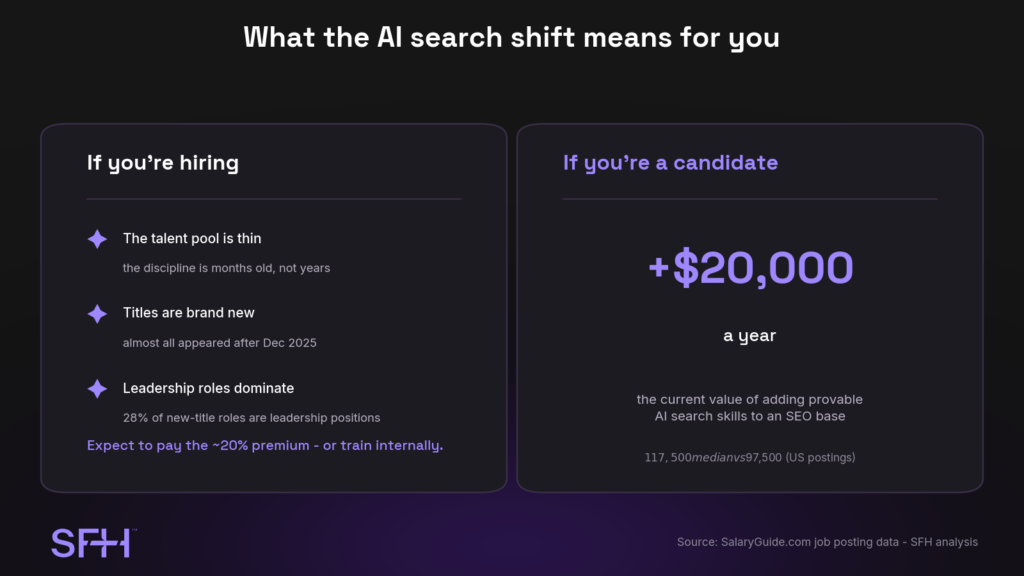
If you’re hiring: the AI search talent pool is thin, titles are brand new, and leadership-level roles dominate, so expect to pay the 20% premium or train internally. If you’re a candidate: adding provable AI search skills to an SEO base is currently worth around $20,000 a year.
To an agency owner writing their first AI search job description this month: sit down and build an outcome-focused scorecard first. Don’t put “AI search” in a job title just because you read something that sounded smart. Map out what this person’s outcomes look like at 3, 6 and 12 months. If experimentation is a big part of that, put it in (we have clients hiring a Head of Experimentation right now). Then reverse-engineer the job description from those outcomes, and research the salary properly. You can check that at salaryguide.com. I get absolutely militant about the hiring process, and this is why.
To an SEO 5 years in: make the shift in thinking. This is one of the most exciting times search has ever had. When everything evolves, there’s opportunity everywhere, and we see it from the hiring front: demand for the top 1% of search marketers who understand this is through the roof. Build your network in this space. Attend webinars. Watch as much YouTube as you can. Experiment on your own projects. And build the behavioural side too: value articulation, client communication, leadership. Then you’re off to the races
Methodology
Job posting data comes from Salary Guide‘s job board database: 328,650 marketing-classified postings from 632,840 total postings collected between July 2025 and June 2026. Postings scaled up significantly from December 2025, so trends are reported as shares of monthly postings, not raw counts; July-November 2025 figures are directional only. “GEO” was matched as the all-caps acronym in a search marketing context to exclude geo-targeting false positives (spot-checked manually). Salary analysis covers US postings with advertised annual salaries (13,779 postings, roughly 4 in 10 SEO postings list salary), using the midpoint of the advertised range and excluding outliers outside $20k-$500k.
FAQs
Frequently asked questions
Is SEO dying in 2026?
Hiring data says no. SEO appears in 11-12% of all marketing job postings every month, flat across the last year. What’s changing is the job itself: 1 in 5 SEO job ads now also asks for AI search, GEO or AEO skills.
What is GEO (generative engine optimisation)?
GEO is the practice of optimising content so AI systems (ChatGPT, Gemini, Claude, AI Overviews) retrieve and cite it when building answers. Mentions of GEO in marketing job descriptions more than doubled between December 2025 and June 2026.
How much more do AI search skills pay?
US SEO roles mentioning AI search skills carry a median advertised salary of $117,500 vs $97,500 for those without, a 20.5% premium.
What should SEOs learn in 2026?
Our 5 experts converge on: brand marketing, PR and distribution, retrievability over rankings, cross-channel breadth, and the judgment to test and kill tactics rather than chase acronyms.