
AGENCY GROWTH CLUB
Charlie Clark (Minty Digital ) on Growing an Agency Beyond “SEO”
Guest: Charlie Clark
Guest: Charlie Clark
Charlie Clark, Founder of Minty Digital, had one of the agency’s strongest H1 periods after stepping away from the pressure to post constantly on social media. The change was not a retreat from marketing.
It was a reallocation of attention: more time on speaking events, better operating processes, clearer ownership across the team, a rewritten founder role, and a client-informed “organic growth” offer that brings SEO, content, PR, and AI visibility together. He also explains why GEO needs honest caveats, why small agencies can move faster than larger rivals, and why sales should never switch off just because a waitlist has appeared.
The chapter labels and timestamps below are taken from the official YouTube chapter list and cross-checked against the supplied transcript.
Charlie’s social-media break began in November while he was in Thailand with a friend who lived, in Charlie’s words, almost completely analog. He removed LinkedIn and Instagram, along with other social apps, from his phone. The trigger was not a rejection of marketing. He was tired of feeling obligated to post, of seeing feeds and comments that looked machine-written, and of continuously absorbing other people’s views on what he should do next.
The result was more time and headspace. Charlie still accessed social on his laptop, and he later returned to the occasional post, but he stopped treating daily activity as a requirement. He directed the regained attention into the business: speaking events, operational improvements, work with the team, and service development. He says Minty’s H1 results in client retention, profitability, and revenue were its strongest, following a tougher period a couple of years earlier.
“I’m just trying to be a bit more intentional rather than saying … I need to post every day to make an impact.” — Charlie Clark
The useful distinction is between visibility and compulsion. LinkedIn can be a valuable channel, but it should not displace the operating, client, and business-development work that makes the content credible in the first place.
Charlie says Minty’s most important improvement was not adding another founder initiative. It was strengthening the team’s ownership. He deliberately removed himself from decisions he could not give full energy to, including hiring, and placed them with responsible leaders. The team improved client-retention methods, developed progression packs, and worked to deliver the benefits that had been promised internally.
That decision created a new problem: after removing himself from so many tasks, Charlie needed to define what his role actually was. He wrote a job description for himself using the same process Minty would use for a hire. The resulting brief has three central areas: new business and partnerships; high-level work with strategically important retainers; and top-level strategic input across the agency’s search and advertising services.
Actionable advice: Removing a founder from a task is not delegation unless a capable owner has the mandate, information, and accountability to take it. Once that transfer is made, rewrite the founder role explicitly. Otherwise, the founder often drifts back into the work that was supposedly delegated.
Charlie spent less time debating whether the industry should call emerging search work GEO, AEO, AI search, or something else. Instead, he says Minty spoke to customers about what they were actually trying to achieve. The response was a reframed offer: content, LLM visibility, SEO, and PR are now brought together as an organic growth service. In prospect conversations, Minty has begun moving away from the word “SEO” as the headline label.
The repositioning reflects the kind of buyer conversations Charlie was having after moving from Barcelona back to London. He values the broader contact with operators outside the SEO and technology bubble: people who care about a business problem, a customer, a lead, or a revenue outcome before they care about a category label. Speaking at legal and healthcare events reinforced the same point; an industry audience often has a different relationship with search than an SEO-conference audience.
This is not an argument that SEO no longer matters. Charlie says the foundations still matter deeply. The commercial change is that Minty is packaging those foundations with adjacent capabilities in a way its buyers can connect to an organic-growth outcome.
Charlie says Minty previously experienced the pain of losing a “whale” client while the agency was smaller. It changed the company’s preferred model. Although Minty still works with some high-ticket accounts, Charlie says the agency wants a broader, mid-tier-weighted client base so that one customer is not responsible for around 40% of revenue and the associated pressure that comes with it.
That is not a published industry concentration standard. It is Charlie’s own guardrail, shaped by a difficult experience. His pricing view is consistent with the same long-term approach: prices should rise gradually in line with costs and market conditions, rather than jumping sharply just because demand is currently high. Overpricing, he argues, can simply create a reason for clients to seek a better deal.
“The worst time to be looking for more business [is] when you really need more business.” — Charlie Clark
Actionable advice: Track revenue concentration before it becomes an emergency. A client may be commercially attractive and still create a risk that deserves a contingency plan. Build a repeatable sales and marketing rhythm when the company is healthy, not only after a major account becomes uncertain.
Charlie’s “5,000 GEO agencies” phrase is deliberate exaggeration, not a data point. His message is that clients and CEOs are receiving a constant flow of AI-visibility pitches. Whether those pitches are technically sound is not the only issue; they introduce an alternative narrative into the client relationship. An incumbent agency that replies only, “this is how we have always done SEO,” risks looking out of touch.
Minty’s response is neither to dismiss AI visibility nor to make promises it cannot support. Charlie views GEO as an evolution that depends on SEO foundations. Minty tells clients that it is investing in relevant visibility tools, learning alongside them, and aiming to build discoverability while continuing to focus on the organic-search work that produces established revenue and leads.
The service has commercial implications. Minty offers a tiered model that can add outreach and AI-visibility work to foundational work. Charlie says this layer requires additional tools and effort, so it carries a different price and deliverable scope. Clients can decline it, but Minty is clear about what that changes in the work.
Charlie is direct about the current attribution gap. In his view, no tool can accurately show AI-search conversions or sales in the way clients may want. Minty therefore uses share of voice versus competitors as a baseline discoverability measure, borrowing a familiar approach from PR rather than presenting it as a direct ROI calculation.
To make the tracking more relevant, the team starts with an ideal customer profile, or several ICPs, then uses them to develop the kinds of prompts worth monitoring. The results are cross-referenced with SEO data. Charlie repeatedly caveats the output: AI answers can vary by user and context; the tools provide a baseline, not a promise; and a shared view of the limitations is preferable to a false precision claim.
“We’re just looking for a baseline here—baseline share of voice versus competitors.” — Charlie Clark
Actionable advice: Present AI visibility as an evolving measurement system. Set the scope before the work begins: what prompts are being monitored, which competitors matter, what signal the metric provides, and what it cannot prove about causality or revenue.
Charlie’s view of AI-search tools and high valuations is pragmatic. He does not say the current environment is identical to the dot-com boom, but he sees a comparable question around where the durable value will sit: in underlying infrastructure and data, or in application layers that a motivated operator may be able to reproduce quickly.
His practical example is a social-listening tool that Minty had been paying more than £10,000 a year to use. Charlie says he recreated the relevant functionality with Lovable and a few APIs while travelling to the airport. The point is not that every SaaS tool is dispensable or that no-code builds are risk-free. It is that smaller agencies can test, prototype, and adjust their operating stack quickly because fewer approval layers separate an idea from execution.
That agility becomes valuable only when it is passed into the client experience: lower unnecessary cost, faster learning, and better service delivery. For Charlie, the opportunity is not simply to celebrate a lean internal tool stack; it is to convert speed into better value for the customer.
AI fluency is now non-negotiable for Minty’s hiring process, but Charlie says the more important filter is critical thinking grounded in fundamentals. He is looking for people who understand the practical work and can face clients, not people who have only learned to operate a new interface or repeat fashionable language.
That shifts the ideal role from a narrowly defined technical SEO, link-building, or digital-PR specialist toward an organic search strategist. Charlie does not call the role a generalist position; he sees it as specialist work with a broader remit than it carried five years ago. At a larger company, a highly dedicated technical team may still be appropriate. At Minty, the agency values people who can cover more of the connected service efficiently.
Charlie says he is far less involved in hiring than he used to be, entering only at the final interview and offer stage. That is a response to past habits of hiring people too quickly after meeting them or relying too heavily on instinct. At Minty’s current stage, a wrong hire has implications beyond salary: the person must support clients and collaborate effectively with the wider team.
The process begins with a shortlist from a large applicant pool. Candidates complete a one-way video interview with five or six questions, which allows the team to observe reliability, preparation, communication, and fit before committing to a long live interview. The field narrows further through follow-up conversations and a paid task before Charlie becomes involved in the final decision. The target process takes around three to four weeks.
Actionable advice: Design each hiring stage to answer a distinct question. A CV can establish relevance; an asynchronous response can test preparation and communication; a paid task can test work; and final conversations can explore team fit and expectations. Avoid using a long first interview to discover information that a lighter stage could have revealed earlier.
Charlie says Minty has gradually expanded its US client base through a compound of work rather than one channel. US Search Awards wins helped create marketing material; webinars increased visibility; organic growth and industry partnerships developed over time; current clients made referrals; and case studies made the work easier to communicate. Charlie says the agency has not yet relied on a US office or even his own physical visit to the market.
He describes the US client base as growing each month, with particular concentrations in Texas, Florida, and New York at the time of recording. The emphasis remains on doing good work and letting proof compound, while considering more on-the-ground event activity in future.
Charlie’s view is that search is becoming more interconnected across Google, Bing, LLMs, social platforms, and other discovery channels. He thinks Google will remain significant and may regain more share, while agencies and brands need to consider more than a single channel. He does not claim to have a precise market forecast. His practical concern is planning: current tools do not yet bring these different discovery environments together in a way that supports confident forecasting and strategy design.
On Minty’s own future, Charlie says he enjoys the current balance of work, clients, and team. The agency has had acquisition conversations and has been built to be capable of operating beyond him, but he is not actively pursuing a sale. His view is open rather than committed: if an appropriate conversation arrived, he would consider it, but he also believes Minty can grow materially further in the next few years.
Charlie’s answer is not branding, a logo, or a polished website. He would focus first on sales: talk to people, bootstrap, build demand, and keep marketing and sales active even when the business is performing well. In his view, an agency that stops selling when the pipeline is healthy is taking the greatest risk at precisely the moment it feels safest.
Minty’s current sales process is designed to reduce founder bottlenecks without pretending that complex search services are simple to sell. A salesperson primarily qualifies leads and helps develop a clear brief with a head of department. The service expert joins the client conversation early, contributes to the proposal, and remains involved after close. Charlie prefers this model to the classic handoff where a salesperson vanishes and a client meets an account manager for the first time after signing.
“Selling search is a consultative sale. It’s not like selling double-glazed windows.” — Charlie Clark
The transition still requires patience. Charlie says a sales hire will not close as effectively as a founder from day one, especially in a nuanced category. The answer is more qualified leads, call shadowing, service immersion, recorded-call learning, and expert participation—not expecting one new salesperson to replicate years of founder experience immediately.
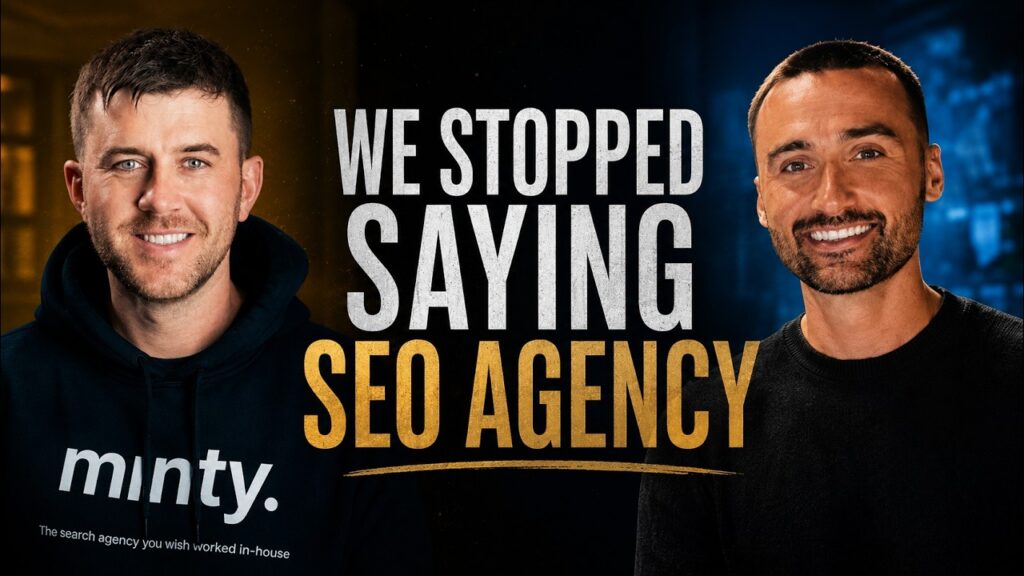
Charlie Clark is the Founder of Minty Digital. In this episode, he discusses Minty’s strongest H1 performance, a more intentional approach to social media, its organic-growth-service positioning, AI visibility, hiring, and sales-process changes.
Charlie says the work is part of a tiered offering: foundational work can be supplemented with outreach and AI-visibility layers. Because this involves more tools, work, and cost, it changes the price and deliverables. The exact offer is specific to Minty’s model.
It is an internal concentration guardrail, formed after Minty lost a whale client while smaller. Charlie says he wants a model where around 40% of revenue is not reliant on one client. It is his own operating target, not a universal industry standard.
Minty uses share of voice versus competitors as a baseline discoverability signal, builds ICP-led prompts to track, and cross-references the findings with SEO data. Charlie cautions that the tools do not currently establish precise AI-search ROI, conversions, or sales attribution.
Minty uses shortlisting, one-way video interviews, follow-up interviews, a paid task, and a final founder-stage decision. Charlie says the target process is three to four weeks, with AI fluency, critical thinking, fundamentals, client ability, and reliability all considered.
He would focus on sales. His advice is to build the client-acquisition engine from day one and keep it running even when the business is busy, so the agency is not forced into desperate decisions when demand slows.
Charlie says Minty listened to clients and found they wanted an outcome that combines content, SEO, PR, and LLM/AI visibility. The agency has therefore packaged the work as an organic growth service, while retaining SEO foundations as a central part of delivery.


With 95% of roles filled within 25 days, our approach is built for pace and backed by a 1 year guarantee. Get access to the systems and frameworks that power elite SFH teams.