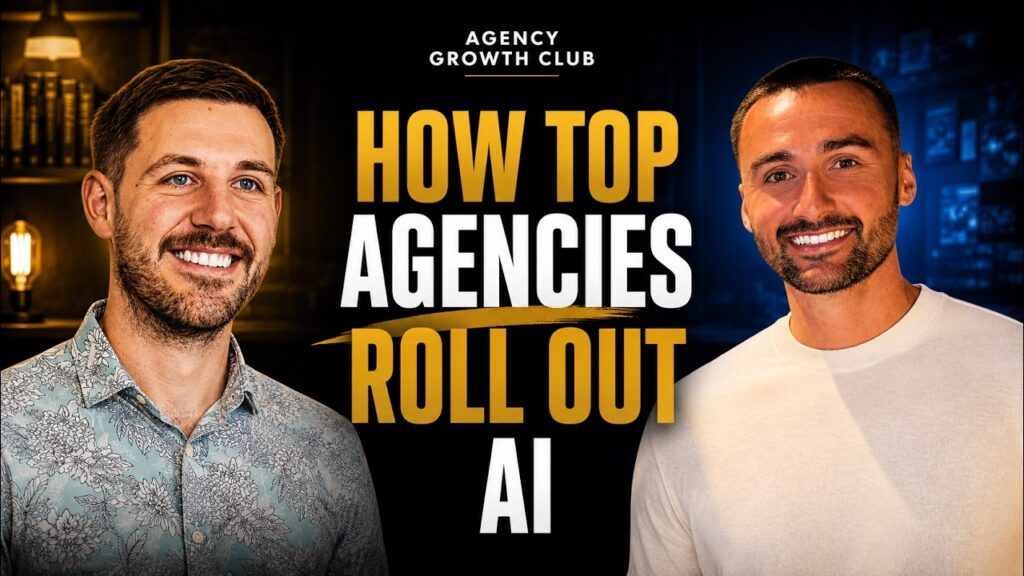
Guest: Travis Tallent
Travis rolled AI out to a 90-person team under a simple directive: “get everyone to use AI.”
No training, no context, no room for questions. It backfired, and people felt threatened rather than enabled.
He’s since founded DayNova AI, an AI strategy and implementation agency, and this episode is the debrief: why an “AI mandate” fails and an “AI vision” works, the neuroscience behind why people resist change (VUCA), how to gamify AI adoption without punishing people who are already underwater, and where he sees search budgets, Google, AI pricing, and AI valuations heading through 2026.
When Travis led AI rollout across a 90-person team at Brain Labs, the directive from leadership was blunt: get everyone using AI. No training. No explanation of why. No space for people to ask how it actually applied to their day-to-day work.
The result wasn’t adoption — it was fear. People didn’t know what the technology meant for their role, and the ambiguity did more damage than the tool itself ever could.
Travis’s alternative is what he calls an AI vision: a clear, honest statement to the team that acknowledges the tools are still evolving, but is specific about two things, where humans should keep investing their time (strategy, relationships, polish), and where agents should absorb the repetitive work (internal linking, content briefs, first-pass research).
The vision gives people a map instead of an ultimatum.
Travis’s co-founder at DayNova AI is a neuroscientist, and the framework underpinning the company’s change-management approach is VUCA (volatility, uncertainty, complexity, and ambiguity) a model that predates AI by decades but explains the current moment precisely.
Any sufficiently large change is a threat to the brain. AI arrives with unusually heavy volatility (tools change weekly), uncertainty (what does this mean for my job), complexity, and ambiguity, and most leadership messaging removes none of it. Travis’s read: a lot of the people currently job-hunting aren’t leaving over AI itself, they’re leaving because leadership isn’t listening to how they’re experiencing the rollout.
The fix sits with leadership: name the VUCA directly, and be specific about what the technology does and doesn’t change for each role.
Josh and Travis both see gamification working as an adoption lever: leaderboards, incentives, friendly competition.
But Travis flags an important caveat: it only works for people who have spare capacity to learn.
For someone already stretched thin on delivery, a game doesn’t motivate, it adds another task on top of an already full plate, often pushing the actual learning into after-hours work with worse outputs to show for it. His fix is to run a quick capacity and sentiment assessment first: does this person feel threatened or excited by AI, and do they have room to grow into it right now?
Gamify for the ones who do; give the rest space before adding pressure.
For marketers: stop treating every task as a one-off.
Map any repeatable process, internal linking, metadata, content briefs, start to finish, and turn it into a reusable system inside whatever tool is being used (skills in Claude, markdown files in ChatGPT). The system, not the individual prompt, is the asset.
For agency owners: scheduled automation aimed at cognitive load, not output.
Travis runs an “inbox sweep” three times a day (8am, 2pm, 5pm) that triages email and Slack and hands him a brief of what actually needs a response, removing the need to manually process every message as it lands.
A recurring theme: AI systems are probabilistic and carry a built-in “yes bias”, they tend to agree with and validate the input they’re given. Understanding that alone builds healthy skepticism into how outputs get used.
The practical implication is architectural. Anything involving pulling or structuring data, pipelines, data warehouses, should stay deterministic.
AI belongs at the insight layer on top of clean, structured data, not as a substitute for the pipeline itself. Treated this way, AI amplifies a process instead of introducing noise into it.
Travis expects search budgets to increase, across both paid and organic.
On the paid side, an expansion of paid placements within Google means brands need to spend more to hold the same position. On the organic side, the job has expanded well beyond a brand’s own website, visibility now spans Reddit, TikTok, Amazon, and YouTube, and each additional surface requires additional budget and, often, a different internal owner (YouTube budget, for instance, often still sits with a video/creative team rather than search).
Travis isn’t predicting business categories disappearing outright, with one caveat: he sees affiliate sites in a genuinely difficult position. For brands that sell products or services directly, his view is that the fundamentals hold, but the shape of the journey changes.
Google and ChatGPT are both pushing to keep the comparison and transaction layer inside their own platforms. That means traffic to a brand’s website can fall while revenue holds steady or grows, depending on how well the brand is positioned to be surfaced and chosen inside those platforms rather than clicked through to.
Travis expects Google to keep expanding AI Mode as a default experience, tested and refined query by query, landing on a split between searches that genuinely benefit from an AI-generated answer and the simpler, navigational searches (a specific website, a known destination) where an AI overview just adds friction.
Travis’s take: AI pricing goes down from here, not up. His reasoning:
His broader point for non-tech businesses specifically: the AI-cost horror stories in the press (companies burning through massive token budgets) are almost always developer-heavy, tech-first companies. For most businesses, even heavy AI automation typically costs less than hiring one additional person.
Travis’s first, immediate recommendation for anyone using AI tools, personally or at a company: go into settings and turn off model training.
It’s a single toggle, and it stops inputs, resumes, client data, internal documents, from being used to train the underlying model.
Beyond that, he flags two structural risks worth building around:
Speaking as an interested observer rather than a valuations expert, Travis expects some currently overvalued AI companies to fail, and draws the dot-com parallel directly: plenty of companies went bust in that bubble, and internet usage kept climbing regardless.
His expectation is the same pattern repeats, some businesses fail, the underlying technology doesn’t go anywhere, and adoption keeps compounding over the next five to ten years.
Travis is direct on this: AI is table stakes now, the differentiator is communication and influence.
Being able to explain and defend why a campaign is or isn’t working is, in his and Josh’s shared experience across client conversations, one of the most common reasons a technically strong marketer loses an account.
The campaign performs, but the client doesn’t understand why, and the relationship erodes anyway.
Josh ties this back to retention economics directly: Search for Hire’s upcoming team benchmarking tool on Salary Guide is built to flag exactly this kind of risk before it becomes a resignation, surfacing when someone’s tenure and pay are drifting from market data, so a conversation happens before a departure does.
The data point behind the urgency: retaining someone costs, on average, roughly 6.5x less than replacing them.
Struggling to hire or retain SEO and Paid Media talent while your team works through its own AI rollout?
That’s what Search for Hire does. Book a call with the team.
For the full episode with Travis and Josh, find the link below:
Create instead of an AI mandate, create an AI vision. Any change can be a threat to the human brain. A change as large and existential with as much bad press as AI is a huge threat to the human brain. There’s a lot of people looking for new employment right now. And I think it’s because they feel like their leadership is not listening to them when it comes to AI adoption. AI is the table stakes. I think the differentiator now is communication and influence.
Thank you so much for coming on the agency growth club. I’ve been lucky enough to — I’ve had a few calls with you where you’ve given me some great advice. We met in Bonos areas when you were down training the brain labs team. So always a pleasure to chat today. We’re obviously going to talk about — you’ve started Day Nova AI. So you’ve gone all in by yourself which I want to unpack — everything to do with AI, enterprise AI, the way that you guys have set up everything. So first of all, thank you so much for coming on.
Absolutely. Thanks for having me, Josh. I always love our conversations and I’m very grateful to be here.
Awesome. First question, Travis, I want to go straight in, right? Low-hanging fruit that a marketer is not doing today. What AI use case can they add into their books?
Yeah. Number one, I would say using skills and creating repeatable systems. So for a marketer, if you are doing a lot of internal linking or a lot of metadata, really think about what is your process start to finish — and maybe that varies a little bit by client, that’s okay, think about it client by client or brand by brand — but think about that system and then integrate that system into whatever AI tool you’re using. So like Claude skills, if you’re using ChatGPT use markdown files, so on and so forth. All of these things are pretty portable these days.
You’ll be proud to know then that I use my podcast interview question skill to help me with a few questions today.
Ah yeah, yeah, yeah. I’m very, very proud. I like doing my own research first but I also like just saying okay this is a great question, I wouldn’t have thought about that.
Awesome. And then, okay, let’s do flip side of that exact same thing. What’s the best AI use case that an agency owner can take away today?
Yeah, one of the things I’ve really enjoyed setting up is scheduled automations. So I have this one called inbox sweep. It happens at 8am, at 2pm, and at 5pm every single day. Sweeps my inbox, sweeps my Slack messages, gives me a quick brief on here’s what’s new, here’s what I need to respond to, and triages what I need to focus on. And to me, as someone who is in a lot of meetings, has to switch context a lot in my role, it’s those types of things that really help alleviate the cognitive load of “okay, I need to go through every single email, I need to go through every single Slack.” So yeah, that to me is super impactful.
Awesome. Do you use Obsidian to store everything?
I really like Obsidian on a personal level. It is not great on a team-wide or company-wide level because it doesn’t have permissions. You can go through fancy technical setups with your IT team to have it add permissions, but at that point you’re better off just using a system like GitHub and a super good folder structure. So that’s what we’ve opted for for Day Nova. That said, there are a ton of other tools out there — you could use Notion or Google Drive, any of that stuff.
Yeah, I feel like a lot of my friends are using Notion. I love — I use Obsidian for personal stuff, but I just love when you zoom out and it just looks like that big brain.
I know, yeah dude, they have captured the market with that. It’s like all over my threads and Twitter feed.
Yeah, it looks so much smarter when I show people this — they’re like “oh my goodness, that looks insane.” I’m like, “yeah, it’s not actually that complicated.” But yeah, so Travis, you rolled out I think it was Claude and Gemini to a 90-person team at Brain Labs, right? Knowing what you know today, how would you have done that differently?
Ooh, good question. So this was very much my motivation for going all-in on AI, and I learned a lot of things of what not to do through that process. One of the major things that I learned not to do is the directive that I had from leadership is “get everyone to use AI.” That’s it. And there was no training, there was no motivation beyond that of — it was basically use AI or perish. And that is a horrible framing to give a team, and in my role I tried to move quickly, I wanted to be first to have my team roll this out successfully and all of that, and I was just kind of mimicking whatever I was told from leadership. And I quickly learned — oh, that scares the crap out of people and really makes them feel uneasy around “what is the role of AI.” And then they’re also left with the questions of “legitimately, how do I use this new tool that literally is changing by the week” — like, I feel like anytime I open up Claude it’s like “relaunch the app, relaunch the app.”
And a much better way to do that, I know now, is to create instead of an AI mandate, create an AI vision. Be really clear with the team that we don’t know everything about AI, these systems are changing very quickly. That said, there are some really powerful use cases — let’s figure those out together. And I am communicating in my vision what I want people and humans to invest their time on, and what I want us to invest time in building out agents and systems to help alleviate the grunt work. Right? So as an SEO leader, that could be “I want you all to invest time in strategy and human relationships and making sure that every presentation is really, really polished and really great.” And then on the agent side, “I want you to use agents for grunt work like internal linking or content briefs, and so on and so forth” — and let’s do that in a really smart way so it’s still high quality work. But having that clear vision is a much better way to roll it out to the team.
The other learning I had going through that process is not everyone is going to be a champion, and that’s okay. I think naturally some people are going to be more reserved when faced with a new tool or new technology. And it’s important to double down on those champions, but also give those champions guardrails — because what I ended up seeing is champions basically recreating the same thing ten times, and that’s a waste of everyone’s time. So let’s be really specific around — okay, for you I want you to build an internal linking agent, for you I want you focused on a content brief agent, for you I want you focused on an outbound PR agent, right? That way there is a coordinated effort around what everyone is responsible for and working on. So those were the two big learnings — those are the things that we integrate in any Day Nova engagement these days as well.
I love that. One pattern that I’ve noticed from interviewing extremely smart, successful agency owners is when they’re trying to encourage their team to do things instead of just making it a mandate — right, “we have to use AI now” — they try and gamify it. I had a similar thing — I had Jonathan Dane, founder at Client Boost, on the podcast a few months ago, and his whole thing is that his team, they’re building their personal brands, they’re all posting on socials, but they’ve got actual KPIs on it. It’s not just posting for the fun of it, but every single month it was — I can’t remember what it was, it was a bonus, but it was also like a fun thing and they made it into a leaderboard. And if you go on — I don’t know if you’ve seen it, but you see Client Boost with the little blue background, you see all of his team posting all the time. And the more agency owners I speak to, it’s like “yeah, we try and gamify the use of AI.” Everybody, all the marketers, know that it’s not just a nice-to-have anymore, it’s a necessity — you need to be using AI. But if you can gamify it, I feel like that’s the unlock, and I’ve tried to do that with my own team as well and seen success with it. Have you got any experience with any of that?
Yes, absolutely. So I also think gamification can be really powerful. I think, depending on the team appetite and where they’re at, sometimes it makes sense to do an invite-only game, or someone has to apply to be a part of the game. And the reason why I say that is so many teams and team members are strapped for time, that legitimately learning a new system — and I want to be very clear, AI has a learning curve, and I cannot stand that all of the leaders in this space think it’s as easy as just talking to it and you’ll figure it out. I think if you give it enough time that’s true, but I’m talking years — the learning curve here is quite steep, and there’s some really easy things you could do to skip ahead. So for someone who’s strapped and struggling to just get the work done day to day, that is not a person who’s going to be motivated by a game. And for them it actually could lead to worse outcomes, because instead of spending their time doing their work, they’re spending their time on this technology that’s not giving them better outputs, and it’s actually forcing them to do work after hours, all of that. So it depends. That’s why I’m a big fan of, in any new engagement, as a leader it’s really important to roll out an assessment — understand where people’s heads are at with AI. Do they feel threatened by it? Are they excited by it? Understand their capacity — are they already underwater? And if so, you need to find a way to give them room to grow and learn with AI. So yeah, I’m a big fan of the games, but with caveats.
So Travis, you mentioned there some people just thinking AI is very easy to use, right, and I’m sure you’ve come into this — I see it quite a lot, people pick up AI, they don’t actually use their own taste and curation and their own judgment to build it out, so again we just see all this AI slop all over LinkedIn, or we see the same kind of image carousels, and everybody thinks that they’re doing themselves a favor by getting it out but they’re actually doing themselves more harm — those agency owners, normally in the older age bracket, what kind of advice would you give to them?
I would say number one, really spend time learning about the systems. These are probabilistic systems. They are also built to have a yes bias — there’s a lot of bias in AI output. And when you understand those two things alone, I think it gives you a natural level of skepticism on whatever the output is, so then you can iterate, build on top of that, create better prompts, skills, foundations, etc. — so then you get better outputs. Number two, don’t try to use these systems in a deterministic way. A lot of automations are better spent where AI is only one small part of that entire automation — so if you’re pulling data from different data sources, make sure that that is done in a deterministic way, like being pulled into a data warehouse, etc., analyzed in a deterministic way, and then if you want insights that would ultimately be probabilistic at that point. So just make sure that you’re using the tools in the right way. And then last but not least, be really clear about what makes your process special and unique, and double down and build that into the system. These systems are going to naturally have their own ideas on how outreach should be done or how internal linking should be done, and you can trust it, but again it’ll have that yes bias — it’s not going to be unique, it’s going to be very diluted and similar output as everyone else. So really double down on your process, what makes it unique, and spend time and effort building that.
Absolutely. So Travis, you’ve been involved and worked with some of the biggest companies and brands out there, hundreds of millions plus — where do you see the budget for search going in 2026?
Do you mean paid search or SEO?
All of it.
Good question. I think that search budget is going to go up. And here’s why — there is an expansion of paid search placements within Google, and I think naturally, in order to achieve the same outcomes, you will need to invest more on the paid search side. On the SEO side, it’s getting way more complicated — so you basically went from two decades where you could focus largely on your website and your website’s SEO and you could see results, and this day and age you need folks on your website, on Reddit, on TikTok, on Amazon, on YouTube, and so on and so forth. And that in and of itself requires bigger budgets to have a larger footprint on the internet. I do think it will get muddy — I think, you know, typically YouTube budget sits with the video or creative team, and now today that should be paired with the search budget. But all in all, I think the brands that are going to win are the brands that really double down on focusing on search-first marketing.
Okay, awesome. And I asked you — I’m putting together a piece, I asked you three questions, right — one of them was on the future of AI search, and you said that the transaction layer disappears into the platforms next, and what gets swallowed is the middle of the funnel. So I want to know, what category of business dies first, and how long have they got?
I want to be clear, I’m not a search doomsdayer. I don’t necessarily think categories of businesses will die — although I think affiliate sites are in a rough position right now. I think that any brand that actually sells things, products, services, will be fine. But I think we need to shift away from the world of “people search for something, they click on a website, so you get traffic, then they convert.” It’s going to become a lot muddier. Google and ChatGPT are really pushing hard to move the transactions into their own platform, and as a business that means that traffic goes down but transactions and revenue can be stable or go up, depending on how you play your cards. So that’s what I mean, that middle layer disappears. I don’t think people are going to websites to compare products two years, three years from now. I think they’re using tools like ChatGPT or even Google Search to compare products directly in the platform.
Okay, you mentioned Google Search — what do you think Google Search is going to look like in two years time?
It’s going to be much more in-platform. I think we’re already seeing this — they’re slowly rolling out AI Mode to be the default engine, and in some searches I really like it personally, and in other searches I think it’s really annoying. You know, I don’t need an AI overview for a website that I’m just trying to click, right — I don’t need to know when that company was founded, I just want to go to that website. So I think Google will continue testing that at scale, and then we’ll really zero in on which queries require AI Mode and which queries are the more traditional Google route.
So if we go back a year to basically the “search everywhere” method, right, being on all kinds of different search platforms — so you’ve recently gone on yourself, you’ve done Day Nova, I think you’re about a month and a half in, so first of all massive congrats on the launch, you’ve also signed quite a big client, that we hopefully will break through how you got them and that strategy — but taking that search everywhere method, have you applied that to Day Nova?
You know what’s funny is, when you’re starting a business there’s so much to do — I mean, you know firsthand, right — and taking anything from zero to one, you really have to make a lot of judgment calls of “here is where I’m spending my time, my money, my resources.” So in a sense of — is that the eventual strategy I would love to take with Day Nova? Absolutely. Is that the strategy I’m doubling down on a month and a half in? No. I’m going after much more mid- to lower-funnel strategies as of now, because the reality is if my calendar fills up with, let’s say, a hundred discovery calls, I’m not going to have any time to do anything else. So it’s a stairstep approach, and I think part of being a leader and a good marketer is knowing when to use which strategy as your business develops and your marketing matures.
So before we started here, I told you that that client that you signed, right, would normally take somebody like a year plus — you were kind of like, “yeah, but I thought it would take a lot faster and I want more,” which is like a month and a half in is crazy. So I want to break down, Travis, from your side, first of all, because to a lot of people that’s like a dream number — that’s like “right, I’m going to start my business, that’s what I want in maybe my first year,” right, you got it in the first month and a half. How did that client come in — was it through one of — I see you’re doing webinars, was it through any of them?
It was a relationship, and you know, to me that’s really where I’m doubling down right now — I’ve set up automations on LinkedIn where I’m sending people the webinars and the diagnostic tools, things that I find really useful, and in my role managing 90 people I would have loved to have resources like that so then I could learn from it. So all of my outreach is always meant to be very educational and helpful, at the end of the day — I can’t stand outreach that’s like “let me pitch you.” And I have had pretty good response from that — some not so great responses, I think in general some people just don’t like to be bothered — but that has worked for me really well and has certainly given us a pipeline. The other thing that I’ve really doubled down on is building adjacent relationships with businesses who are in the same field but not doing what Day Nova does, or what our mission is. So for example, I’m an AI educator at a company called Chatwalrus, which does AI trainings — fantastic company, they have over 120 clients, mostly in the retail or e-commerce vertical, and I educate these folks on how to use Claude, how to use Gemini, very in-the-weeds tactical trainings — and that’s where Chatwalrus wants to play, they don’t want to play in the strategy piece, they don’t want to play in the building AI automations piece, which is great, so we end up working together in a really symbiotic way. And to me, starting a business, that’s where I want to double down and spend my time is like those relationships where someone else primes the sale for me, so then I don’t have to cold outreach to someone and try to convince them that they need AI strategy. So yeah, that’s been my overarching strategy at a glance.
Yeah, and again we said before we started recording, I feel like you’ve done it the perfect way — you’ve earned your stripes, you’ve worked at these big companies, you’ve spoken at these events, you’ve done the education level, like I think it was a thousand people at Brain Labs down in Bonos areas — like you’ve earned those stripes, now it’s like “right, I’m going to start my own thing,” whereas dude, when I first started I was 23, no experience whatsoever, so I was knocking on these doors and everyone’s like “who is this guy?” So I feel like you’ve done it the proper way.
Well, you know, what’s funny is when you start a business I think you always think back to like, what would be different if I made different decisions, and now that I’m in it there’s definitely a part of me that’s like “I wish I did this sooner.” It’s a lot of fun, I like being able to make judgment calls, I like being able to learn and grow quickly and iterate quickly, and I think that’s also learning — that’s the culture I want to build at Day Nova, is like empower my team and empower people to make those decisions quickly, give people autonomy, because I’ve been stuck in roles where I don’t have that autonomy and I have to go through five layers of approval for a twenty-dollar-a-month charge, and it’s just insane, and I think that’s a really big learning for everyone, and that’s been a big learning for me going through this process.
Awesome, and okay so Travis, take me through — right, so let’s say you get a client, right, everything’s signed, you’re ready to kick things off. What does it look like when Day Nova goes in? What does the first month look like, what’s the goal, is it different for each client?
Yeah, it is very different for each client. That said, I like to think of us as a three-legged stool. Phase number one is we need to map the AI strategy to your operating model. There’s a lot of AI blueprints out there that are very generic, that I think people are selling in productized ways that are not that helpful to companies. AI strategy needs to be mapped to the existing operating model so you can identify who are the champions within that, or where are the bottlenecks within that, and so on and so forth. And that helps you with step number two, which is build — let’s identify what automations to build to help alleviate those bottlenecks, those pressure points within the operating model. And then last but not least, I think what really makes Day Nova different is we’re focused on embedding the AI within the company, and that comes through team coaching, team training, the gamification piece that we talked about. I’m really fortunate that my founding advisor is a legitimate neuroscientist and has been an executive coach and has done a ton of change management, as well as a tech product manager and data engineer — so just a tremendous amount of skill and experience on both sides of the founding team, that allows us to have that more holistic view for a company. There are a lot of AI agencies out there that are starting to sprout up, and a lot of them only focus on one of those three tiers, and then six months, a year later, the CEO of that business will say, “well, that failed, there’s not a lot to show for it.” I’m a firm believer that you need all three of those things — whether we build it for you or build it with you, all three of those things need to exist in order to see AI ROI from any type of investment.
I love that, and you mentioned your founding advisor having the neuroscience angle — so what’s one thing from brain science about AI adoption that a lot of agency owners are either completely missing, or that you’re finding your advisor adding into this?
Yeah, again going back to like the AI mandate versus AI vision — any change can be a threat to the human brain. A change as large and existential with as much bad press as AI is a huge threat to the human brain. And I think a lot of agency owners, in a way that I don’t think is coming from bad intent — I think it’s good intent of “use AI and save your job, and we can save the business, save the industry” — I think that’s where the motivation of pushing AI adoption is coming from. But how someone hears that is very, very scary, and it adds to their cognitive load to where they’re actually producing worse work, they’re not focused on better outcomes. And I tell you firsthand, I’ve had a ton of conversations with people of all levels and in all industries — there’s a lot of people looking for new employment right now, and I think it’s because they feel like their leadership is not listening to them when it comes to AI adoption. So the brain science behind this is rooted in VUCA — volatility, uncertainty, complexity, and ambiguity, it’s from the 80s, and anytime there’s new technology or just change in general, your brain will go through VUCA, and your job as a business leader is to remove VUCA and really be clear in that AI vision. How do you envision this technology impacting the business? How do you envision this technology impacting everyone’s roles? So on and so forth.
So what does VUCA stand for again?
Volatility, uncertainty, complexity, and ambiguity.
I love that, that’s going to be my homework tonight, I’m going to find out as much as I can about VUCA, it’s going to be my new thing.
You’re going to have to — I’ll say I got it from Travis, don’t worry.
Okay, so you mentioned there, which I fully agree on, there’s a lot of people that are either unhappy in their jobs or whatever because of AI adoption going so slow — what would you say to them?
Yeah, first of all — what do I say to people interested in new jobs? Because from my experience, you can either try your best to use a use case at your current company to be like “guys, look, we’re completely missing out on this, we need to hop on this and get in it” — or you can have the grass-is-always-greener situation, and I’ve known people that then jump, and it’s the same thing over there.
Yep, yep, yep. So that’s exactly right — I think that is something I always tell people, is make sure this isn’t a grass-is-greener-over-there situation, because I’ve always lived with the mantra “the grass is green where you water it.” And there’s a lot that someone can individually influence in any role, any company that they are at, so make sure that you try to influence all of those things first. If you feel like you have attempted to influence all of those things and you’ve been unsuccessful, or you’ve hit the ceiling of everything you can influence, then I think it is time to explore other areas. The other thing I’ll say is really be clear about why you’re leaving — a lot of times if you’re leaving only for money, then go have a conversation with your boss, because there’s definitely incentive for a boss to retain someone and not go to market and pay new, higher salaries, so on and so forth — so figure that out. But if you want to leave for some other reason, and you feel like you’ve hit that ceiling of influence, then go do it, and go get that experience somewhere else.
I told you last week we’re launching the B2B side of salaryguide.com, and one of the things that we’re doing is we’ve got a team benchmark version — basically does exactly what you said. You upload your whole team, the last time they had a salary conversation when they joined, and it’ll basically tell you if they’re green, so they’re safe, amber, you need to have a conversation, or red, and it basically tracks them versus our salary submissions but also the average tenure between — so let’s say we’ve got 500 CVs from SEO managers in Austin, we’ll be able to work out what the average tenure or time in that role is. Let’s say it’s two and a half years, you’ve got somebody, they’ve been there two years, you haven’t had a conversation about salary, or even again it doesn’t have to be salary — it could be a career roadmap, it could be new goals, it could be whatever it is — you need to have that conversation now, because the cost to retain them I think is on average something like six and a half times less than replacing them. So I love that you just said that — just let me do a little shameless plug.
No, and I think that is missing so much from the industry — I’ve been in the room when those decisions are made and when those conversations are had, and it could be a really frustrating experience, because someone’s asking for, you know, three to five K more, and I know if we go to market we’re going to pay two or three times that, and folks are arguing with me about that kind of raise. So having the data to back up those conversations, I think, is crucial, because you can’t argue with data — and that’s what I love about that product.
Awesome, and we’re chatting about — okay, people are looking at getting different jobs, right, so now, if again we talked about AI as a non-negotiable, right, that’s the entry ticket — how, in 2026, what’s the differentiator to get somebody hired now?
Yeah, AI is the table stakes. I think the differentiator now is communication and influence. Again, going back to you being able to communicate what you want to see changed in an effective way that garners influence, and change itself is one of the most impactful skills, I think, especially in the world of marketing, because so much of our job is convincing people this is a good idea, or convincing people this is worth the test. So being able to have great communication and influence skills, I think, is something that AI can help but will never get rid of — I think people will always want to buy from people in many, many industries and categories. And then two, I think it’s also the biggest career up-level that you can do, is really investing in your communication and influence skills.
Absolutely, I could tell you honestly, I could tell you ten stories in the last few months of we’ve been on client discovery calls and they’re like “oh, we love this person, we had to get rid of them because they kept on getting themselves into trouble” — it was like value articulation was the biggest thing, it was like the campaigns were performing, they just could not tell the clients, and the clients would then ring us up or email us being like “what’s the problem here,” because this person just kept on getting themselves into more trouble. And it’s just like, yeah, I feel like since I started in this industry five years ago, communication was like number one, and I feel like a broken record still going on about it, so I’m glad that you’re also talking about it, Travis.
Yeah, yeah, absolutely.
So okay, moving on — I seen you did a great post recently, and it made me think of prices when it comes to AI. So again, we’re on — I think we’ve got one day left of Fable 5 before it starts charging, before it basically puts me bankrupt — but where do you think the future of prices is going to go with AI?
Yeah, I think the only way AI prices can go is down. And here’s why — yes, there has been so much money put into the infrastructure and the R&D of AI, but historically speaking, we saw the same thing in the telecom industry during the dot-com boom, and that R&D is a sunk cost — that was basically the entry ticket for any of those companies, and when those investments are made there’s some realization of “we will never get that money back,” and the reason why I think AI cost is coming down is, if Anthropic or ChatGPT try to increase cost today, they will lose all momentum, and people will realize “oh, it’s actually cheaper for us to just hire a human than it is to set up this autonomous agent,” and that goes against their thesis — their thesis is mass adoption, how do we get as many people and businesses and organizations using this in as much of an abundant way as possible. The other thing we’re seeing is Chinese models are coming out — it’s funny because they’re basically training on all of the R&D that was done by OpenAI and Anthropic, so they’re definitely taking the shortcut here, but that’s how it works, and these other companies are providing models at much cheaper rates. Two, there is this big push and rise in the AI industry to focus on local-first models — again, going back to deterministic versus probabilistic, there’s a lot of API calls and that kind of stuff that you can just do without AI, and a lot of automations you can do without AI, and figuring out what those are, building those automations, and then finding a way to integrate that in a local model — to where it’s not pulling from a cloud-based model where you’re being charged with every token, but rather it’s built on a system, say like a Mac Mini, or so on and so forth. That is where I see a lot of businesses and organizations going, for a lot of the simple automation stuff. And then what I do think is any frontier model, like Fable, will become expensive and will be even more expensive, but I think those will be saved for the roles that need it — the research and development, the super intensive coding tasks, so on and so forth, and the output will be so obviously beneficial that companies are happy and willing to pay for it, because they’ve optimized all of the menial, tedious stuff for cost, and then they have this other cost that is actually driving innovation and the business forward. So that’s my tinfoil-hat theory on AI cost.
I love it — have you seen the picture where it shows all of the — I think it’s ChatGPT, I don’t think it’s AI in general, but it’s like all the ChatGPT users, and it’s like 99.8% are using the free trial, and it’s like these ones are the premium, and that’s — it’s crazy. And then you’ve got the likes of Nvidia coming out saying — you probably know this more than me, but they want their developers spending the same amount on tokens as, I can’t remember, it’s something crazy —
Yeah, as their salary — yeah.
Yeah, it’s — and I think we’re going to see deviations here. I also want to underline, I’ve had a lot of conversations with companies lately worried about AI cost — the reality is if you are not a tech company, you’re not going to spend that much on tokens. Even if you automate a ton of stuff within your business, it will probably be less than the amount of hiring one additional human. So any of the stories we hear of, like, Uber burned through all of their Anthropic tokens, or Microsoft turned off the API to Anthropic because of token use — just keep in mind, these are very tech-heavy, developer-heavy companies, and if that’s your business, you will spend a ton on tokens, that’s just the reality that you now live in.
And so, I mentioned before we jumped on this, one of my best friends, Kai, he was hosting an AI event in London, I went and supported him, so I got to speak to a lot of people in the room, and again, there was people kind of hearing about AI properly for the first time, and what I would say is the most common problem everybody kind of asked about was either safety or privacy — so there was a teacher that didn’t want to upload her documents or whatever because it had student names, and then there was a company that does like three billion revenue that was like “no, no, I think we’ll have to create our own LLM if we’re going to do this.” So what are you seeing, and what’s your thoughts on the whole safety and privacy piece?
I’m pretty privacy-first, just in general, in my life. The very first thing I would say to anyone, whether you are in a company or on a personal plan for any of these tools, go into your settings and turn off model training, immediately, forever. It’s a simple toggle button, but when you turn that off, any of your inputs now no longer train their model — so you can feel comfortable putting in, say, your resume, and it will not be — your information will not be integrated into the training model, and your experience, etc., won’t be fed into it. So that’s number one. Number two, I think when you think about this organizationally, this is a big concern, and this is also why I think local-first models are going to see a big rise, and it’s also why I believe there are a lot of better automations to set up with just normal APIs, rather than throwing everything into AI and saying “here you go.” And the other thing you’ll see is the more context you give to an AI system without guardrails and appropriate pipelining, the more hallucinations it’ll make, and that can have detrimental consequences. So to me, it really is all about that infrastructure, and considering things like privacy and security and compliance. The funny part is though, Josh, a lot of businesses don’t have very clear systems in place even without AI around this stuff, and that’s step number one — let’s understand what is a risk to the business, and let’s build around that risk, and a lot of the time we’re building things like decision rights, like who can see this, who cannot see this — most businesses are still at that stage of trying to figure out those types of things, AI or not.
Absolutely, and I think one thing that you covered there is extremely important, is the detrimental consequences — so I remember the first ever SEO event I was taken to was a black hat SEO event, and there was guys on the stage that were talking about opinion sculpting and burying things on page ten, like oil spillages and Brexit, and I was like, what is this stuff going on. But again, like, if I just think of my aunties, they will love using ChatGPT and stuff like that, but they would believe anything that comes up on that — they would just be like “oh, absolutely,” like that’s the one thing. And I think it’s crazy now that I’ve seen the opinion sculpting inside on Google —
In my defense, I don’t believe anything I see, like anything, proper question, be very skeptical of any computer output, ever — foundationally, like, they’re built by people, people have biases, and that’s going to impact their outputs.
Yeah, and honestly, Travis, I could talk to you for hours on all of this, I’m trying to stick to my structure. But my last bit about that was valuations within AI, right, are going through the roof, especially even if we just stick on AI search, right — you’ve got Profound valued at over a billion, and it’s in such a short time as well, like — and we’re not just talking about them, there’s loads of them. Where do you see — do you think those valuations are legit, do you think they’re bloated?
Oh, this is — I want to be very clear, I am not an expert in company valuations, so this is coming purely from opinion and just like reading news headlines. Here’s my take — I think that there will be some companies that go bust, and that there are quite a few companies that are overvalued today in the AI space, but that doesn’t mean that the technology or the infrastructure under it goes away either. So when people talk about an AI bubble, that doesn’t mean that ChatGPT goes away, or AI is no longer useful, and that’s really important, and we can lean on history for that — like, there was a dot-com bubble, there were a ton of companies that went bust during that time, and valuations were absolutely bonkers, but we all use the internet today more than we ever have before. So I think we’ll see the same exact thing happen — there’s going to be a bust, but AI as a technology is here to stay, and it will be integrated into companies, businesses, products, more than we see today, when we look at this five, ten years from now.
What I think is so funny is that’s the second time I’ve asked that question and the start of what you gave there is nearly word for word.
Well, you know, I think it’s important to say “I don’t know” about some things, or be very clear around what is my area of expertise.
Absolutely. But Travis, I’ve enjoyed every single minute of this. Anybody that’s following along, wants to get in touch with Day Nova, wants to chat to you more about AI, where can they find you?
I spend a lot of time on LinkedIn, a lot of time on Threads, and I would be happy to brainstorm AI anytime for free — so feel free to snag a free AI consult at day.ai.
Awesome, thank you, Travis. Thanks for sticking around to the end, and I really hope you enjoyed this episode. If you’re an agency owner that is wanting to scale and wants to continue bringing your business to new heights, and doesn’t want to put everything on pause for hiring and finding the best talent that’s out there in SEO and paid media — well, that’s something I can help with. I own a recruitment company that has specialized in both the SEO and paid media sector, and we work with a hundred-plus businesses. So I’m going to leave two links below — there’s no big pitch here, but if you want to talk over strategy and hiring and how myself and my team can find you the best A-player talent in both the SEO and paid media sector, then please book in, and I look forward to talking to you. Thank you.
An AI mandate is a blanket directive — “use AI or perish” — with no training or context, which tends to create fear rather than adoption. An AI vision is specific: it names which tasks should stay human-led and which should be handed to AI agents, giving a team direction instead of an ultimatum.
It can, but only for people who already have capacity to learn something new. For team members already stretched on delivery, gamification adds pressure rather than motivation — Travis recommends assessing individual capacity and sentiment before rolling out incentives.
No — Travis expects search budgets to rise, driven by expanded paid search placements and the need for organic visibility across more surfaces than a brand’s own website, including Reddit, TikTok, Amazon, and YouTube.
Travis expects the opposite — prices trending down, driven by sunk R&D costs, cheaper competing models, and a shift toward local-first, deterministic automation for simple tasks. Frontier models will stay expensive but reserved for high-leverage work.
Turning off model training in an AI tool’s settings — a one-time toggle that stops personal or company inputs from being used to train the underlying model.
VUCA stands for volatility, uncertainty, complexity, and ambiguity — a 1980s change-management framework describing how the brain reacts to disruption. Any large change, including AI adoption, triggers it; leadership’s role is to reduce VUCA through clarity, not add to it through vague mandates.
Communication and influence — specifically, the ability to explain and defend results to a client or stakeholder in a way that builds trust, not just deliver the results themselves.

With 95% of roles filled within 25 days, our approach is built for pace and backed by a 1 year guarantee. Get access to the systems and frameworks that power elite SFH teams.