
AGENCY GROWTH CLUB
Danny Gavin (Optidge) on the Fractional COO That Changed Everything
Guest: Danny Gavin
Guest: Danny Gavin
Danny Gavin, founder of Optidge, was working 12-13 hour days until a chance conversation in a Clubhouse room introduced him to a fractional COO, and a 48-72 hour time audit forced him to confront exactly how much of his day he didn’t actually need to be doing himself.
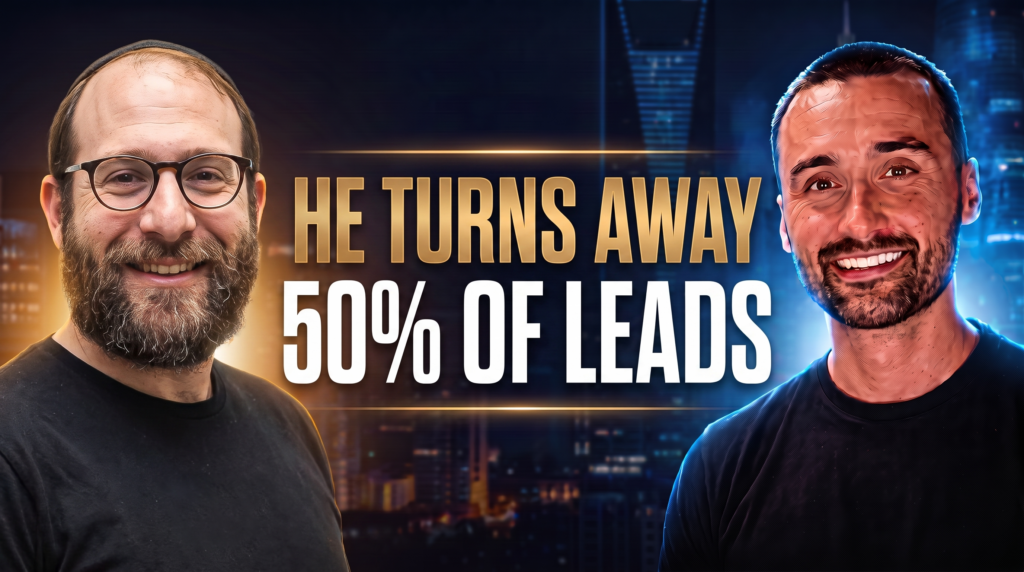
On this episode of the Agency Growth Club, he breaks down how that shift unlocked delegation, why roughly half of potential clients get turned away, and the software mistake that cost thousands despite what he thought was careful vetting.
Pulled from the transcript’s real per-line timestamps, matched to where each topic starts.
Gavin wasn’t actively looking for operational help when he found it. About a year after COVID, he was a regular in a Friday Clubhouse room (the audio social app) focused on marketing and networking, when a woman named Leah joined and mentioned she worked as a fractional COO specifically for digital marketing agencies, a role Gavin had never heard of before.
At the time, Optidge was still a 5-6 person agency, and while not everything ran through Gavin alone, a disproportionate share of decisions and hiring did. What started as a planned 3-month engagement stretched into 3-4 years, specifically because it addressed a problem Gavin knew he had but didn’t know how to solve: he was the visionary founder doing work he wasn’t supposed to be doing himself.
“I knew I had the problem, but I didn’t know what the solution was. That was a solution that was really great for me.”
The direct business result: learning to delegate freed up his time specifically to sell more, and as sales grew over the following years, the systems and processes built alongside that shift meant new hires (and existing staff) could onboard far more easily than before.
Gavin is upfront that delegation wasn’t an easy switch to flip. His first concrete exercise: tracking literally everything he did for 48-72 hours, specifically to get an honest baseline of where his time actually went, since it’s easy to feel busy all day without being able to name what was actually accomplished.
Once he had that baseline, he could identify what genuinely required him versus what didn’t. The second, harder shift was psychological: trusting his fractional COO enough to hand things off despite the uncertainty, and accepting a specific mental reframe, when you delegate something, it’s rarely going to be done exactly the way you’d have done it yourself, and the realistic best case is often around 80%.
“Your 80% might be someone’s 100%, and that’s okay. Once you realize that, the client didn’t leave, the invoicing still went out, you realize, okay, this is okay. And then it’s a lot easier to do it again.”
Actionable advice:
Gavin credits a healthy contractor-to-full-time ratio with reducing hiring risk directly. Full-time hires carry real weight and commitment, so Optidge uses contractors, sometimes for as little as 5 hours a week, to absorb new client work without immediately committing to a full-time salary, then transitions the right people to full-time only once the workload and fit genuinely justify it.
He frames this as solving a common early-stage tension directly: whether to hire ahead of new work or wait for it to materialize first. Contractors let Optidge bring in capacity incrementally rather than jumping straight from zero to a full-time commitment, and Gavin notes the arrangement suits many contractors too, who often prefer spreading their time across multiple clients rather than committing fully to one.
Gavin is candid that turning away potential clients is genuinely hard, especially when a request comes through a personal referral or a friend-of-a-friend he’d naturally want to help. The discipline came from learning through direct experience which client types were a poor fit, startups without enough budget to work with, or larger corporate clients where internal bureaucracy made it nearly impossible to actually get things done.
The real cost wasn’t always visible on the invoice: some clients who technically paid still cost Optidge money once time, effort, stress, and opportunity cost were accounted for. Gavin credits having a team that reinforces the discipline together, being able to say “I’m a little scared to turn this one away” and have the team remind him why a specific type of client isn’t the right fit makes the decision easier to actually follow through on.
Actionable advice:
Referrals are Optidge’s primary channel, specifically from existing clients rather than other agencies, growth Gavin describes as happening naturally over the agency’s seven years. Two secondary channels support this: some paid media testing on Optidge’s own behalf, and Gavin’s own visibility as founder and CEO, positioned as a “softer sell,” he’s not constantly pitching services directly, but staying broadly visible so he’s top of mind when someone does need help.
His clearest example: he reached out personally to two people he saw had lost their jobs, offering help with no expectation of anything in return. Both eventually landed new roles, and both came back to hire Optidge for paid media work once they were in a position to.
“They were like, ‘Danny, we thought of you because when we were down, you spoke to us.’ The idea here is just to be top of mind, right? If you’re not top of mind, it’s very possible I’m not even going to think about you, even though we know each other really well.”
Actionable advice:
Gavin admits Optidge could still do better here, the instinct to avoid asking (fear the client will react badly) took real effort to overcome. The shift: framing an upsell as a genuine value proposition, here’s what more spend could accomplish, rather than a pure sales ask, and accepting that a “no” is a fine outcome, while staying silent when there was a real opportunity has occasionally cost Optidge a client who went elsewhere to a provider who seemed to care more.
Running both organic and paid services gives Optidge a structural advantage: clients often start in one service line, and once trust is established there, a natural cross-sell conversation opens up. On the paid media side, fees are directly tied to ad spend, so growing a client’s spend grows Optidge’s revenue in parallel. Gavin cites a live example at the time of recording: a client who’d previously had to reduce their retainer ultimately agreed to expand it again after Optidge continued delivering strong results.
Gavin describes a genuine tension: clients have been taking longer to pay in recent years, but his own instinct (pay any invoice he receives immediately) makes him reluctant to chase people aggressively. Optidge’s fix is shifting more clients onto recurring credit card or ACH billing rather than relying on manual invoicing, alongside a structured escalation system, a defined email at a certain number of days overdue, followed by a phone call at a further threshold.
Some accounts have still had to go to collections, with mixed results. Gavin’s clearest retrospective lesson: the root issue is often being too accommodating upfront rather than setting firm payment expectations from day one, since being lenient for a month or two often leads to a much harder collection problem later, without meaningfully improving the odds of getting paid.
Roughly a year or two before this recording, Optidge signed a 12-month contract, worth multiple thousand dollars, for an agency operations platform meant to improve team utilization tracking and forecasting. After onboarding, it became clear the platform was built for time-and-materials project work, not Optidge’s retainer-based model, and simply didn’t fit how the agency actually operated.
Optidge tried to exit the contract but the vendor wouldn’t release them, offering only a partial discount instead. Gavin frames the lesson honestly: he felt he’d done real due diligence beforehand, and the mismatch only became clear once the team was actually inside the tool day to day.
“It could have been really, really good, the solution that we needed, but it didn’t end up being that way. It’s okay, and we’ve moved on from that.”
Actionable advice:
Gavin names two things. First, learning to delegate earlier would have accelerated Optidge’s growth. Second, and more foundational: Optidge’s culture is built on kindness and putting people first, something multiple new hires have told him directly sets the agency apart from anywhere they’ve worked before.
His honest reflection: over the past three years of growth, there have been moments where a purely business-favorable decision won out over a people-first one. If he could tell his earlier self anything, it would be to hold the people-first instinct firmly even as growth creates real pressure to prioritize the business case instead.
Gavin’s team is working four levers in combination: upselling and cross-selling existing clients (the easiest lever), raising prices with confidence, saying no to smaller clients who can’t meet Optidge’s rising minimums (freeing capacity for larger accounts rather than letting the pipeline clog with sub-scale work), and increasing paid advertising investment.
Gavin names two closely related struggles: he’s naturally averse to change and tends to take things personally, a pattern he traces back to leaving home for boarding school in California at 14. Working through change specifically has been, in his words, a constant, ongoing battle rather than something he’s fully resolved.
The second, connected skill is genuinely being open to feedback, not just claiming to be. His honest admission: even when he says he welcomes feedback, his first instinct in the moment can still be defensive. The discipline is stepping back, not taking it personally, and actually acting on it, which he sees as essential specifically for a remote agency, since a culture of free-flowing, non-defensive communication is what makes distributed teams actually function well.
Gavin met a fractional COO by chance in a Clubhouse networking room roughly a year after COVID. What began as a planned 3-month engagement lasted 3-4 years, helping him build systems, delegate effectively, and free up time that directly translated into more sales for Optidge.
Gavin’s first step was tracking every task for 48-72 hours to establish an honest baseline. His guiding mental model is accepting that delegated work will often land around 80% as good as if he’d done it himself, and treating that 80% as a genuine pass, not a compromise.
Optidge signed a 12-month contract (multiple thousand dollars) for an agency operations platform built for time-and-materials work that didn’t fit Optidge’s retainer-based model, and the vendor wouldn’t allow an early exit once the mismatch became clear.
Gavin names being genuinely open to feedback without taking it personally, alongside a natural aversion to change, both of which he considers ongoing, unresolved struggles rather than skills he’s fully mastered.
Founder Danny Gavin learned through experience that certain client types (underfunded startups, bureaucratic corporate accounts) cost more in time, stress, and opportunity cost than they generate in revenue, even when they technically pay, leading Optidge to build deliberate client-fit criteria.
Primarily referrals from existing clients, supported by founder Danny Gavin’s personal visibility and a genuine practice of helping people with no expectation of return, including reaching out to laid-off professionals who later became clients once they landed new roles.


With 95% of roles filled within 25 days, our approach is built for pace and backed by a 1 year guarantee. Get access to the systems and frameworks that power elite SFH teams.