AGENCY GROWTH CLUB
Cadence’s 3-Step Playbook to Go From $20M to $100M
Guest: Matty Martin
Guest: Matty Martin
Matty Martin, Head of Marketing at Cadence, doesn’t think DTC growth is about finding one big lever, he thinks it’s three ordinary ones done in sequence: spend more, spend it more efficiently, then make each customer worth more, sooner.
On this episode of the Agency Growth Club, he breaks down the subscription-exclusive cap that quietly became Cadence’s biggest LTV driver, the Discord of 400–500 micro-creators that turns a $20 gifted can into a repeatable content engine, and the hiring mistake, choosing the big-brand CV over the guy who said he’d send 500 cold DMs a day, that taught him what he actually screens for now.
Pulled from the transcript’s real per-line timestamps, matched to where each topic starts.
Cadence will do roughly $20 million in revenue this year, with a target of $100 million next year. The brand is in just over 8,000 US stores and roughly 1,500 UK stores, and both retail footprints are still growing. Matty is direct that most of the path to $100 million runs through direct-to-consumer.
“We’ll do $20 million this year. Next year, we hope to do $100 million… I do believe that a lot of that will be driven by DTC.”
Asked how a brand actually plans its way to a number that big, Matty breaks it into three deliberately sequenced steps rather than one big lever: spend more money, spend that money more efficiently (more new customers per dollar), then make each customer worth more money, sooner. He ties the third step specifically to the supplement category’s daily-habit nature, “you really make the money on the customer, you don’t make the money on the purchase.”
Underneath those three, he names the practical levers that support them: introducing more creative diversity on Meta to reach a wider audience, sorting out on-site conversion rate, building landing pages around new audiences instead of sending everyone to the same product page, and, for the LTV step, pushing customers onto subscription and keeping them there as long as possible.
Actionable advice:
Cadence currently sits at roughly 50/50 DTC vs. retail, and Matty expects that to drift to around 80/20 DTC next year. He’s candid that this mirrors a pattern he’s seen across other CPG brands that look like “overnight successes” but actually had years of ecom infrastructure behind them first, citing Bloom as an example. The DTC database also directly supports retail: Cadence can email a concentrated group of subscribers in a specific region (“we’ve opened up Kroger in Texas”) and drive them into stores for a new listing.
He also flags a measurement problem specific to retail: subscription cohort tracking, Cadence’s core retention lever, simply doesn’t exist once a customer buys in-store. “Obviously on retail, you can’t track any of that.”
Matty argues retail marketing is a fundamentally different problem from DTC. On DTC, a brand can scale on Meta spend alone before hitting diminishing returns. In retail, the challenge is getting someone to physically go to a store, then think of the brand once they’re standing in the aisle, both of which Matty says are primarily solved by influencer content, not media buying: “it’s people seeing people going to stores, showing them what aisle it’s down… hyping the drink up.”
He also flags that Cadence’s retail audience skews meaningfully older and more geographically distributed than its DTC-built brand identity (East Coast and California runners in their 20s). Across thousands of Walmart stores in states like Kentucky and Kansas, the actual in-store buyer is more often “the mom of the household or the dad of the household,” buying for their kid rather than themselves, a pivot Matty credits Cadence’s lean team structure with being able to make quickly.
Actionable advice:
Matty draws a clear line between the two influencer tiers Cadence uses. Athlete partnerships (he names Olympic gold medalists like Tara Davis-Woodall and Alex Yee) are a poor ROI play in isolation, their value is almost entirely social proofing and positioning, credibility signals a core customer recognizes instantly without needing to know the individual athlete.
Micro-influencers serve a completely different function: content volume and repeatable UGC. Matty’s math on a single gifted case of cans (roughly $20 in product cost): even a mediocre CPM outcome from one post becomes a strong return once that creator is inside Cadence’s Discord and produces five to seven additional pieces of content from the same relationship.
Cadence built a Discord specifically to house micro-creators before they need them at scale, so that when the brand decided to push harder into UGC and paid partnerships, they already had 400–500 creators ready to brief. Matty describes the actual workflow: drop a brief (an example he gives is a “muscle growth, sleep” angle), and within 48 hours the team has 10–20 pieces of usable content ready to feed straight into the Meta ad account.
“I really think a Discord is genuinely one of your best marketing assets you can build right now.”
Actionable advice:
Matty spent his first two and a half years at Cadence prioritizing acquisition over retention almost entirely, deliberately, because with a lean team he had to pick the single biggest lever available. That lever is subscription: a subscriber is worth roughly 3.2x what a non-subscriber is worth over a year, and a one-time buyer who later converts to subscription is worth 5–6x a one-time-only buyer.
He credits a direct conversation with the team at Keto and IQ for the specific insight that shaped Cadence’s subscription offer: get a customer past month three and into month four, and you’ve effectively secured them for a year. Cadence built its discount and gifting cadence directly around that finding, an aggressive first-order discount to remove the buying decision entirely, then a shift toward lower-cost merch gifting (rather than deeper discounts) from month two onward.
The single biggest difference-maker in Cadence’s retention numbers, according to Matty, is a branded cap available exclusively through subscription, never sold on the website outright. The team seeded it internally first (staff and athletes wore it for roughly a year before it existed publicly), building demand before ever making it available.
Matty traces the idea directly back to his time at Represent, which he says “blew up” once it launched an “owners club” with visible branded merch. The logic transfers directly to Cadence: most people take electrolyte sachets privately (at home or the gym), so a visible logo item does double duty, it drives subscription and functions as free brand advertising every time someone wears it. “I leave my flat, I can guarantee if I went for a 10k run today and tomorrow, I’d see a Cadence cap at least once across those two runs.”
Actionable advice:
Prior to roughly November of last year, Cadence’s marketing org was flat, with Matty personally involved in every channel, growth, retail marketing, brand, content. He describes the cost directly: too many people to manage, too much to think about, and too much time spent on calls. The fix was making the structure more vertical, promoting a team member (Herk) into a Head of Brand role covering content, social, and activation, which reduced Matty’s involvement in that function to a single weekly touchpoint instead of five to six hours of calls.
That freed Matty to focus primarily on growth, which he describes as the fastest-growing part of the team, and reinforced a hiring principle he applies consistently: new channel leads need to prove they can run a channel solo before they’re given a team to manage.
Cadence’s paid media lead, Jack, was hired only two weeks before Black Friday, and Matty says the account “transformed overnight.” His explanation centers on a specific trait: certain roles need someone built for systems, a constant creative pipeline and a media-buying process with guardrails, rather than someone who thinks purely campaign-by-campaign. Jack’s agency background, used to juggling many accounts at once, translated directly into that systems mindset once focused on a single account.
Matty also flags that Cadence deliberately stayed narrow, hyper-focused on a single core customer (someone training three to seven times a week) for roughly the first seven to eight months of Jack’s tenure, because there was clear opportunity in that specific segment. Only now, with the $100 million target ahead, is the team deliberately diversifying creative and audiences, including an open call for outside creative agencies posted on Matty’s own social channels that drew roughly 200 inbound submissions.
Matty is candid about a hiring mistake he made in the influencer channel, choosing a candidate with a recognizable CV from one of the biggest beverage brands in the US over a candidate who said he’d personally send 500 cold DMs a day if that’s what it took. Both candidates were, in Matty’s words, “scalers”, but one had sat in a role built around executing an already-established playbook, while the other was, in his framing, a straightforward operator and executor. Matty picked the CV.
He now screens explicitly against what he calls the “culture of scale” a candidate is coming from: someone who’s only ever worked inside businesses already worth a billion dollars is used to small, incremental gains being considered a win, not the kind of urgency a fast-scaling brand actually needs.
Actionable advice:
Matty frames Cadence’s real competitive target as legacy sports drinks, specifically Gatorade, not other electrolyte brands. His reasoning: electrolyte sachets are a genuinely DTC-native product (low COGS, light on shipping, daily-use), but no single brand in that category has yet built major scale, while the sports drink, energy drink, and water categories it’s adjacent to are enormous (he cites energy drinks alone as a $94 billion market on tape). Capturing even a small fraction of that adjacent shelf space, in his framing, is a far bigger opportunity than fighting other electrolyte brands for a still-small category.
He also points to Gatorade’s formulation directly as the opening: built on decades-old science, high in sugar, and carrying artificial dyes, sweeteners, and flavors that the market is actively moving away from, the same shift Matty says already played out with poppy-style sodas displacing shelf space from legacy cola brands, and Bloom-style energy drinks doing the same in that category.
Asked for the single biggest lesson from his two years at Cadence, Matty doesn’t hesitate: hire people who either sell cans or save money. He’s direct about the alternative, “we’ve had people who don’t do either of those things, and ultimately what you end up with is someone who spends money and doesn’t make any money.” He credits an A-player/B-player/C-player hiring framework, one he says he first heard articulated by the interviewer, with shaping how deliberately he now screens for that standard.
“You really just want someone who’s reliable as hell, and you can really just trust them to own and run a channel.”
Actionable advice:
Before making a hire, ask directly whether the role either drives revenue or reduces cost, if the honest answer is neither, revisit whether the role is actually needed yet.
For the full episode with Matty and Josh, find the link below:
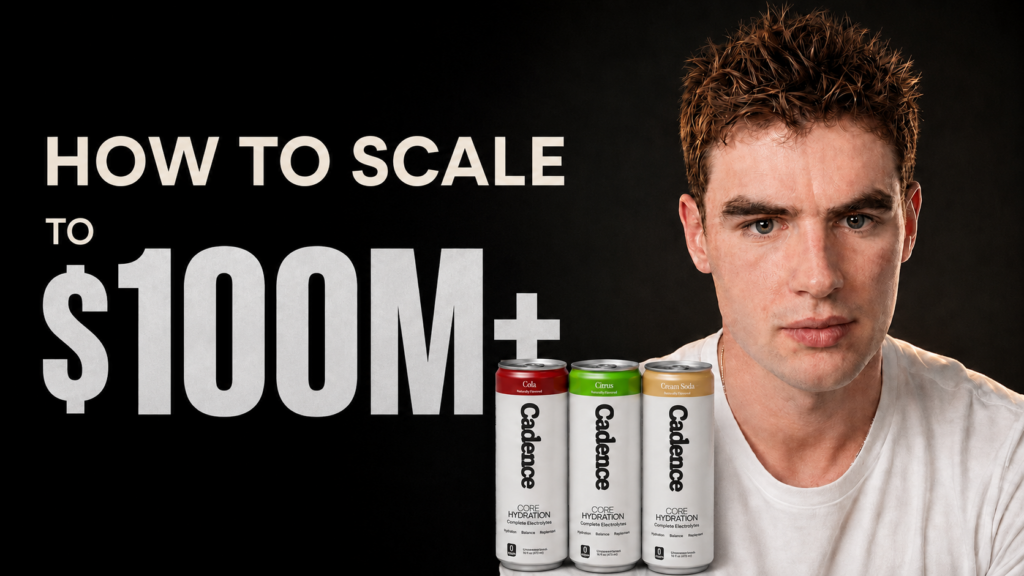
Matty Martin frames Cadence’s growth around three sequential levers, spending more on paid acquisition, spending it more efficiently to get more new customers per dollar, then increasing lifetime value and pulling it forward sooner through subscription.
Cadence offers a branded cap exclusively to subscribers, never sold outright on the website. The scarcity mechanic, inspired by Represent’s “owners club” merch model, both increases subscription conversion and functions as free brand awareness whenever a subscriber wears it in public.
Athlete partnerships are used primarily for social proof and brand positioning, while a Discord of 400–500 micro-creators produces the bulk of Cadence’s UGC and drives in-store discovery, since Matty argues retail purchases are won primarily through people seeing influencer content, not media buying.
He chose a candidate with a recognizable big-beverage-brand CV over one who offered to send 500 cold DMs a day, a decision he now frames as valuing brand-name experience over an operator who’d actually execute, and one he actively screens against in hiring since.
Matty argues the electrolyte sachet category is still small relative to adjacent markets like sports drinks and energy drinks, and that Gatorade’s decades-old, high-sugar formulation is exactly the kind of legacy product the market is already moving away from, similar to shifts already seen in soda and energy drinks.
Matty states a subscriber is worth roughly 3.2x a non-subscriber over a year, and a one-time buyer who converts to subscription afterward is worth 5–6x a one-time-only buyer, numbers he credits to a conversation with the team at Keto and IQ about retaining customers past month three.


With 95% of roles filled within 25 days, our approach is built for pace and backed by a 1 year guarantee. Get access to the systems and frameworks that power elite SFH teams.