
AGENCY GROWTH CLUB
Andrew Peluso (Pesty) on Hiring a CEO and COO to Build a $10M+ Pest Control Agency
Guest: Andrew Peluso
Guest: Andrew Peluso
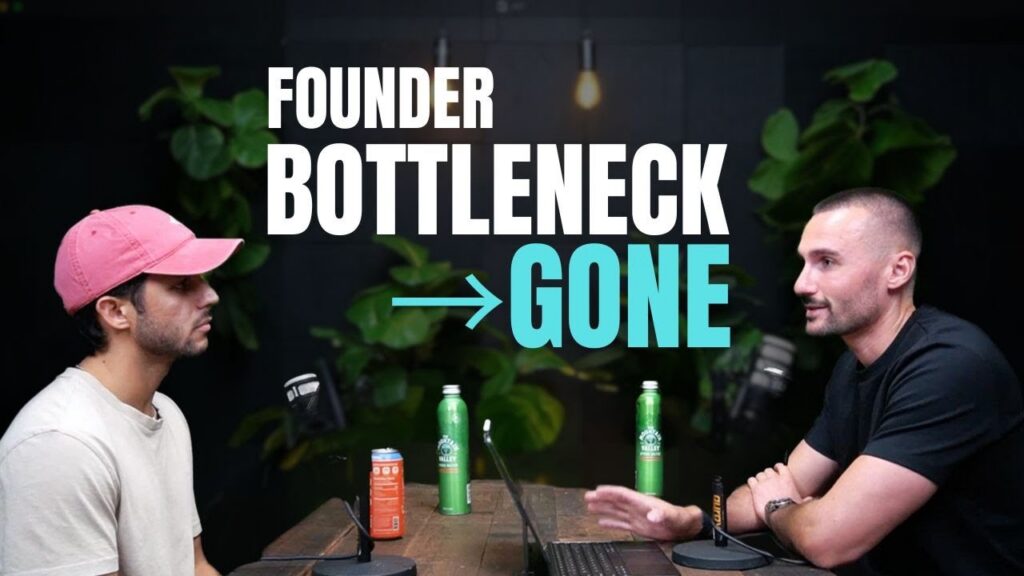
Andrew Peluso, founder of Pesty (formerly Bananas Marketing), decided he wasn’t the right person to take his agency from seven figures to eight, so he hired a CEO and a COO in the same week and is working his way into an advisor role.
On this episode of the Agency Growth Club, he breaks down how he found and evaluated both hires, how compressing a year-long revenue goal into 3 months got his team 66% of the way there anyway, and why niching down to one hyper-specific ICP was the single change that finally gave Pesty real product-market fit.
Pulled from the transcript’s real per-line timestamps, matched to where each topic starts.
Andrew describes himself as a three-time agency founder who learned the importance of niching the hard way. He started with a generalist marketing agency doing web design and development for anyone, then launched Bananas Marketing, offering SEO, paid search, and web design for service businesses, which he says still wasn’t niche enough. Last October, Pesty went fully specific: search marketing exclusively for pest control companies doing at least $1M/year in revenue, run by ambitious operators targeting 30%+ year-over-year growth. He’s been in the agency world since 2016, after working in sales before that.
Having decided in April he was ready to move toward something new in tech and AI, Andrew weighed two options: bring in a COO while holding the CEO title himself, or hand off the CEO role entirely. He chose the latter, arguing he’d seen how the first path plays out and didn’t believe he could aggressively grow the business while holding onto the title without fully committing to it. He also didn’t want to sell, since he believed the business could realistically reach tens of millions in revenue at high profitability with the right leadership in place.
“I didn’t want to hold the business back.”
Andrew started his CEO search organically, putting feelers out in the SEO and agency community and cold emailing Peter Kang, who runs a portfolio of agencies, for guidance. Kang connected him with an executive recruiter. By that point Andrew had already built momentum with a promising candidate on his own, but paid the recruiting firm $15,000 for access to a pipeline of vetted candidates, structured so that if he didn’t end up hiring through them, the $15K was simply the cost of comparison.
Actionable advice:
Through the recruiting process, Andrew met a range of serious, credentialed candidates, people who had built and sold agencies and technology companies. He describes them as clearly A-players with winning track records. Even so, his organically-found candidate kept impressing him further as the comparison continued, ultimately reinforcing rather than replacing his early instinct.
Andrew’s eventual CEO hire, Shane, had directly relevant industry history: he’d built one of the largest pest control blogs in the space and sold it for roughly $1.2–1.3 million. He then became head of growth at another company, where he helped scale revenue from $10 million to somewhere between $300–350 million during his tenure. Beyond the resume, Andrew emphasizes that he and Shane shared very similar mindsets about how to run an operation aggressively at a high level.
Andrew ultimately passed on every candidate the recruiting firm presented for the CEO role, staying with the person he’d found organically. But one of those recruited CEO candidates, Kim, had strengths precisely where his chosen CEO had weaknesses, and vice versa. Kim had risen from an account management role at Klientboost to eventually become President of the company. After roughly a month and a half of CEO conversations, Andrew told her he’d found someone else for that specific role, but suspected, given her skills, experience, and desired lifestyle, that she’d actually be an excellent COO instead.
Neither hire was expecting the arrangement they ended up in, Shane wasn’t expecting to be paired with a highly experienced COO, and Kim wasn’t expecting to step into a COO position at all. Andrew brought both of them out to a company off-site to get a feel for each other and the team. Both came away confirming they saw what Andrew saw and could make the pairing work. That was early September, meaning the entire CEO/COO hiring and pairing process happened inside roughly six weeks.
Asked what specifically made Shane and Kim stand out beyond their resumes, Andrew points to preparation as the real differentiator. He distinguishes between candidates who show up simply competent, candidates who’ve done basic homework on the company, and candidates who show up with something closer to a full memo, spreadsheet, or deck. Shane, in particular, showed up with a detailed memo and spreadsheet full of thoughtful questions, which revealed both his ambition and how big he was genuinely thinking, a trait Andrew had assumed would be table stakes at the executive level and discovered often isn’t. Kim showed up similarly over-prepared, with a full presentation ready to go, unprompted by Andrew.
“I know what Pesty can be. In fact, I was actually even thinking too small compared to what we ended up landing on with Shane.”
Actionable advice:
Andrew argues genuine A-players have little interest in wasting their time, and because they’re rare, they have no shortage of opportunities, which makes them highly selective about where they choose to work. He wants to see that same seriousness reflected back in how a candidate treats the interview process itself, and is candid that even at the CEO level, most candidates show up underprepared. “It does make it rather easy for people who are serious to stand out. The bar is not high.”
Andrew’s two agencies, fulfilled by one combined team, finished the prior year at $950,000 in revenue. He entered the year with an initial goal of adding another $1 million in annual recurring revenue by year-end. After compressing that same goal into a 3-month window (detailed below), the team added $600,000 in ARR, 66% of the full-year goal achieved in 25% of the time. Pesty is now projected to hit $2 million in revenue by the end of this year and a $2.7 million ARR run rate heading into next year, more than doubling the prior year’s result.
Andrew credits a leadership training program based in Austin for the shift. Going in, he was specifically trying to break through a ceiling he’d put on himself, wondering what separates people who think in genuinely big terms from everyone else. As part of one level of the program, participants set a goal, and Andrew noticed the program’s own framing nudged people toward “stretch but achievable” targets. He deliberately ignored that framing and set a far more aggressive one instead.
Andrew is direct that the shift wasn’t about new tactics, it was about what he calls “a way of being,” specifically urgency and vision. His reasoning: if he’d kept the original by-year-end goal, he’d have unconsciously paced himself to hit it right at the deadline, simply because that’s what he’d said he wanted. Compressing the timeline didn’t produce the full $1M, but it produced meaningfully more progress than the original pace would have.
“Rather than adding a million dollars in annual recurring revenue by the end of the year, we’re going to do it in three months.”
Andrew gives a concrete example of the urgency he’s describing: he cancelled a planned bicycling trip up the California coast with a longtime friend, paying whatever cancellation fees were required, to sponsor and speak at a boutique pest control conference he believed had strong ROI potential. He arrived expecting roughly 30 companies matching Pesty’s ICP, but found only about 10 pest control companies present, most of which weren’t a fit. He delivered his presentation with the same energy regardless, and still walked away having closed the conference organizer as a client and meeting an industry consultant who has since referred several additional clients.
Actionable advice:
Andrew credits Pesty’s narrow positioning, specifically pest control companies doing at least $1M/year, run by ambitious operators wanting 30%+ year-over-year growth, as a major driver of this year’s results. He argues that level of specificity makes Pesty “one of one” in a category that otherwise includes general pest control marketing agencies and broader home service marketing agencies. When an ICP-matching prospect finds the website, Andrew says the reaction is that the company was built specifically for them, which has made marketing meaningfully easier and shifted sales into fundamentally different conversations.
Andrew is candid that he didn’t fully realize how much of a bottleneck he’d become, he was still managing accounts, running monthly meetings, building proposals, and handling sales personally. Reaching eight figures, in his view, requires delegating that work fully and spending real money to hire A-players rather than continuing to run a lean, highly cost-conscious operation. He’s also planning to build software (an online scheduler for clients), put a proper sales system in place, set a real marketing and advertising budget for the first time, and hire a marketing manager to own it.
“A players, they want to be paid, and they deserve to be paid.”
Andrew wants Pesty to become known enough in the agency and pest control space that A-players seek the company out directly, rather than needing to be sourced through recruiting firms. He connects this directly to a brand refresh Pesty and Bananas went through roughly a year and a half ago, he expected it to improve leads and client perception, but was surprised by how much it mattered to employees. A team member’s headshot and the company logo on their LinkedIn profile function as a status symbol, and employees don’t want to be associated with a site they consider low-quality unless that’s genuinely part of the company’s identity.
“A players want to work with other A players… they want to be part of something that is growing and growing as fast as possible.”
Actionable advice:
Asked for the single biggest lesson he’d give his younger self, Andrew doesn’t hesitate: niche down. He says he didn’t experience genuine product-market fit until last October, when Pesty moved from a general pest control SEO and PPC agency to the current hyper-specific positioning (search marketing, pest control companies doing $1M+/year, ambitious operators, 30%+ growth goals). That one tactical shift in positioning, he says, made everything, marketing, sales, and operations, easier, more efficient, and more profitable.
Asked whether he has his own mastermind or peer group pushing him the way he pushes others, Andrew says honestly, not really, and only in the last year and a half has he started being genuinely exposed to people operating at that bigger-thinking level. His read is that access to those circles tends to follow demonstrated track record and credibility, rather than simply wanting to be included, serious operators are selective about who they spend time with, regardless of whether someone’s business is currently six, seven, or eight figures.
Unprompted, extensive preparation, both showed up with detailed memos, spreadsheets, and thoughtful questions that revealed genuinely big thinking, a trait Andrew expected to be standard at the executive level and found was actually rare.
He didn’t believe he could maximize Pesty’s growth potential while personally holding the CEO title, and wasn’t interested in selling the business since he believed it could reach tens of millions in revenue with the right leadership fully committed to the role.
He found his CEO largely organically through the SEO/agency community and a cold email to Peter Kang, then paid $15,000 to an executive recruiting firm to benchmark that candidate against a pool of seasoned operators. His COO was actually one of the recruiting firm’s original CEO candidates, repositioned into a role that better matched her strengths.
By compressing an original year-end goal of $1M in added ARR into a 3-month sprint, inspired by a leadership training program. The team didn’t hit the full $1M, but reached $600K, 66% of the annual goal in 25% of the time.
Niche down sooner. He says Pesty didn’t find real product-market fit until narrowing its ICP last October, a single positioning change that improved marketing, sales, operations, and profitability across the board.
Getting himself out of the day-to-day (account management, sales, proposals), hiring A-players and paying them properly, building better sales systems and marketing infrastructure, and developing an employer brand strong enough to attract top talent without relying on recruiters.


With 95% of roles filled within 25 days, our approach is built for pace and backed by a 1 year guarantee. Get access to the systems and frameworks that power elite SFH teams.