
AGENCY GROWTH CLUB
Sophie Brannon (StudioHawk) on Hitting $1M ARR in Year One of a US Launch | Agency Growth Club
Guest: Sophie Brannon
Guest: Sophie Brannon
Sophie Brannon leads StudioHawk’s brand-new US operation, and in its first year it crossed $1 million in ARR out of an office most competitors have never heard of, Atlanta, chosen over New York and LA specifically to avoid a talent and cost ceiling.
On this episode of the Agency Growth Club, she breaks down the growing pains that came with growing that fast (reactive hiring, a churn scare, learning the US market’s actual calendar), the cash flow discipline that kept the business from depending on any one client, and why StudioHawk is deliberately ignoring the advice to niche down or add new services.
Pulled from the transcript’s real per-line timestamps, matched to where each topic starts.
StudioHawk is a global SEO specialist agency, doing only SEO and digital PR, founded by Harry roughly 10 years ago when he was just 17. The company started in Melbourne, expanded to Sydney, then opened a London office in 2019 when Anthony, one of StudioHawk’s earliest Australian hires, relocated to the UK (that office now has around 15 people). As of last September, StudioHawk launched its US office out of Atlanta. Globally, the company is now roughly 110 people and growing rapidly, with the US office currently “pumping.”
Sophie says expanding into the US had been a long-standing ambition for Harry specifically, the real question was timing, making sure StudioHawk was established enough to hold its own in the world’s biggest market. The idea had been in active discussion for three to four years before the team committed around 2024–2025. StudioHawk landed its first US client in September, and notably, that client is still on board today.
Sophie says the value of in-person, face-to-face relationships is meaningfully higher in the US than elsewhere in the world, and that without “boots on the ground,” success is much harder to come by. A large share of StudioHawk US’s early growth came directly from client and partner referrals and simply getting to know people locally in Atlanta, including introductions to attorneys, tax professionals, and relevant mastermind groups, connections that compounded quickly once the team was physically present.
StudioHawk considered New York first, but found the taxes, salary expectations, and office costs would likely cap growth around 5–10 staff for a fully in-office company. LA had the same cost and talent-cost problems without solving the ceiling issue. Charlotte was appealing but felt too small and restrictive for the business opportunities StudioHawk needed. Atlanta, suggested by contacts in Charlotte, ended up checking every box: strong local universities (Georgia Tech, Emory, Georgia State) for hiring and training juniors from the ground up, the world’s busiest airport for team travel, and a city culture Sophie compares directly to StudioHawk’s existing Melbourne and London office neighborhoods.
“Everyone’s just as baffled… but actually, it makes so much sense for us.”
Actionable advice:
Sophie is candid that StudioHawk US had real advantages most first-year startups don’t: an already-established global brand (StudioHawk is Australia’s largest SEO agency), and a decade of process and structural learnings from the Australian team to draw on, even while running the US office as a genuinely separate, startup-like entity.
Even with those advantages, StudioHawk US hit typical small-business growing pains. The team typically hires and trains juniors from the ground up, but incoming clients needed a senior voice, which meant Sophie stayed personally embedded in client campaigns longer than planned. Hiring was reactive rather than proactive, the team wasn’t expecting to grow as quickly as it did. A surge of interest around September and October speaking events led to proposals going out later than they should have, likely costing some business, and new clients coming on board faster than the team could evenly absorb, which briefly strained service quality and caused a churn scare.
Sophie also had to learn the US market’s calendar the hard way: many businesses treat September as fiscal year-end, meaning it’s actually a budget-review month rather than a signing month, and activity effectively goes quiet from a mid-November cutoff through Thanksgiving and the holidays, with a wave of new starts arriving January 1st.
For 2026, Sophie’s focus is shifting from reactive to proactive hiring, informed by pipeline and trend forecasting rather than filling gaps after they appear. StudioHawk US will be seven people as of January with a new junior hire, and Sophie is deliberately building out more hierarchy and structure. She’s also explicit that not every hire is meant to be permanent, and that not everyone needs to be an A-star player, B-players who support the top performers are a legitimate and necessary part of the team, too.
Actionable advice:
StudioHawk hires around a specific internal archetype the team calls “wholesome nerds,” a persona shaped by the people who’ve succeeded across all of StudioHawk’s regions, and every candidate is evaluated against how well they match it alongside their experience. Sophie credits this with reducing culture-fit problems significantly, and notes that even candidates outside that archetype who get hired anyway “typically don’t cause us problems” as often as a true mismatch would. Rushed hires made outside that filter, she says, have been the source of more issues down the line.
Actionable advice:
Sophie acknowledges she has the advantage of the Australian team as a financial backstop, but credits StudioHawk’s discipline just as much: tracking profitability by person and by client consistently, and, uniquely to the US office, using time tracking from day one to pinpoint real utilization and profitability. Because the team sometimes hires ahead of confirmed client revenue, accurate forecasting and modeling are essential to avoid overextending.
The deeper principle: StudioHawk deliberately avoids building the business around any single large client, even turning down sizable early US opportunities that would have required hiring a large team to serve one account, an account that, if lost, would force painful layoffs. “That’s an awful way to operate… but unfortunately there are a lot of agencies out there that that is their model.”
Actionable advice:
Sophie outlines several real market differences she’s experienced firsthand. US contracts involve significantly more legal procedure, AP department sign-off, and back-and-forth redlining than she’s used to. Face-to-face meetings are more of a baked-in expectation in the US, in contrast to the UK, where she says it’s become notably harder to get anyone off a Zoom call since COVID. US clients also tend to have larger budgets and more willingness to let a campaign run before expecting proven ROI. Finally, responsiveness expectations differ sharply: an after-hours or weekend email response is praised as above-and-beyond in the UK, but treated as a baseline expectation in the US, extending even to holiday shutdowns, where UK/EU/Australian teams fully disconnect while US clients often expect a mobile number to still work.
StudioHawk considered expanding into paid media, potentially as a separate sister business, but asked clients directly what additional service they’d actually want. The answer was consistently better reporting, not PPC. Sophie sees staying a specialist as a genuine differentiator in a market, especially in the US, where most competing agencies are full-service and, in her view, spread thin as a result. She argues that specialist positioning carries even more weight now, in the AI search era, where specific expertise is increasingly valued over generalist breadth.
A common piece of growth advice Sophie hears, particularly in the US, is to niche down into a specific industry vertical, the way competitors like Hennessy Digital (legal) or Brainlabs (automotive) have. StudioHawk has never done this and doesn’t plan to across the business as a whole. Instead, Sophie’s vision, particularly for the US, is to build dedicated niche teams within specific industries (finance, automotive, and others) to capture the credibility benefit of vertical expertise without turning away business outside those verticals, especially given the model’s proven success at roughly $10M USD / $20M AUD in global revenue already.
“It’s a proven model, so why would we change it?”
Sophie is candid that the global StudioHawk brand carried less weight in early US conversations than the team expected, prospects largely didn’t care what the company had achieved outside the US. Instead, growth came from personal connections, partnerships with complementary specialist agencies (web dev, CRO/UX, PPC) built on mutual referrals, consistent event attendance and networking, and client referrals, plus simply telling Harry’s personal story face to face. Heavy event and stage presence is planned to continue as a core 2026 strategy for the US specifically.
Sophie describes leaning heavily on genuine excitement about the opportunity rather than consciously managing her energy day to day, though she’s aware 2026 will bring real physical strain, she plans to split her time in two-week blocks between the US and UK. She credits working closely alongside Harry as an intensive, informal mentorship, learning US business structure, tax law, and company setup in real time, while also getting to apply ten years of SEO fundamentals (technical, content, links) to a genuinely new market and challenge.
Sophie’s year-two focus is growth without letting service quality slip, specifically around retention, process improvement, and integrating more AI into delivery so clients see results faster. On the numbers, she’s candid that StudioHawk US didn’t expect to hit $1M so quickly, and while $3M by the end of next year would be “incredibly optimistic,” she believes it’s achievable if the team sustains its current growth rate or accelerates further.
Sophie admits she initially turned down the opportunity to lead the US launch, Harry had to convince her, largely because her life was already established in the UK. In hindsight, she believes saying yes sooner could have accelerated the US launch further, though she also credits the delay with giving the team time to prepare properly before committing. Her overall reflection: no real regrets, it’s been a continual learning process.
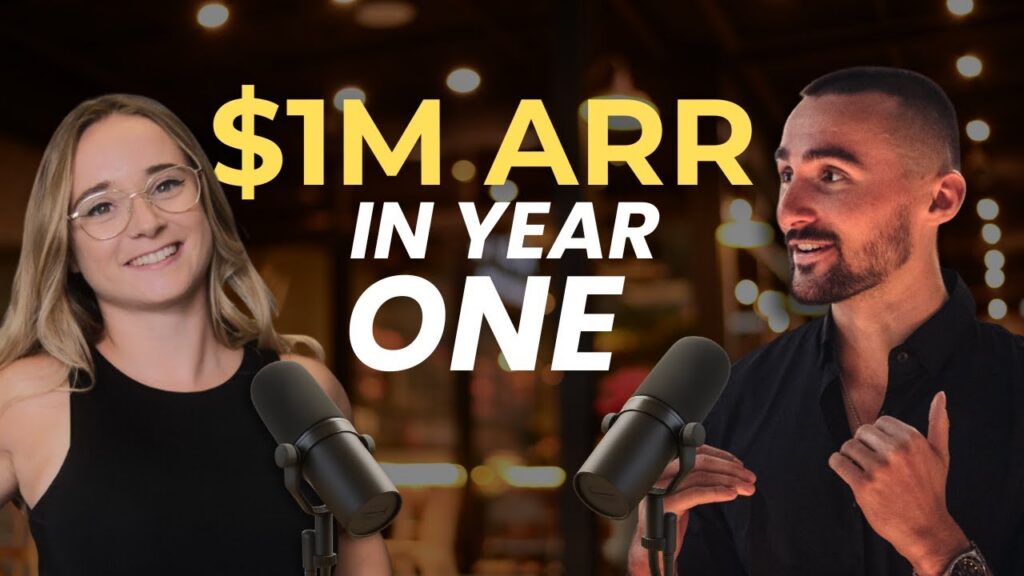
StudioHawk US launched in September of the prior year out of Atlanta and crossed $1 million in ARR within its first year, a result the team describes as faster than they initially expected.
After ruling out New York and LA for high taxes, cost of living, and salary expectations that would cap growth around 5–10 staff, and Charlotte for being too small, Atlanta offered strong local talent pipelines (Georgia Tech, Emory, Georgia State), major airport access, and a city culture the team found similar to its existing Melbourne and London offices.
No, client feedback confirmed they wanted better reporting rather than additional services, and StudioHawk sees staying an SEO specialist as a growing differentiator, particularly as AI search increases the value of specialist expertise.
Not company-wide. Rather than fully niching like some competitors, StudioHawk plans to build dedicated niche teams within specific industries (such as finance and automotive) while continuing to serve a broad range of clients overall.
Primarily through personal connections, partnerships with complementary specialist agencies, event networking, and client referrals, the team found the global StudioHawk brand carried less weight in early US conversations than expected.
Continued growth without letting service quality drop, with a stretch goal of $3 million in ARR by the end of next year, described as “incredibly optimistic” but achievable at their current growth rate.
Reactive rather than proactive hiring, proposals going out later than planned during a surge of inbound interest, and a churn scare caused by onboarding too much new business at once without enough team capacity to maintain service quality.

With 95% of roles filled within 25 days, our approach is built for pace and backed by a 1 year guarantee. Get access to the systems and frameworks that power elite SFH teams.