
AGENCY GROWTH CLUB
Kevin Kapezi (Growthack) on Breaking the Solopreneur Ceiling
Guest: Kevin Kapezi
Guest: Kevin Kapezi
Kevin Kapezi ran Growthack as a solo consultant until a genuine perfect storm, a newborn son, a major migration, and his co-founder exiting all at once, forced him to build a real team.
On this episode of the Agency Growth Club, he breaks down what it actually took to let go of being “the source of knowledge,” the unprompted LinkedIn introduction that nearly landed one of Growthack’s biggest clients ever, and the pitch he lost specifically because Growthack hadn’t positioned itself around AI clearly enough.
Pulled from the transcript’s real per-line timestamps, matched to where each topic starts.
Kevin Kapezi is founder and director of Growthack, a specialist SEO agency (based in Nottingham) that deliberately stays small, a team of three. Rather than building out a full-service offering, Growthack’s philosophy is to bring in outside specialists for anything beyond its core expertise, website migrations, rebrands, or larger projects, functioning, as Kevin describes it, like “a special forces group” competing against much bigger agencies rather than trying to match their breadth directly.
Kevin is clear there wasn’t one single breaking-point moment, it was several things converging at once. His son was born in the middle of a major website migration he was personally delivering, and around the same time, his co-founder went through personal circumstances that led to him exiting the business entirely, including handing back paid media work Kevin himself didn’t do.
“If you think about being a consultant, you are the only person that is available for delivery as well as everything else. Once something happens in your life, you’re in a tough, tough position, and you don’t want your clients to suffer.”
Kevin was clear from the start he didn’t want to return to working for someone else, which made building a more resilient business the only real option available to him.
Kevin is candid that delegation was genuinely difficult, he describes himself as naturally self-reliant and inclined to do things his own way. His first senior hire, Glenn, shared a similar independent streak, which initially created friction, both were used to owning tasks fully themselves, so early on there was real overlap and mild clashing over who did what.
What resolved it was building trust incrementally over time, alongside a concrete fix: documenting Growthack’s actual processes and workflows. Without that documentation, new hires had to guess or reverse-engineer “the Growthack way,” which slowed everyone down. Kevin also credits Glenn directly with bringing in useful practices from his previous agency, framing the transition as a genuine two-way exchange rather than Kevin simply imposing his own methods.
Josh introduced a specific delegation reframe in this part of the conversation, citing a previous guest, James Brockbank, directly: training someone to deliver a task to roughly 80% of your own standard is genuinely a win, chasing 100% every single time is what actually traps founders in the weeds and prevents them from building a team that can function without them. Kevin agreed directly with this framing, connecting it to his own experience trying to get Glenn fully up to speed on Growthack’s specific way of working.
Actionable advice:
Kevin names this as the biggest mindset shift of building a team: as a solo consultant, he was the trusted expert and source of knowledge by default. Handing that role to someone else, trusting Glenn’s technical judgment or Sarif’s content expertise as genuinely authoritative, required a real adjustment.
The result, once he made that shift, was a stronger delivery model overall: Kevin now focuses on strategy and client alignment, while Glenn owns technical depth and Sarif (described by Kevin as a “content scientist” who experiments extensively) owns content strategy, each going genuinely deep in their own lane rather than Kevin spreading himself thin across all three.
Kevin points to being unwell (dealing with an eye issue) during the week of this recording as the clearest recent proof: client meetings, follow-ups, and communications continued seamlessly without his direct involvement. He was more genuinely surprised by this earlier on, before the team had proven itself repeatedly.
One specific habit Kevin credits directly: Glenn’s consistent weekly update emails to clients, short and simple, but sent reliably every week, which closes the anxious gap clients often feel (“are they actually doing anything?”) and makes subsequent live meetings noticeably smoother.
Kevin is honest that hiring well is genuinely difficult even when you follow every standard process, interviews, reference checks, structured stages, since you don’t really know how someone performs until they’ve actually started. The clearest differentiator between his unsuccessful hire and Glenn (his strongest hire): Glenn proactively brought up personal values and growth goals during the process that aligned directly with where Growthack was heading, rather than Kevin having to dig for that alignment himself.
His broader framing: the first few people brought into a small agency set the tone for everyone who follows, if early hires aren’t genuinely aligned, even a strong “A player” hired later may look at the existing team and conclude the environment isn’t right for them.
Josh introduced a specific interview heuristic in this part of the conversation: watching for “orange flags”, not full red flags, but small hesitations or inconsistencies worth probing further rather than dismissing, precisely because so many hiring mistakes trace back to panic hiring under pressure rather than genuinely mapping out the right person for the role in advance.
Actionable advice:
With delivery no longer resting entirely on him, Kevin led a server-side tracking initiative for Growthack’s ecommerce clients, addressing a specific, common data gap: for a high-volume online seller, GA4 often only reports roughly 50-60% of actual revenue, meaning nearly 40% of the real picture is missing from the data informing paid media and strategy decisions.
Two major clients now have server-side tracking live, one on WooCommerce, one on Shopify, a genuinely complex rollout that required trialing multiple providers and significant internal back-and-forth to simplify. Kevin credits having a team specifically with giving him the space to lead this kind of higher-leverage strategic initiative, work that simply wouldn’t have been possible while he was still the only person handling delivery.
Kevin is candid that personal brand ROI is genuinely hard to measure directly, but describes a moment that made the compounding value click for him: at an industry conference, someone in a shared WhatsApp group connected with him on LinkedIn with zero direct interaction beforehand, then, entirely unprompted, DM’d him about a major brand needing Growthack’s kind of service and offered a direct introduction.
That opportunity, ultimately lost to one of five or six competing agencies, would have been one of Growthack’s biggest clients ever. Kevin’s read on why it happened at all: consistent visibility on LinkedIn builds enough perceived credibility that people are willing to make warm introductions without ever having interacted with your content directly.
This part of the conversation was Josh sharing his own experience, not Kevin’s, offered as a parallel illustration of the same point. Roughly three and a half to four years earlier, while working remotely from Lake Garda, Josh posted a photo of the lake and mountains alongside a message about remote work, at a time when LinkedIn posts still had strong organic reach. That single post generated around 120,000 impressions and six discovery calls, one of which became Sage, now one of the biggest client names Search for Hire (Josh’s own company) references when demonstrating credibility in finance and software, entirely unrelated to Growthack.
Both agreed the underlying lesson generalizes: a meaningful share of people who eventually convert are “lurkers”, people who’ve been consuming content for a long time without ever engaging, and consistent posting is what puts you in front of that one opportunity that can genuinely change the trajectory of a business.
Kevin is planning to invest in a home studio setup specifically to produce more educational YouTube content, walking through client problems and case studies directly, since it’s difficult to communicate that depth of explanation in a short LinkedIn post or a website page alone.
Josh referenced Ross Simmonds’ “create once, distribute forever” philosophy (from a previous podcast episode) directly here: a single well-made educational video can be repurposed into nurture-sequence content, and reused directly in live discovery calls, sending a relevant video the moment a prospect raises a topic it already covers, adding authority and saving real time compared to explaining the same concept live from scratch every time.
Kevin shares a recent, genuinely humbling loss directly: a Series A-funded SaaS company preparing to raise a Series B, representing a major growth opportunity Growthack was well-positioned to deliver on technically. Despite the team’s energy and genuine excitement during the pitch process, they lost the deal, ultimately, to an agency positioned more explicitly around AI.
“It made me think, hang on a minute, we are AI, we do deliver work that translates into AI search, into GEO, whatever you want to call it, we’ve just been sitting on the fence about saying that clearly.”
Kevin is personally skeptical of how overhyped AI positioning has become in marketing broadly, referencing comments from Sam Altman himself about overvalued AI startups and a tech conference in Lisbon where seemingly every single startup had “AI” baked into its pitch regardless of relevance. But the direct business lesson stuck regardless: for a specific segment of VC-backed prospects, explicit AI positioning functions as a checkbox requirement, and an agency not visibly checking that box simply won’t get considered, however capable it actually is.
Actionable advice:
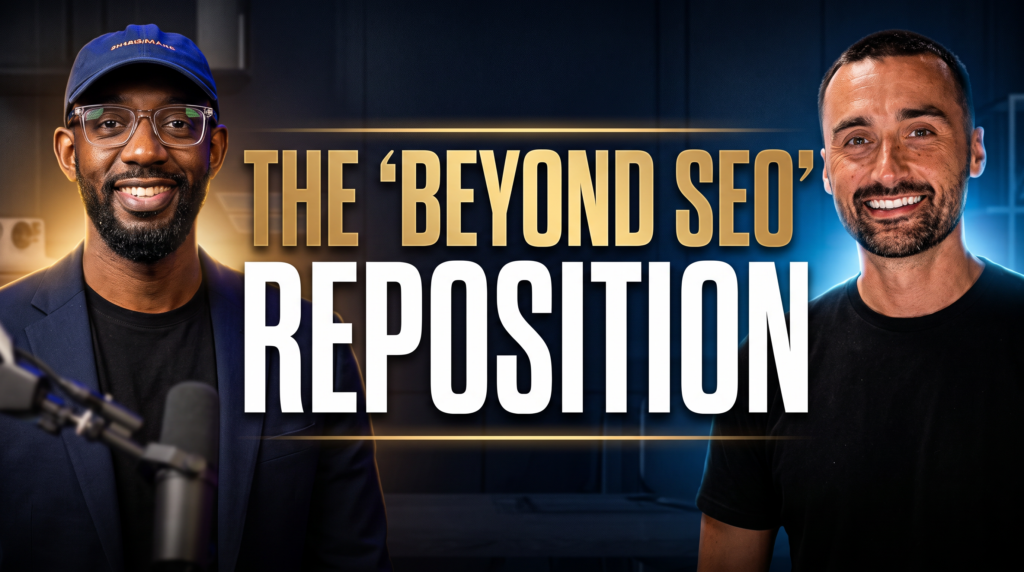
Kevin’s focus for 2026 is consistency rather than rapid expansion: growing the newly launched Growthack podcast to a complete first season (targeting 8-10 guests), after which he expects the “Beyond SEO” positioning to land more clearly as a complete body of work rather than scattered individual episodes.
Directly informed by the AI-positioning pitch loss, Kevin’s broader 2026 priority is being more intentional about messaging overall, clearly articulating what Growthack does, why, and why brands should specifically choose them, going all-in on “Beyond SEO” as a position the agency wants to own outright in its category.
A combination of events happening simultaneously, the birth of his son during a major website migration he was personally delivering, and his co-founder exiting the business, made clear that as a solo consultant, any disruption to his personal life directly threatened client delivery.
Prioritize personal alignment (values and growth goals that genuinely match the agency’s direction) over technical skill alone, since the first few hires at a small agency set the tone that later, stronger hires will judge the environment against.
At an industry conference, someone in a shared WhatsApp group connected with Kevin on LinkedIn with zero prior interaction, then unprompted DM’d him a warm introduction to a major brand needing Growthack’s services. The deal was ultimately lost to a competing agency, but it demonstrated that consistent visibility builds enough credibility for people to make introductions without ever engaging with his content directly.
A method of capturing more complete ecommerce data than standard GA4 tracking, which often misses roughly 40% of actual revenue for high-volume online sellers. Growthack rolled it out for clients on WooCommerce and Shopify specifically to improve the accuracy of data informing paid media and strategy decisions.
According to founder Kevin Kapezi, the prospect chose a competing agency that positioned itself more explicitly around AI. Despite being technically capable of delivering the work, Growthack hadn’t clearly articulated its own AI-related capabilities, which functioned as a checkbox requirement for that specific buyer.
Growthack’s trademarked positioning and podcast theme, reflecting founder Kevin Kapezi’s 2026 focus on clearly articulating what the agency does beyond traditional SEO delivery, and why brands should choose Growthack specifically, rather than competing purely on service breadth.


With 95% of roles filled within 25 days, our approach is built for pace and backed by a 1 year guarantee. Get access to the systems and frameworks that power elite SFH teams.