
AGENCY GROWTH CLUB
Ashley Liddell (Deviation ) on Building a 7-Figure Agency from Scratch
Guest: Ashley Liddell
Guest: Ashley Liddell
Ashley Liddell, Co-Founder of Deviation, did not follow a conventional path into agency ownership.
After leaving a refuse-collection job, he engineered a job opportunity at Rise at Seven through a highly targeted Google Ads campaign, developed a public point of view around Search Everywhere, and then used that trademarked framework as the basis for Deviation.
In this Agency Growth Club conversation, Ashley explains how early proof work, public education, events, complementary co-founder roles, and deliberate reinvestment helped Deviation reach an episode-time milestone of seven figures with an 11-person team in just over two years.
The timestamps below are taken from the supplied transcript and aligned to the start of each substantive discussion.
Ashley became a parent very young and initially took secure work in refuse collection to support his family. His father had worked in the same field and presented it as reliable employment with predictable pay and a pension. After a few years, Ashley reached a point where security no longer outweighed the desire to build something different. He left the role, went back to university, changed his course from business to marketing, and began to pursue a path into digital marketing.
This section is not useful because it turns career change into a motivational slogan. It is useful because Ashley describes the practical action that followed the change in mindset: education, an intentional search for experience, and a willingness to create an opportunity rather than wait for a local one to appear. Living in Hull, he knew that he would need to compete beyond the market immediately around him.
“No one’s going to give you it. So I quit the job … and basically went back to university.” — Ashley Liddell
Ashley’s route into Rise at Seven is one of the episode’s most practical stories. He researched the people he wanted to work with, created a landing page with his CV and a meeting link, then used a free Google Ads credit—around £400—to bid on terms including Carrie Rose, Stephen Kenwright, and Rise at Seven. When someone searched for the company, the ad could appear above it with a direct question: “Can I have a job?”
Carrie Rose and James Hayward Brown reached out. Ashley had interviews and joined the SEO team. The tactic worked because it was not creativity without relevance: it demonstrated paid-search thinking, confidence, effort, and a specific understanding of how to put himself in front of the right decision-makers. It was an application and a work sample at the same time.
Actionable advice: If you want to stand out in a crowded applicant or prospect pool, build the approach around the capability you claim to have. A marketer can create a relevant campaign; a writer can create an incisive brief; an analyst can produce a useful insight. The aim is to make the decision-maker experience the value, not merely read about it.
After Rise at Seven, Ashley joined IPG Media Brands to help build out a proposition he had been discussing publicly: Search Everywhere. He says his original view was that search was becoming a social, multi-platform conversation, not a channel limited to conventional SEO. Because he had published blogs and LinkedIn posts on the concept before joining the business, he says he had records showing that the idea pre-dated his employment there.
Ashley then trademarked the term. He describes being asked to transfer it to his employer and declining. The following day he was called into an HR meeting and told that his employment would be terminated if he did not hand it over. Ashley says he chose to retain the trademark, learned that he would continue to be paid for a period without gardening leave or a non-compete, and began building Deviation the next day with Sam.
The transferable lesson is not legal advice, and it is not that every founder should rush to file a trademark. It is that a point of view can become an asset if it is clearly developed, documented, and associated with the person who created it. Ashley repeatedly emphasises the importance of having “receipts” for his prior work. Founders should obtain qualified legal advice for their own employment agreements, IP position, and trademark decisions.
“I’d kept receipts from stuff I’d done before working there.” — Ashley Liddell
Ashley distinguishes Search Everywhere, his framework and mindset, from the wider phrase “search everywhere optimisation.” For Deviation, the framework connects the channels and platforms that influence a user’s discovery journey: traditional SEO, brand building, digital PR, social search, and more. It begins with intent and the journey a person is on, rather than an isolated list of keywords to rank for.
He is cautious about the way AI conversations are currently being used. In Ashley’s view, some people have adopted “search everywhere” language only to frame a set of AI or LLM tactics. He treats AI visibility as a possible by-product of a connected search strategy, not the sole objective. His own framework is broader: help brands create recognition and preference across the places where people seek, discuss, validate, and discover information.
“We optimise for the journey rather than trying to optimise for specific individual keywords.” — Ashley Liddell
That difference is now influencing client demand. Ashley says brands are asking not only for non-brand search gains, but for help making their brands more visible and more preferred. They are also asking for a strategic layer that can connect social, search, PR, and brand activity rather than leaving teams to operate independently.
Ashley does not present founder harmony as constant agreement. He sees disagreement, challenge, and different strengths as an advantage when both people have the same commitment to the business. Sam is the more operational and commercially focused co-founder. Ashley sees his own strengths in strategic direction, proposition, and broader “blue sky” thinking. Their job is to make the combination valuable rather than competitive.
Ashley describes Sam as someone who stress-tests a plan: what might a client ask, what could a lead challenge, and what has the strategy missed? In return, Ashley brings ideas and a view of where the business can go. They also shared entrepreneurial ambition and, crucially, were equally prepared to invest time in the early build. An earlier third prospective co-founder did not continue because he lacked the availability to commit at the same level.
Actionable advice: A co-founder should complement your skills, be willing to challenge your assumptions, and share the workload and ambition. Chemistry matters, but a functional founder relationship also needs a constructive mechanism for disagreement and a clear division of ownership.
Ashley says Deviation’s first major proof points came from three early projects: Represent, PureGym, and Gymshark. Represent’s Matty Martin reached out after seeing Ashley’s Search Everywhere content on LinkedIn. The three projects gave Deviation case studies that could help a prospective client see how the framework might apply to a brand of similar scale or ambition.
The financial reality was deliberate. Ashley says two of the three projects were essentially done for free, while another attracted only a small payment. Deviation could take that risk because Ashley had income from his previous employment arrangement. The team’s logic was not “do free work indefinitely.” It was to build specific evidence in strategy, education, and proposition work, so that future conversations would begin with proof rather than theory.
From there, the agency made the Search Everywhere conversation itself its acquisition engine. LinkedIn posts, webinars, speaking at BrightonSEO and BrightonSEO San Diego, articles in industry publications, and events helped people associate Ashley—and then Deviation—with the idea. Ashley’s stated preference was clear: create useful education and intrigue so relevant brands reach out when they need the solution, rather than rely on high-volume cold outreach.
“We got three case studies from three huge brands, which meant whenever we went into a room … they could see that we knew what we were talking about.” — Ashley Liddell
Ashley says Deviation operated very leanly from July through December 2024. The founders left money in the business to fund marketing, events, and the website. Only once the agency had secured its first and second 12-month retained-service clients did they start paying themselves a little. Even then, founder pay remained lean for roughly the first year while the company reinvested.
The hiring approach was also intentionally forward-looking. Ashley says Deviation sometimes hired a month or two earlier than a simple revenue-per-headcount calculation would recommend. The founders wanted another strategist in the room during pitches, wanted people to learn the Search Everywhere framework before delivery pressure mounted, and wanted PR capability in place before PR client work began. They hired two PR staff roughly two months before the agency had a PR client; Ashley says that early training meant the team could move quickly once work arrived, and that PR later became its fastest-growing single channel outside full Search Everywhere engagements.
This is an episode-specific operating choice, not a general rule to hire ahead of revenue at all costs. Ashley’s point is that capacity has a training lead time. A business that waits until the retainer starts may find that its revenue begins before its people are ready to create the promised result.
Ashley says Deviation’s hiring errors were predominantly errors of role timing. At times, the agency hired an executive when it needed another strategist, or the reverse. The team could correct those choices because growth gave it room to learn. The bigger mistake was delaying the addition of an account manager, delivery manager, or traffic manager. When the agency grew from four people to eight quickly, capacity management and client context shifts became much more difficult for Sam to hold alone.
Ashley says the business had just made an offer for that account/delivery-management layer on the day of recording. The general point is not that every small agency needs the same title at the same headcount. It is that founders must watch for the moment where winning work, delivering work, and managing the flow of work become three different jobs. If a founder or operations lead remains the bottleneck across every account, quality and strategic headspace are likely to suffer.
Delegation has been more natural for Ashley on delivery than on strategy. He enjoys the big idea and client strategy but does not enjoy the detailed delivery work. His approach is to let strategists contribute to pitches, making the plan a shared piece of work from the beginning. That reduces the founder’s attachment to every implementation decision and lets Ashley act more like an executive sponsor across accounts.
At the time of recording, Ashley says Deviation had not yet categorically had to turn away a prospective client, although he could see that point approaching. AI and LLM concerns had created more interest, but not every organisation was ready to act on the kind of integrated strategy Deviation proposes. In some conversations, the contact was not the budget holder or could not influence the operational changes needed across siloed teams.
The response is not a harder sell. Ashley says the agency is continually refining qualification: are they speaking to the right person, is there budget, and can the business actually implement the strategy? He distinguishes a promising discussion from a commercially viable engagement. That is a useful lesson for any agency whose offer requires a client to coordinate more than one internal team.
Ashley’s content strategy is more expansive than a single social channel. He still posts regularly on LinkedIn, but he also sees value in Substack, video, events, webinars, podcasts, and contributing to established publications. He says Deviation’s own website did relatively little in the early days compared with the leverage created by LinkedIn, external platforms, webinars, and real-world events. The website became more useful once the brand and topic association already existed.
His advice is to contribute a real point of view rather than repeat a crowded conversation. Ashley argues that a distinct stance can earn citations, recommendations, and inclusion when people are seeking new perspectives. The tactic, however, is not simply “post more.” The real task is to develop a position, express it consistently in the places the right audience already trusts, and give people a reason to repeat or refer to the idea.
Actionable advice: Start with one opinion your agency can defend through actual work. Write it in depth, publish a more accessible version on LinkedIn, speak about it when relevant, and create a body of evidence around it. A personal brand becomes commercially useful when it is a reliable association in a buyer’s mind, not merely a frequent posting habit.
Ashley’s most practical advice is not a single operational fix. It is to build relationships with people who have already done something similar and use them as sounding boards. He mentions Stephen Kenwright as someone who has generously given time and feedback; he also says other founders may need to pay for access to experienced perspectives. The investment can be valuable when it prevents a costly rushed decision.
But Ashley pairs that recommendation with an important warning. Advice should inform a founder, not replace founder responsibility. He says that some trusted people did not fully agree that his proposition was the right direction when he was considering Deviation. If he had followed their feedback without judgment, he might not have started the business. The founder must still live with the outcome, so advice and intuition need to work together.
“Ask for the advice, but … you also have to trust your gut a little bit.” — Ashley Liddell
Ashley and Sam are transparent that they are building Deviation with a future sale in mind. Ashley does not say this will happen on a particular date or that growth will continue forever at the current pace. Rather, he says the plan is to continue growing the business, deepen the Search Everywhere conversation, enjoy the opportunities that come with it, and build toward an exit over time.
Ashley’s personal ambition after that potential exit is to become CMO at a major consumer brand. He names Adidas, Stone Island, WWE, and Manchester United as examples of the kind of challenge he would find compelling. This is not a promise or a recruitment announcement; it shows that Ashley distinguishes the company’s route from his own long-term career direction. That clarity, he argues, helps founders decide what they are actually trying to build.
For the full episode with Ashley and Josh, find the link below:
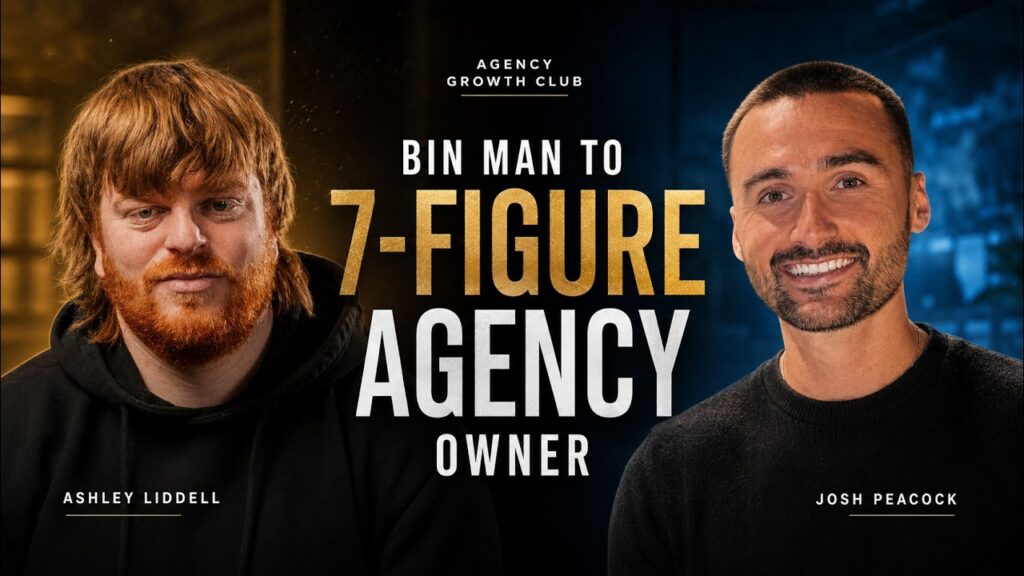
Ashley Liddell is the Co-Founder of Deviation, a search agency built around the Search Everywhere framework. In the episode, he describes his route from refuse collection through Rise at Seven and IPG Media Brands to co-founding Deviation with Sam.
Ashley describes it as Deviation’s framework for connecting traditional SEO, brand building, digital PR, social search, and user intent across the platforms that shape a discovery journey. He says it is broader than AI or LLM tactics and should not be reduced to a set of tricks for those systems.
He created a landing page with his CV and a meeting link, then used around £400 of free Google Ads credit to bid on searches related to Carrie Rose, Stephen Kenwright, and Rise at Seven. The ad asked, “Can I have a job?” It got the attention of Rise at Seven leaders and led to interviews and an SEO role.
Ashley had developed and trademarked the Search Everywhere concept before working at IPG Media Brands. He says that after declining to transfer the trademark to the employer, his employment was terminated. With a period of continued pay and no gardening leave or non-compete, he and Sam started Deviation the next day.
The agency built early proof through projects with Represent, PureGym, and Gymshark, then made its framework visible through LinkedIn, speaking, webinars, events, and industry publications. Ashley says the aim was to educate the market and create inbound interest rather than rely on high-volume cold outreach.
Build a network of credible sounding boards, ask for feedback before making major decisions, then retain responsibility for the decision itself. Ashley’s view is that external advice is valuable, but the founder must still trust their own judgment and live with the outcome.
He says the agency’s main hiring issues were timing and level: sometimes it hired an executive when it needed a strategist, or the reverse. The more significant gap was waiting too long to add account/delivery-management capacity as the number of people and retained clients rose.


With 95% of roles filled within 25 days, our approach is built for pace and backed by a 1 year guarantee. Get access to the systems and frameworks that power elite SFH teams.