
AGENCY GROWTH CLUB
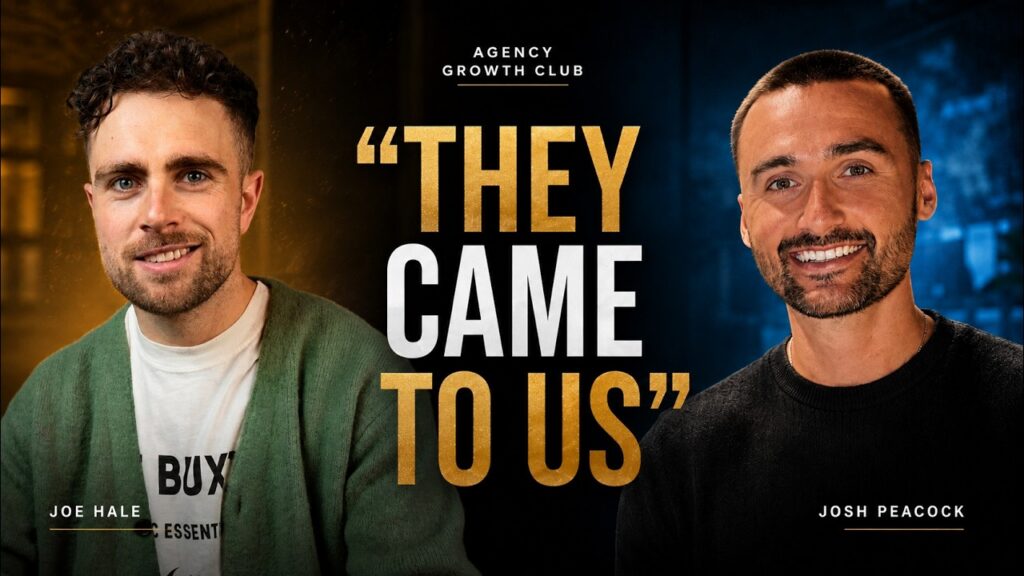
Joe Hale (Verde ) on Landing Dream SEO Clients Without Outbound
Guest: Joe Hale
Guest: Joe Hale
Joe Hale, founder of fashion and e-commerce SEO agency Verde, grew the business by combining a narrow sector focus with visible proof of work.
He found Verde’s first paying client through a freelancer platform, then used LinkedIn to turn brand names, case studies, and genuine industry interest into inbound conversations.
He also explains why he hired senior talent before it felt comfortable, why “good talkers” are not always good operators, and why agencies should be honest about what AI search can—and cannot—yet be measured to deliver.
Pulled from the episode’s published YouTube chapters and checked against the supplied transcript.
| Time | Chapter |
| 0:00 | Introduction |
| 1:03 | Landing Verde’s first paying client |
| 3:06 | Niching into fashion and luxury |
| 4:31 | Turning big brand logos into bigger clients |
| 9:34 | How dream brands come to Verde without outbound |
| 11:57 | Joe’s personal-brand formula |
| 15:34 | Employee-generated content and incentives |
| 17:10 | Cash flow in the early days |
| 21:03 | Growing revenue 4–5x year-on-year |
| 25:41 | Why Joe hired senior before it felt financially safe |
| 29:01 | Good talkers versus good doers |
| 30:14 | How Verde approaches AI search with clients |
| 32:13 | AI search as a monitored sandbox |
| 35:13 | Why Joe thinks nobody has cracked AI search |
| 37:41 | Where to find Joe |
Joe started Verde without an existing client or a side project that had already become a pipeline. At the beginning, the business was closer to a consultancy/freelance operation than the agency Verde would become. He signed up to freelancer platforms, watched closely for opportunities in the sectors he wanted, and responded quickly when a suitable fashion opportunity appeared. The budget was small, but Joe took the work—and says it became Verde’s first award-winning project.
The lesson is not that freelancer platforms are a permanent acquisition strategy for every agency. Joe’s more transferable point is the discipline of looking selectively rather than applying indiscriminately. He knew which categories he wanted to serve, treated relevant opportunities urgently, and used the first engagement to build proof rather than simply to bill hours.
“Anything that came up around fashion, I was on it.” — Joe Hale
Actionable advice: If the business is early, choose a narrow hunting ground before choosing a channel. Define the kinds of client, category, and commercial problem that are worth pursuing, then make the first engagement a source of genuine evidence—not merely revenue.
Joe’s positioning decision started with two questions: where did he already have relevant experience, and what kind of work would he still find interesting after years of building the agency? His background included work with fashion brands while at previous agencies, and his personal interest in fashion and sport made the focus feel sustainable rather than imposed. Verde therefore leaned into fashion, luxury, sportswear, and e-commerce, with fashion as the clearest point of emphasis.
This is more than a branding exercise. A focused sector gives an agency a better working vocabulary, a clearer competitor set, a stronger intuition for the client’s commercial world, and better material for public proof. Joe describes being able to reference brands and category moves because the team follows the sector beyond a narrow SEO brief; that genuine interest, he believes, makes a difference when prospects compare agencies.
| Positioning input | Joe’s example | Commercial effect |
| Existing experience | Previous work around fashion brands and e-commerce | Gives the agency category context before the sales conversation begins. |
| Personal interest | Fashion and sportswear are categories Joe follows and enjoys | Makes long-term content, research, and client conversations more credible. |
| Clear focus | Fashion, luxury, sportswear, and e-commerce instead of a broad generalist offer | Gives prospects a reason to see Verde as a category-aware specialist. |
| Visible proof | Brand work, results, and case studies shared publicly | Converts sector relevance into evidence future clients can assess. |
Joe says Verde has worked with brands including Pure Sport, Adenola, Couture Club, and Jaded London. The agency’s approach is not to let those logos sit silently on a deck. He shares work the team is proud of on LinkedIn, particularly when it involves brands he genuinely likes. That creates the initial awareness; the results and case-study evidence create the next level of credibility when a prospect books a discovery call.
Joe’s distinction matters. Large logos alone can create attention, but brands in a competitive category receive constant agency approaches. The differentiator cannot be the claim that the agency would “love to work with them.” In Joe’s framing, the agency needs to show that it understands the category, has already delivered, and cares enough about the client’s world to bring useful context into the conversation.
“It’s not the fancy outreach, it’s not the gifts… Ultimately, it’s really come down to results and actually caring about what you’re doing.” — Joe Hale
This segment is Josh Peacock’s example, not a Verde case study. Josh describes an approach discussed by agency owner Andrew Peloso: produce client video testimonials that focus less on the agency’s mechanics and more on the client’s present position and future growth ambitions. Joe says he has seen a similar idea elsewhere and finds it compelling. The concept is worth retaining as a content option, but it should not be attributed to Joe as Verde’s documented process.
Actionable advice: Treat client proof as a progression: known brand → useful context → measurable result → credible client perspective. The more your content allows a prospect to recognise their own ambition or problem, the less the agency needs to rely on generic self-promotion.
At the time of recording, Joe says Verde had not run outbound that year, yet was still holding conversations with brands from its dream-client list. He does not claim that outbound is never useful. His point is that the conversations Verde has won have not depended on elaborate cold tactics; they have come from a visible combination of results, sector knowledge, and consistent LinkedIn presence.
A fashion brand considering a new SEO partner is unlikely to be persuaded only by a technically accurate audit. Joe argues that Verde’s advantage is passion for the industry as well as SEO capability. In conversation, the team can understand the brand’s broader market, mention relevant competitors, and speak beyond a search-optimisation checklist. That is a useful definition of niche authority: not merely knowing the work, but showing that the client’s category is already part of your operating context.
| Inbound asset | What it signals to a prospective client | Joe’s caution |
| LinkedIn posts | The agency is visible and consistently close to the sector | Lower reach does not necessarily mean fewer private-viewer conversations. |
| Brand work | The agency can win trust in a competitive category | A logo alone will not protect the account; results still need to follow. |
| Case studies | The agency can explain what happened and why it mattered | Make the commercial outcome legible, not just the activity list. |
| Genuine category fluency | The agency understands the brand’s context and competitors | It must be real interest, not copied niche language. |
Joe is deliberately moving more into video despite finding the format uncomfortable and easy to postpone. He says the practical barrier is familiar: filming, editing, lighting, time, and the temptation to wait until the work is polished. His approach is to publish more frequently anyway, even when the material is not perfect, because visibility requires showing up rather than waiting for an ideal production process.
More importantly, Joe does not want to be remembered only as “the SEO person.” His content blends business topics with the parts of life that make him recognisable: fatherhood, football, running a marathon, and other interests. That human layer can create an initial point of connection, while professional content establishes competence. Clients have told him they feel they know him before they begin working together, which he sees as a meaningful advantage in a relationship-driven service business.
“I’m more than just someone that does SEO… I’m a multifaceted human.” — Joe Hale
Actionable advice: Do not force every personal post into a contrived business lesson. Keep the connection honest: share work that demonstrates expertise, share enough personal context for people to remember you, and allow a relationship to form before the sales call.
Joe’s view of employee-generated content comes partly from a prior agency led by Chris Donley. There, team members could choose to participate in quarterly LinkedIn-content goals, with financial rewards linked to posting and engagement. Joe initially saw that as straightforward personal upside. In hindsight, he sees that the agency also benefited: more people were visible, more professional relationships formed, and the business accumulated trust outside the founder’s own audience.
Joe says he wants to bring a version of this thinking into Verde. It is important not to imply that Verde already runs a formal, company-wide incentive programme; the transcript presents it as a model he experienced and an approach he would like to develop. His strongest claim is the personal one: LinkedIn posting has been the single most important growth lever for Verde because, when the business was new, it gave potential clients a way to discover it.
Joe’s early Verde story is more measured than the “all-or-nothing founder” narrative. He says he had consistently saved over time, continued consulting for other agencies and another brand, and managed spending carefully. Revenue grew gradually—an extra thousand or so at a time—and it took six or seven months, if not longer, to return to the income he had previously earned. He went full-time in the business in February 2024.
The picture is one of deliberate runway-building rather than instant scale. Joe wanted Verde to become an agency, so he accepted lower personal earnings and a more frugal period while building a financial base that could eventually support salaries. The episode does not present this as a universal blueprint; it presents the honest trade-off behind Verde’s early choices.
| Early-stage principle | What Joe did | What it protected |
| Maintain personal resilience | Drew on savings and continued consultancy work | Reduced pressure to make every early client decision from panic. |
| Grow in increments | Accepted gradual monthly revenue increases | Allowed the business to reach stability before expanding fixed costs. |
| Accept short-term sacrifice | Lived more frugally and delayed full-time focus | Created room to build toward the agency he wanted rather than forcing premature scale. |
| Reinvest with intent | Connected revenue milestones to the ability to pay a salary | Turned growth into a concrete capacity plan. |
Joe says Verde’s April revenue at the time of recording was between four and five times the prior April’s. He does not ascribe this to one tactic. Instead, he identifies a set of reinforcing decisions: taking lower-budget work early in order to produce case studies and a name; hiring senior people; staying ambitious about the level of brands Verde could work with; and treating client results and retention as the foundation for the next wave of growth.
The key nuance is that early work could be underpriced but still strategically valuable if it created evidence. Joe says Verde sometimes overdelivered for clients with limited budgets, knowing that the experience and case studies could later create opportunity. That approach only works if the agency maintains delivery quality and has a clear threshold for when it must move into more sustainable pricing and capacity planning.
“As soon as the money comes in, that’s not the end goal. It’s like, let’s do a really good job for them, retain them, and that’s how we’re then going to win the next wave of clients.” — Joe Hale
Joe sees junior and senior hiring as context-dependent choices. A junior path can be powerful when an agency has the time, documentation, management capacity, and appetite to train closely. But a fast-growing founder-led business may not have that surplus. Joe says hiring more senior people created space: client issues could be handled without every conversation waiting for him, the service could remain strong, and he could spend more time on strategy and on the next stage of both client and agency growth.
He is clear that seniority is not enough. Across more than a decade agency-side before Verde, Joe had seen people who were strong thinkers and speakers but not necessarily strong executors. For an agency, he says, the work still needs doing: it is the quality of delivery that produces client results, revenue, and retention. Verde’s positive experience has come from senior hires who understand the bigger picture and still want to get their hands dirty.
| Hiring choice | When Joe’s logic suggests it can work | Primary trade-off |
| Junior-first | The agency has genuine time and capability to train, review, and absorb early mistakes | Lower cash cost, but significant founder/manager time and slower independent delivery. |
| Senior-first | The agency needs reliable client ownership and wants to free founder time for strategy | Higher cash cost, but potential for faster execution and broader operating capacity. |
| Any senior hire | The candidate can evidence both strategic understanding and practical execution | Years of experience or a polished interview alone are not proof of delivery quality. |
Actionable advice: Hire for the bottleneck you genuinely have. If founder time is the constraint, a strong senior operator may unlock capacity faster than a low-cost hire. If the agency has a robust learning system and patient managers, a junior pathway can build capability differently. Either way, test whether candidates can actually perform the work—not only describe it.
Joe says AI search has become more common in client conversations, particularly when stakeholders higher in an organisation ask why a brand is not appearing in a particular AI experience. Verde does not dismiss the question, but it does not let the newest topic automatically displace work that is already producing material organic-search revenue for clients.
The agency is monitoring AI-search visibility across platforms, thinking about how clients can participate in relevant conversations, and reporting on what it can see. Joe says some current SEO work—such as collection-page and supporting-content development—appears to be contributing to stronger visibility for a client relative to competitors. But he deliberately uses cautious language: AI-search prompt coverage is incomplete, measurement remains limited, and the tools cannot observe every prompt or prove every causal link.
“No one’s got it figured out… it’s something that everyone’s learning.” — Joe Hale
Joe’s pragmatic hierarchy is clear. AI search may be exciting and worth testing, but the work must still be judged commercially. He says Verde knows it can generate substantial year-on-year revenue growth through organic search for clients, and that demonstrated revenue is where the main emphasis remains.
Joe’s criticism is directed at overconfidence, not at experimentation. He thinks parts of the industry are presenting AI search as if its mechanics have been solved, when results vary by platform, timing, query, and user context. His preferred client posture is transparency: explain what is changing, what is observable, what is uncertain, and what the agency is testing.
He also warns against treating every search query as the same. A factual zero-click query, such as asking for the time in Lisbon, has a different user intention from a shopping query for neon running socks, where the user may want to compare brands, products, and values before buying. In Joe’s view, broad “clicks are down” narratives obscure those differences. Verde is seeing strong click growth on some work while observing that generic, less commercially connected blog content can be more exposed to changing search behaviour.
Actionable advice: Build the AI-search conversation around query intent and commercial outcomes, not screenshots or panic. Distinguish between questions where the user wants a direct answer and questions where they still need to explore, compare, and buy. Then state the limits of measurement before presenting a forecast.
Four to five times revenue in a year doesn’t come from one decision. For Joe, it came from several compounding choices made before the growth arrived: the right niche, consistent content, senior talent hired early, and a refusal to let AI hype distract from what was demonstrably working.
Verde started slowly. A thousand here, fifteen hundred there per month. It took six or seven months just to get back to the salary Joe was earning before he went out on his own. He stayed in it.
The brands followed the results. The results followed the people. The people followed the standards.
Joe Hale is the founder of Verde, an SEO agency working with fashion, luxury and sportswear brands including Pure Sport, Paul Smith, and Adenola. You can find him on LinkedIn at /in/joehale or on Instagram at verde.digital.
This episode of the Agency Growth Club is available now on YouTube and all major podcast platforms.
Joe found the first client through freelancer platforms. He had a defined focus on fashion opportunities, acted quickly when a suitable post appeared, accepted a small budget, and says the work later became Verde’s first award-winning project.
At the time of recording, Joe says Verde had done no outbound that year. He attributes inbound conversations to public LinkedIn content, visible results and case studies, a clear sector focus, and genuine understanding of the brands’ commercial environment.
Joe combined prior professional experience with personal interest. He had worked around fashion brands before, enjoys fashion and sportswear personally, and wanted to build an agency in a space he would find compelling for the long term.
Joe blends professional SEO content with human context—such as fatherhood, football, and running—so people can recognise him as more than a service provider. He is also experimenting with less-polished video content rather than waiting for a perfect process.
He needed trusted people who could take client responsibility, sustain quality, and free him to work on strategy. He says junior hiring can work when an agency has the time and structure to train, but it can create a major workload in a fast-growing business.
He means that impressive interviews, strategy language, and years of experience do not automatically prove execution capability. The people who create client results are the ones who can turn knowledge into dependable delivery.
His answer is qualified. Verde is testing and reporting on AI-search visibility because clients are asking about it, but Joe says the evidence is still limited and the core SEO work remains central because it has clearer, proven revenue impact. He argues for transparent experimentation rather than a claim that anyone has solved AI search.


With 95% of roles filled within 25 days, our approach is built for pace and backed by a 1 year guarantee. Get access to the systems and frameworks that power elite SFH teams.