
AGENCY GROWTH CLUB
Deepak Shukla (Pearl Lemon) on Why Personal Brand Is a Trap and Reviews Are a Sales Skill
Guest: Deepak Shukla
Guest: Deepak Shukla
Deepak Shukla runs seven companies and 134 people out of Pearl Lemon’s ecosystem, and he’s convinced most agency owners are doing two things backwards: treating reviews as an automation problem instead of a sales skill, and building a personal brand that quietly destroys their company’s enterprise value.
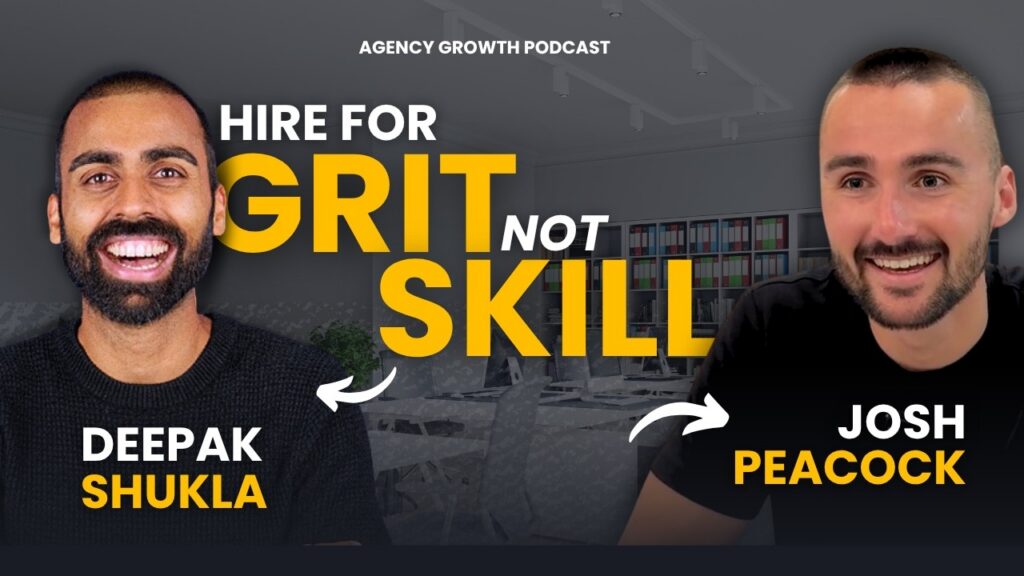
On this episode of the Agency Growth Club, he breaks down Pearl Lemon’s aggressive review system, why he hires purely for grit and motivation, and the $30,000 bet he made with himself to force his own AI adoption.
Pulled from the transcript’s real per-line timestamps, matched to where each topic starts.
Deepak runs seven companies ranging from five to seven figures a year in revenue, typically rolling out a new business every 18 to 24 months. SEO has been the main growth driver across all of them.
Deepak’s foundational point on reviews: getting someone to leave one is an act of persuasion, not automation, automated request emails simply don’t work in service-based businesses. His core recommendation for agency owners is to improve their sales skill first, since that skill directly translates into the ability to secure reviews.
Pearl Lemon asks for reviews aggressively and broadly. That includes every client, but also every prospect who received real value on a call even without becoming a paying client, since a genuine conversation builds enough rapport to make the ask land. It also includes contractors, subcontractors, and partners, anyone technically providing services to the business, who can be asked to leave reviews on Glassdoor and Indeed as well. Pearl Lemon also captures reviews live at physical events they run, asking attendees to leave one on their phone in the moment.
“Clients won’t leave reviews if you send them an email. But if you write something, send it to them, ask if they approve it, and then get on a call with them and get them to leave it whilst they’re in front of you, then they’ll do it.”
Deepak connects this directly to revenue: reviews drive Trust Pilot ranking and general search visibility, but the bigger effect is what happens after a lead is already acquired, prospects check reviews as part of due diligence, which both increases conversion and feeds positively into how a company appears in LLM outputs.
Actionable advice:
Every new Pearl Lemon employee is asked, at the eight-week mark, to leave a review and record a video, unscripted, at least seven minutes long, camera-facing, no AI, about their experience so far. Deepak notes this both supports recruitment (prospective hires can see genuine team sentiment) and reassures existing clients. He’s candid that negative reviews still happen as the company scales, citing a specific example where three account managers went through major personal life events (two getting married, one divorced) within four weeks of each other, disrupting client delivery and generating one negative review against roughly 113 positive ones. His broader point: rapid growth brings chaos, and chaos means delivery won’t always be perfect, reviews are what carry a business through that reality.
Actionable advice:
Pearl Lemon has a PR team that researches shows and sends outreach, working from defined personas: broad clusters (SEO/agencies), niche-specific angles tied to Pearl Lemon’s other businesses (like food and beverage for its event catering arm), and general entrepreneurial-story angles that work as a catch-all, including HR-adjacent podcasts, since agency owners handle hiring and firing directly.
Deepak is explicit that he doesn’t use podcast appearances as a direct lead-generation mechanism, their real value is in qualification and conversion support. Prospects doing due diligence look for evidence of active, human presence, and long-form video content like podcasts is particularly effective. He shares two concrete examples: a hair transplant company that signed on after reading one of his blog posts, and a travel adventure company that signed on after hearing him discuss his failed British military experience on a podcast, neither because of large audience reach, but because “everyone’s famous in the eyes of five to ten people,” and those are often exactly the people involved in a live buying decision.
“I’d look at it as a conversion rate optimization mechanism rather than a lead acquisition mechanism.”
Deepak’s answer is direct: Google search and the LLMs remain the top channel, and he pushes back on the idea that Google is being meaningfully displaced. His reasoning is about volume versus growth rate: outside of early tech-adopter audiences, the broader market base still runs overwhelmingly through Google, and he notes that “cold email is dead,” “cold calling is dead,” and similar predictions have circulated for years about channels that are all still very much alive.
Deepak’s operating philosophy, a concept he credits circulating from Hormozi’s circle, is “more better new”: rather than chasing new channels, double down harder on what’s already proven. Practically, that means when Pearl Lemon enters a new niche, they build four separate websites at once, run each as an experiment, identify which specific keywords actually convert, and then double down across all four sites specifically on those buying-intent keywords, aiming to occupy positions one through four on a single high-value term. Pearl Lemon currently runs roughly 50 different websites across about 10 niches under this model.
“I feel constrained or worried if I have one website which is my moat. I’d rather have lots of small little islands.”
He connects this directly to risk management: a single-site model is vulnerable to one Google penalty wiping out the business entirely, something he’s seen happen both to Pearl Lemon and to clients.
Actionable advice:
Deepak walks through a concrete example from Pearl Lemon’s event catering business: after noticing bubble tea catering was a relatively lucrative sub-niche, the team built bubbletecatering.uk as a simple, roughly five-page site (built from scratch, no acquired domains). It generates about five leads a month, closing one client every two months, with contract values ranging £3,000–£10,000 (roughly £6,000 on average), working out to about £36,000 in upfront contract value per closed cycle. The site cost about £300 to build and roughly £500 a year to run, deliberately without high-authority backlink investment, just simple web properties supporting the primary “mothership” site (in this case, pearlcatering.com).
Asked how many of Pearl Lemon’s 134 people actually use AI daily, Deepak reframes the question around leadership rather than tooling. He argues new initiatives fail without stakeholder-level ownership at both a process and mindset level, and that mindset has to come first, referencing Churchill’s framing of needing to win “hearts and minds” before expecting compliance. Without personal meaning attached to a process, he argues, people default to minimum viable effort, “I’m fine with my ChatGPT subscription… I crack on.”
“I’d rather inspire someone to innovate themselves rather than try and drive innovation and bring them kicking and screaming up the hill, because as soon as I look away, they’re going to roll right back down.”
Deepak connects the hearts-and-minds problem directly back to hiring: Pearl Lemon hires for motivation and grit specifically, not process knowledge or skill set. The application itself is deliberately friction-heavy, roughly 30 questions and a required long-form video, precisely to filter for the mindset he wants before someone ever joins. Once hired, that same filter determines how AI adoption gets driven: self-motivated people act on the first ask, others need a second or third nudge, and people who resist entirely, in his view, generally shouldn’t be at the company at all.
“You’ve got a recruitment problem, which means you’ve got a mindset problem, which means you’ve got a hiring problem.”
Actionable advice:
Deepak warns against vague, trend-chasing AI mandates (“just use AI because it’s what’s in”), arguing people will always take the shortest path unless given concrete, specific direction. His practical examples: replacing proposal tools like Better Proposals or PowerPoint with AI generators like Gamma, moving from free ChatGPT to a business account with defined client-knowledge projects, and standardizing specific Chrome plugins for defined tasks. He also flags a common founder inconsistency, spending real hours learning AI personally but far fewer hours actually translating that into org-wide implementation.
Deepak argues that in most agencies under a certain size, the founder is implicitly the highest-value operator in the room by compensation logic alone, and therefore usually the person best positioned to define what AI adoption should actually look like. Delegating that thinking away, something he admits he did earlier in Pearl Lemon’s history, produces a diluted version of whatever process eventually emerges. His conclusion: founders need to re-enter a genuine learning mindset themselves rather than assuming someone else will figure it out for the organization.
To force his own accountability, Deepak committed to Lovable’s highest subscription tier, describing the cost as roughly $25–30K. The logic was deliberately blunt: a financial commitment at a level painful enough to guarantee real attention, “I invested 30 grand up front to be like, right, I’m invested now.” That commitment led directly to roughly a thousand hours of his own hands-on AI learning.
“When you pay, you pay attention. And that’s how life is. That’s the whole personal training industry in a nutshell.”
Actionable advice:
One of Pearl Lemon’s 2026 goals is replacing every paid software tool it can with internally AI-built alternatives. Deepak gives two concrete examples already completed: rebuilding a calendar booking tool (previously ~£250/month) and building an internal rank tracker to replace Ahrefs and Semrush subscriptions worth more than £10,000 a year combined, after realizing the team’s actual need was narrow (active rank tracking for thousands of keywords), with other functions like technical audits and lookups already covered by existing LLM tools. Total targeted subscription savings: north of £60–70K a year.
“If that’s all we’re using, I could probably rebuild that. What do you know? I can.”
Actionable advice:
Deepak’s answer to clients questioning continued SEO investment is a confident yes, search itself isn’t disappearing, even as the mechanisms of search diversify. He draws a parallel to years of premature “cold email is dead” and “cold calling is dead” predictions, noting Pearl Lemon recently signed a client (a competitor to a major short-form video platform) for $30K in a single quarter purely for cold calling. His broader framing: established search agencies carry inbuilt Google-ranking knowledge that transfers directly to LLM visibility work, giving them a real advantage over newer entrants going straight for LLM-only strategies with no underlying search foundation.
Deepak argues that how something is said carries more persuasive weight than the underlying facts or statistics themselves, citing a formative lesson from sales literature (referencing Jordan Belfort’s material on tonality) that self-conviction accounts for roughly 80% of a pitch’s effectiveness. He specifically calls out a British tendency toward flat, reserved delivery regardless of the emotional stakes of what’s being said, arguing that infusing more direct, American-style sales conviction into that reserve is an easy, underused differentiator for British and Commonwealth agency owners.
Deepak sees credibility platforms (Forbes, Entrepreneur, Inc., TED/TEDx, and industry-specific ones like Brighton SEO) as carrying a genuine halo effect, opening doors and deals based on brand association alone, distinct from generic PR/newswire placement that carries far less weight with an informed audience. His underlying philosophy is “little and often” compounding over time, consistent, small-scale credibility-building rather than one-off pushes.
Deepak did roughly 100 podcast appearances over about a year and a half, then stopped entirely for five to seven years before deciding to restart, citing the ephemeral, compounding nature of the effort, results fade if the activity stops, so consistency matters more than any single burst.
Can’t live without: Whisper Flow, which Deepak uses to interact with a range of other tools via voice.
Most overhyped AI spend: pure-play LLM ranking pursued without an existing distribution base (an active client list to sell into). Deepak argues LLM ranking algorithms will mature and catch up to gamed tactics quickly, making it a viable short-term cash grab only for agencies with distribution already in place, and a losing race to the bottom for those without it.
Deepak’s most contrarian position in the episode: he believes personal brand building is a trap for agency owners specifically because it attaches the founder to the business rather than detaching them from it. In his framing, growing a personal brand becomes a machine that constantly needs feeding, and the more central a founder becomes to that brand, the less enterprise value and sellability the underlying company retains.
“The more you can detach yourself and become invisible to your company, the more you can increase enterprise value of your company.”
Deepak’s closing advice is deliberately nuanced given his stance on personal brand: podcasts and visible content genuinely help conversion, and cash flow from that visibility is what eventually funds the detachment he recommends. His practical framing is to use personal-brand-adjacent activity (podcasts specifically) as a conversion tool with a defined endpoint in mind, not an open-ended requirement, since staying permanently tied to feeding an audience or algorithm, in his view, is where founders get trapped.
By treating review requests as a sales skill rather than an automated task, asking clients, prospects who received real value on a call, contractors and partners, and event attendees, plus requiring every new hire to record an unscripted video review at the eight-week mark.
Instead of chasing new marketing channels, Pearl Lemon doubles down on what’s already proven, building multiple (often four) niche-specific websites around a single high-converting keyword rather than relying on one primary site.
By defining specific, concrete process changes (naming exact tools like Gamma or ChatGPT Business) rather than vague mandates, staying personally engaged as the lead learner himself, and committing roughly $30,000 of his own money to a tool subscription specifically to force his own accountability.
Purely for grit and motivation rather than skill set or process knowledge, using a deliberately friction-heavy 30-question application with a required long-form video, on the belief that self-motivated hires adopt new tools and processes far more readily.
No, he treats podcast appearances primarily as a conversion and qualification tool. Prospects doing due diligence discover and watch them, which supports closing deals, rather than functioning as a standalone lead source.
He argues that building a personal brand attaches a founder to their business rather than detaching them from it, which reduces the company’s enterprise value and makes it harder to sell, since the brand becomes something that constantly needs to be fed.
According to Deepak Shukla, yes, search itself isn’t disappearing even as its mechanisms diversify, and agencies with existing Google-ranking expertise carry a real advantage translating that knowledge into LLM visibility work.


With 95% of roles filled within 25 days, our approach is built for pace and backed by a 1 year guarantee. Get access to the systems and frameworks that power elite SFH teams.