
How Agencies are Evolving with the AI Search Era
Blog
Freelance vs Permanent SEO Hires: Which Delivers the Best Results?

Search For Hire
November 7, 2025
It usually starts with a crossroads:
You need SEO help, but do you bring on a freelancer to keep things flexible, or lock in a full-time hire to go all-in?
The answer depends on your goals, your budget, and how much control you’re really after.
SEO For Hire helps businesses design SEO team structures that balance flexibility with long-term performance, delivering measurable ROI and sustainable growth.
Key Takeaways:
- Freelance SEO hires offer agility and project-based expertise.
- Permanent SEO hires ensure stability and internal accountability.
- The right approach depends on your goals, budget, and control needs.
- A hybrid model often gives the best overall return.
- SEO For Hire helps you create the ideal balance between speed and strategy.
Why this Choice Impacts Performance
For marketing leaders, finding reliable SEO talent can be challenging.
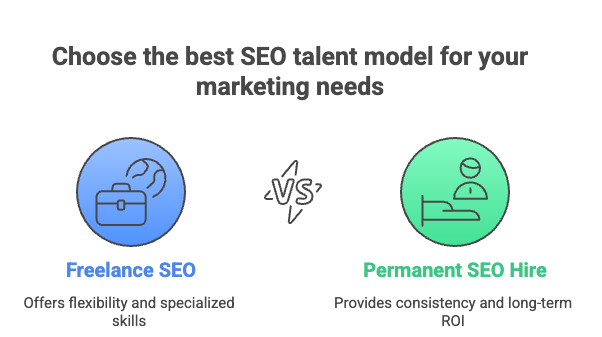
This decision between freelance and permanent SEO hires shapes your campaign outcomes, long-term ROI, and ability to maintain consistency.
Choosing the right model means aligning your resources with measurable business results.
Understanding Your SEO Goals
Start with the why before the who.
Before you compare freelance vs. full-time SEO hires, get crystal clear on the objectives you actually need.
A company prepping for multiple product launches may need fast, tactical support.
But if you’re aiming to cement long-term visibility and search authority, you might be looking for steady, strategic leadership from someone in-house.
The right SEO hire should match your growth stage—not just your budget.
Most agencies make the call to hire when:
-
Organic traffic flatlines or drops
-
Their team hits a wall on technical or strategic SEO
-
Scaling demands consistent SEO ownership and direction
Once your goals are defined, the decision between freelance and full-time becomes far more straightforward.
The Case for Hiring a Freelance SEO Consultant
When speed and specialization matter most, a freelance SEO hire is ideal.
Think:
Short-term projects, audits, or campaign-specific lifts where deep knowledge matters more than long-term commitment.
Freelancers offer agility and niche skills without adding headcount, making them a smart move for companies with solid internal systems and clearly scoped work.
But there’s a tradeoff:
-
They’re juggling multiple clients, so consistency can slip.
-
Long-term strategy and documentation often fall through the cracks.
-
And when they’re gone, so is their institutional knowledge, unless you’ve built in a process to retain it.
If your team knows what to ask for and just needs expert hands to get it done, a freelancer might be exactly what you need.
For a deeper dive on hiring models see our blog “Freelancers vs Full-Time Employees: What’s Best for Your SEO Needs?”
The Advantages of Hiring a Permanent SEO Specialist
When you’re playing the long game,
A permanent SEO hire isn’t just about filling a role—it’s about building a foundation.
Over time, they absorb your brand, your systems, and your audience in ways a contractor rarely can. They don’t just optimize pages—they embed SEO into the DNA of your marketing, product, and dev teams.
This kind of integration pays off in big ways:
-
Standards get applied consistently.
-
Cross-team alignment improves.
-
Dependency on outside help decreases.
Yes, salaries and onboarding take more upfront investment. But the long-term return? Strategic continuity, technical cohesion, and fewer dropped balls.
And perhaps the biggest payoff: governance. A full-time SEO can unify processes across campaigns, tools, and departments, cutting down on duplication, avoiding tech debt, and keeping growth sustainable.
Cost and Control Comparison
It’s not just about the rate, it’s about the ripple effect.
While most comparisons fixate on salary vs. day rate, the real difference between freelance and full-time SEO hires shows up in how much control you have, how deeply they collaborate, and what knowledge stays in-house when the project ends.
| Hiring Type | Strategic Advantage | Strategic Risk |
| Freelance SEO Hire | Fast results and specialist expertise | Limited control and potential knowledge loss |
| Permanent SEO Hire | Integrated strategy and long-term stability | Higher cost and slower ramp-up time |
Freelancers are ideal for short bursts of execution. Permanent hires excel when you need sustained strategy and unified processes.
When to Not Hire a Freelancer
A freelance SEO hire isn’t ideal if:
- Your SEO relies on long-term brand alignment
- You need ongoing documentation and reporting
- Your team lacks time to oversee external contributors
Without clear ownership or governance, a freelancer can leave knowledge gaps once the contract ends.
When to Not Hire Permanently
A permanent SEO hire may not be the right choice if:
- You’re testing short-term campaigns or markets
- Your budget doesn’t yet support a full-time role
- Your SEO goals are project-specific or seasonal
In these cases, a freelancer or hybrid model provides agility while reducing financial commitment.
Combining Freelance and Permanent SEO Hires
Many growing companies benefit from a blended model.
For growing companies, the best SEO setup isn’t always either/or, it’s both.
A full-time SEO lead owns strategy, reporting, and alignment across departments. Meanwhile, freelancers step in for specialized tasks like technical audits, content optimization, or site migrations.
This blended model gives you long-term stability and flexible expertise, exactly what fast-scaling teams need when juggling multiple digital priorities.
How to Decide Between a Freelance and Permanent SEO Hire
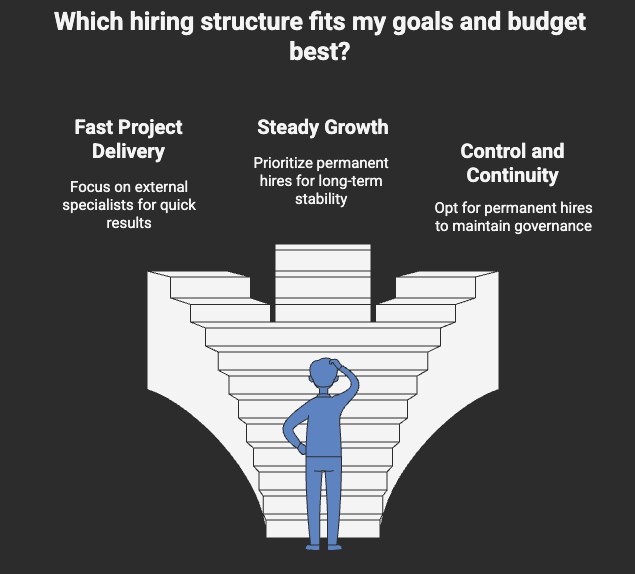
Here’s a simple process to identify which structure fits your goals and budget best.
Outcome:
You’ll find the hiring mix that delivers the strongest ROI for your business.
- Define your goals – Clarify whether you want fast project delivery or steady growth.
- Evaluate internal capability – Review whether your team can manage external specialists.
- Calculate your total investment – Include salaries, tools, and management time.
- Assess control and continuity needs – If governance is a priority, go permanent.
- Benchmark realistic costs – Use data to compare what each option truly delivers.
- Seek expert input – SEO For Hire can advise on the most effective structure for your 2026 growth plans.
About the Author
This article was written by a digital recruitment consultant specialising in SEO and performance marketing.
With years of experience building SEO teams for global and UK-based brands, they provide insight into hiring models that align with business growth and accountability.
Stop Guessing: Get Your Tailored SEO Team Structure Roadmap
Unsure which hiring model fits your growth plan? SEO For Hire helps companies design efficient SEO teams that match goals, resources, and timelines.
Contact SEO For Hire for a free 15-minute consultation and discover whether a hybrid or permanent setup suits your 2026 objectives.